

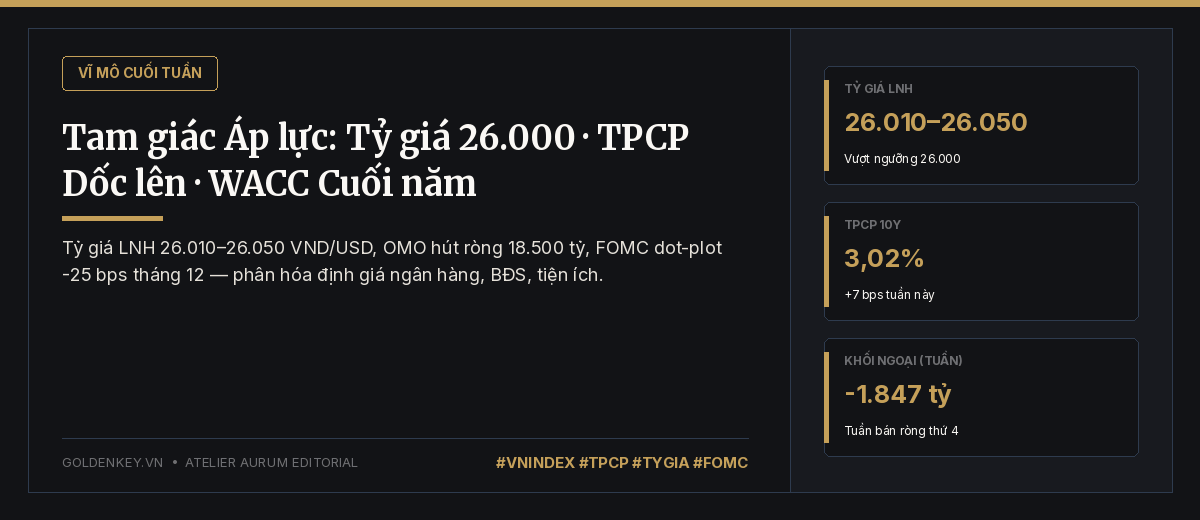
Weekend Briefing • 22/11/2026 | Section: Macroeconomics & Market Outlook — Primary Data: SBV, HNX/VBMA, HOSE/VSDC, FOMC (06–07 Nov 2026), U.S. Treasury, GSO, State Treasury/MOF.
The Macro Pressure Triangle: Three Variables Converging Simultaneously
The 17–21 November 2026 trading week concluded with an unusual macroeconomic configuration: three independent variables — spot exchange rates, domestic banking liquidity, and global monetary policy signaling — tightened simultaneously within a single five-day window, igniting an asset-repricing feedback loop that GoldenKey Invest terms the “Macro Pressure Triangle.”
Vertex One — Interbank FX Pierces 26,000: While the SBV Central Reference Rate on 21 November 2026 stood at 25,869 VND/USD, realized interbank spot transactions cleared within 26,010–26,050 VND/USD — breaching the psychological 26,000 mark for the first time in November. Vietcombank’s listed USD ask rate reached 25,980 VND/USD, leaving roughly 1,182 VND (~455 bps of administrative headroom) below the ±5% statutory band ceiling (27,162 VND/USD). Gross FX reserves estimated near ~USD 88 billion (Q3 2026, SBV) cover ~13.2 weeks of imports — safely above the IMF’s 12-week adequacy floor, though reserve buffers narrow if external dollar strength persists.
Vertex Two — Third Consecutive Week of SBV Liquidity Absorption: The State Bank of Vietnam (SBV) executed a cumulative net drain of ~VND 18,500 billion via Open Market Operations (OMO) and 14-day SBV Sterilization Bills (~VND 22,000 billion outstanding) during 17–21 November — its third consecutive weekly drain. Consequently, the Overnight Interbank Rate (VNIBOR O/N) rose to 4.82–4.95% p.a. (a +32 to +45 bps policy spread above the 4.50% refinancing rate), while 1-Week funding reached 5.10–5.25% p.a. (+60–75 bps). Even with headline policy rates unchanged, de facto liquidity tightening confirms that FX defense now supersedes money-market accommodation.
Vertex Three — FOMC Minutes Confirm Higher-for-Longer Trajectory: Minutes from the 6–7 November 2026 FOMC meeting (released 02:00 ICT on 21 November) confirmed a median dot-plot projecting just one remaining 25 bps cut in Q4 2026 (trimming the Federal Funds Rate target from 4.25–4.50% to 4.00–4.25%). Sticky U.S. Core PCE inflation at 2.8% YoY forecloses the two-cut path priced by bullish consensus. With 10-year U.S. Treasury yields closing 20 November at 4.92% p.a., the VN 10Y VGB versus UST 10Y spread widened to −140 bps — 15 bps deeper than its 6-month average (−125 bps), eroding the unhedged carry appeal of VND assets for foreign institutions.
Steepening VGB Curve: From Primary Auctions to Benchmark WACC
Primary VGB auctions on HNX on 20 November 2026 cleared only at higher yield concessions across the curve. Bid-to-offer absorption reached 88.3% on the 10-year tranche and 90.0% on the 15-year tranche — confirming technical commercial bank demand, yet requiring higher yields to clear supply. Structurally, commercial banks purchase sovereign paper partly to satisfy Basel III / Circular 36 liquidity coverage ratios rather than pure return optimization, meaning rising auction yields reflect supply-absorption strain.
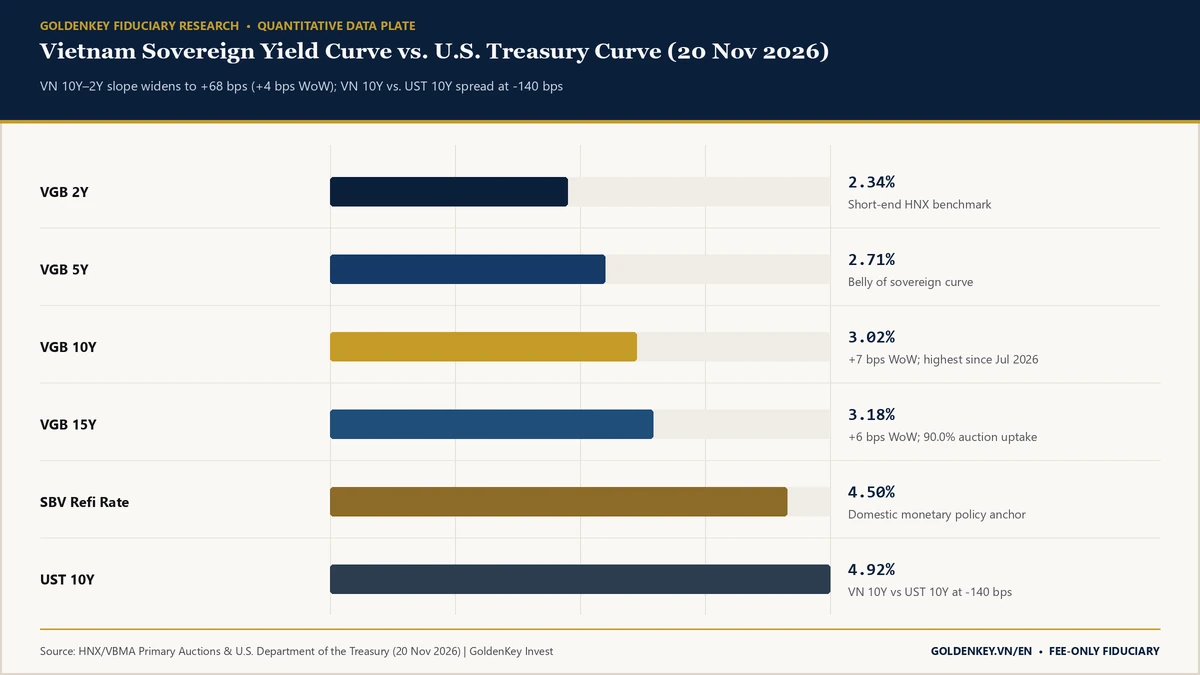
HNX/VBMA curve data on 20 November 2026 show the 10Y–2Y spread widening to 68 bps (+4 bps WoW). This steepening prices two forward risks: (a) heavy December State Treasury VGB issuance planned at VND 65,000 billion (+42.1% YoY vs. VND 45,800 billion in December 2025, per State Treasury/MOF on 20 Nov 2026), with 70% concentrated in 10Y–15Y tenors; and (b) sticky domestic core inflation estimated at 3.02% YoY in November 2026 (preliminary GSO release, 21 Nov 2026). Track historical sovereign yield series on Vietnam Market Data.
The WACC transmission is direct and quantifiable: every +10 bps expansion in the 10Y–2Y sovereign slope lifts long-duration WACC benchmarks for Real Estate and Utilities by 10–15 bps. Should December’s supply surge push 10Y VGB yields up another 30–70 bps (into the 3.32–3.72% zone), Gordon Growth valuation mechanics imply fair P/E compression of 5–12% across Real Estate and 4–9% across Utilities.
Primary Macro & Market Data Summary (17–21 November 2026)
| Variable | Value (21 Nov 2026) | Comparison / Benchmark Threshold | Primary Source |
|---|---|---|---|
| SBV Central Reference Rate | 25,869 VND/USD | November 2026 high; +11 VND vs. 20 Nov | SBV 21 Nov 2026 |
| Realized Interbank Spot FX | 26,010–26,050 VND/USD | Pierces 26,000 psychological mark; ~1,182 VND below ±5% ceiling | SBV 21 Nov 2026 |
| Gross Foreign Exchange Reserves | ~USD 88 bn | ~13.2 weeks of imports; above IMF 12-week adequacy floor | SBV Q3 2026 |
| Overnight Interbank Rate (VNIBOR O/N) | 4.82–4.95% p.a. | +32 to +45 bps above 4.50% refinancing rate; 3rd net-drain week | SBV Week of 17–21 Nov |
| Weekly Net OMO / Bill Drain | ~VND 18,500 bn | ~VND 22,000 bn in 14-day SBV Sterilization Bills outstanding | SBV Week of 17–21 Nov |
| VGB Yields: 2Y / 5Y / 10Y / 15Y | 2.34% / 2.71% / 3.02% / 3.18% | 10Y–2Y spread = 68 bps (+4 bps WoW); 10Y highest since Jul 2026 | HNX/VBMA 20 Nov 2026 |
| VN 10Y VGB vs. UST 10Y Spread | −140 bps | 15 bps wider than 6M average (−125 bps); UST 10Y at 4.92% | HNX & U.S. Treasury 20 Nov 2026 |
| Fed Funds Rate (FOMC Dot-Plot) | 4.25–4.50%; 1 cut (−25 bps) in Dec 2026 | U.S. Core PCE at 2.8% YoY constrains H1 2027 easing room | FOMC Minutes 06–07 Nov 2026 |
| Foreign Institutional Net Outflows (Week / MTD) | −VND 1,847 bn / −VND 6,230 bn | Banks: −VND 1,144 bn (61.9%); Property: −389 bn; Utilities: −142 bn | HOSE 21 Nov 2026 |
| VN-Index Trailing P/E & P/B | 13.2x / 1.71x | 16.5% / 16.6% discount vs. 5-year mean (15.8x / 2.05x) | HOSE/VSDC 21 Nov 2026 |
| Implied Earnings Yield / ERP vs. 10Y VGB | 7.58% / +456 bps | = 1/13.2x − 3.02%; clears 12M deposit rate (5.5%) by +208 bps | Computed from HOSE/VSDC & HNX |
| Planned December 2026 VGB Supply | VND 65,000 bn | +42.1% YoY vs. Dec 2025 (VND 45,800 bn); 70% in 10Y–15Y tenors | State Treasury/MOF 20 Nov 2026 |
| Nov 2026 Headline CPI (Prelim.) / Core CPI | +3.61% YoY / +3.02% YoY | 11M average: 3.45% YoY vs. 4.0% target ceiling — narrows SBV easing room | GSO Prelim. 21 Nov 2026 |
Transmission Channels and Asymmetric Sector Repricing
Commercial Banks — Dual-Sided Cost-of-Funds Squeeze
Representing 38.5% of VN-Index market capitalization, commercial banks absorbed the brunt of Foreign Institutional Net Outflows during the week: −VND 1,144 billion, or 61.9% of market-wide net selling. Margin compression operates across two channels simultaneously: (1) rising wholesale funding costs as O/N VNIBOR climbs to 4.82–4.95%, squeezing Net Interest Margin (NIM) where lending rates lag; and (2) tighter reserve liquidity constraining voluntary primary VGB absorption and Q4 credit expansion should SBV sterilization extend into 24–28 November.
Real Estate and Utilities — Highest WACC Beta Exposure
Real Estate (8.2% of VN-Index weight) saw −VND 389 billion and Utilities −VND 142 billion in foreign outflows — reflecting acute WACC duration sensitivity. With typical Real Estate WACC betas of 1.2–1.5 and sector D/E near 1.5x, every +50 bps rise in 10Y VGB yields lifts sector WACC by 60–70 bps, implying 8–12% DCF asset-value compression. Utilities face parallel discount-rate headwinds across long-dated power infrastructure cash flows.
Under a 2D Gordon Growth sensitivity grid (ROAE of 12% for Real Estate and 10% for Utilities), a +50 bps shift in rf from 3.02% to 3.52% (holding terminal growth g at 6–7%) compresses justified Real Estate P/B from 1.8–2.0x down to 1.5–1.7x. Notably, 3.52% on the 10Y VGB marks the threshold where VN-Index’s implied ERP erodes back toward its ~350 bps historical equilibrium. Benchmark cross-asset yields on Asset Class Comparison.
Event Impact Matrix and Forward Monitoring Signals
| Primary Event | Severity | Direct Transmission Channel | Next-Week Watch Variables |
|---|---|---|---|
| Interbank USD/VND hits 26,010–26,050, piercing 26,000 psychological threshold (SBV 21 Nov) | HIGH | Higher USD debt service; SBV drains VND to defend FX; rising EM FX hedge costs trigger foreign outflows | SBV central rate (24–28 Nov); daily O/N VNIBOR; VFM VN30 / Fubon FTSE ETF creations |
| SBV drains ~VND 18,500 bn (3rd straight week); O/N hits 4.82–4.95% (SBV 17–21 Nov) | MED-HIGH | Wholesale bank COF rises → NIM compression; softer voluntary primary VGB demand → auction concessions | Net OMO/bill balances (24–28 Nov); HNX 5Y–10Y VGB yields; Nov 2026 system credit growth |
| FOMC Minutes confirm 1 cut (−25 bps) left in Dec 2026; Core PCE at 2.8% YoY (21 Nov 02:00 ICT) | MED-HIGH | 10Y UST stays elevated (4.92%) → VN–UST spread at −140 bps → SBV easing window shut; EM carry drag | December FOMC rate decision; 10Y UST volatility; U.S. Nov CPI release (H1 2027 dot-plot impact) |
| 20 Nov VGB Auction: 10Y clears at 3.02% (+7 bps); 15Y at 3.18% (+6 bps) (HNX 20 Nov) | MEDIUM | Long-end rf climbs → Property/Utilities WACC rises; 88–90% bid uptake driven by regulatory LCR demand | Dec 2026 10Y–15Y VGB auction clearing yields (VND 65,000 bn planned supply) and bid-to-cover |
| Foreign investors net sell −VND 1,847 bn WoW; Nov MTD reaches −VND 6,230 bn (HOSE 21 Nov) | MEDIUM | Supply overhang concentrated in banks (61.9%) → depresses banking sector P/B multiples | Vietnam EM ETF flows (24–28 Nov); whether weekly bank net outflows exceed −VND 1,500 bn |
Theoretical Margin of Safety Remains Present — Yet Eroding
The VN-Index closed 21 November 2026 at 1,682.34 points (−0.38% DoD), trading at a trailing P/E of 13.2x — a 16.5% discount to its 2021–2025 five-year mean (15.8x, HOSE/VSDC). Implied earnings/FCF yield stands at 7.58% p.a. (= 1/13.2x), generating an implied ERP of 7.58% − 3.02% = +456 bps over 10Y VGBs — above the ~350–400 bps historical norm and +208 bps ahead of 12-month retail deposits (5.5%).
Nevertheless, four equilibrium qualifiers temper this headline Margin of Safety: (1) ERP compresses back to its ~350 bps historical mean if 10Y VGB yields climb ~106 bps toward ~4.08% under December’s VND 65,000 billion supply wave; (2) realized Q4 corporate cash earnings face NIM and funding headwinds; (3) seasonal year-end liquidity thinning widens bid-ask execution slippage; and (4) the 16.5% P/E discount heavily reflects bank-sector foreign selling (38.5% index weight) rather than broad-based DCF undervaluation. Review capital-preservation protocols for thin liquidity regimes on Risk Management.
Thesis Invalidation Triggers to Watch (24–28 November 2026)
- SBV Central Reference Rate retreats below 25,700 VND/USD → FX pressure subsides, enabling SBV net liquidity injections and pulling O/N back below 4.50%.
- SBV executes net OMO injections exceeding VND 20,000 billion/week → reverses de facto tightening and narrows the O/N policy spread below +10 bps.
- 10Y VGB auction yields stabilize or fall below 2.90% in December (with >95% bid uptake) → supply absorbed without WACC spillover; 10Y–2Y slope narrows below 60 bps.
- Fed delivers a 50 bps cut or guides to 2–3 cuts in H1 2027 → 10Y UST retreats, narrowing the VN–UST spread inside −110 bps and reversing EM outflows.
- Foreign Institutional Net Inflows exceed +VND 1,500 billion/week for two consecutive weeks → invalidates the negative-carry capital-flight thesis.
Sector screening methodologies for rising-WACC regimes and rate-sensitive balance sheets are detailed on GoldenKey Invest’s Securities Advisory portal.
Three-Pillar Fiduciary Mandate | GoldenKey Invest (goldenkey.vn)
No Client Fund Custody • No Discretionary Order Execution (zero issuer/brokerage kickbacks) • No Guaranteed Return Promises.
Every calculation in this briefing is derived 100% independently from first principles using verified primary disclosures from the SBV, HNX/VBMA, HOSE/VSDC, FOMC, U.S. Treasury, GSO, and State Treasury/MOF, without reliance on sell-side brokerage research.
This publication never solicits Buy/Sell/Hold orders or issues single-point price targets. All valuation ranges are expressed as 2D Sensitivity Matrices (WACC × g) and implied valuation buffers (%) strictly for independent institutional reference. Investors bear sole responsibility for portfolio decisions. Published: 22 November 2026.