

READING TIME: 10 MIN • EMPIRICAL PUBLICATION
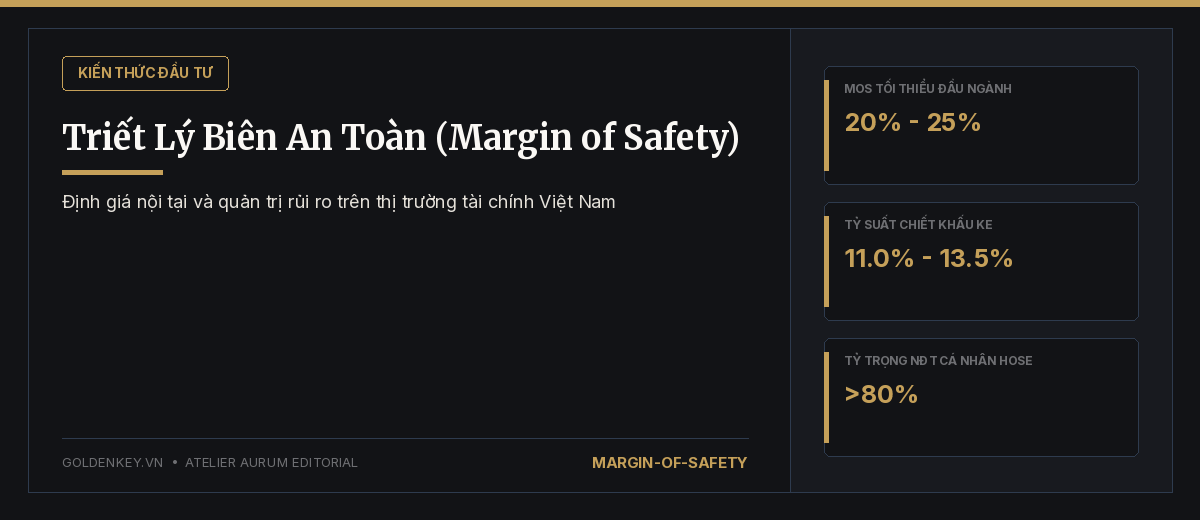
Asked to distill a century of sound investment management into three words, Benjamin Graham—father of modern Security Analysis and Value Investing—declared in Chapter 20 of his 1949 classic The Intelligent Investor that those words are: Margin of Safety. Just as a civil engineer designs a bridge rated to bear 30 tons even though daily truck traffic weighs at most 10 tons, a Fiduciary investor never pays a price predicated on an enterprise's most optimistic forecast, insisting instead on a wide valuation discount to shield principal against unforeseeable future shocks.
In Vietnam's equity market—where individual accounts still drive over 80% of daily matched turnover on HOSE, causing waves of euphoria and forced-selling panic to overshoot underlying corporate fundamentals—drawing a sharp line between Intrinsic Valuation Investing and Price-Momentum Speculation is not merely academic; it is the decisive boundary governing long-term survival of household wealth.
- ▪Graham's Canonical Definition: An investment operation is one which, upon thorough quantitative analysis, promises safety of principal and an adequate return; operations not meeting all three requirements are speculative.
- ▪Margin of Safety Absorbs Forecast Error: No financial model predicts the next five years with 100% precision; requiring a 25% to 35% discount below conservative Intrinsic Value protects capital even when realized growth trails projections.
- ▪"Mr. Market" on HOSE: Daily order-board swings exist to serve disciplined buyers accumulating quality franchises during cross-asset margin calls—never to dictate an investor's assessment of business worth.
- ▪Separating Genuine Value from "Value Traps": Optical low P/E at peak commodity margins or low P/B backed by illiquid impaired assets does not constitute a Margin of Safety.
1. The Economic and Analytical Divide Between Intrinsic Investing and Price Speculation
The most pervasive confusion in financial markets arises because both value investors and short-term speculators execute orders on the same brokerage apps and trade the exact same three-letter tickers. Economically, however, their operations are diametrically opposed:
- The Price Speculator treats a stock as a flashing electronic ticket. Every purchase hinges on one question: "Next week or next month, will a crowd pay an even higher price to take this ticket off my hands?" Expected speculative payoff is a zero-sum game—and strictly negative-sum once deducting the 0.1% transfer tax, two-way brokerage commissions, and margin interest.
- The Empirical Intrinsic Value Investor views every share as fractional legal ownership of real factories, seaports, software platforms, brand equity, and Free Cash Flow generated by an operating business. Capital deployment rests on a fundamentally different test: "If the stock exchange closed completely for the next three years, would the operating cashflow and cash dividends generated by this enterprise justify the capital committed today?" This is a positive-sum compounding engine anchored in Vietnam's real GDP and productivity growth.
2. Establishing a Conservative "Intrinsic Value Band" in Vietnam
Novice analysts often assume Intrinsic Value ($V_0$) is a single point estimate accurate to the last unit of currency (e.g., VND 84,350/share) output by a DCF spreadsheet. Benjamin Graham consistently rejected such false precision: intrinsic value is properly a Conservative Valuation Range triangulated across three independent lenses:
2.1. Discounting Normalized Earnings Power & FCF Yield
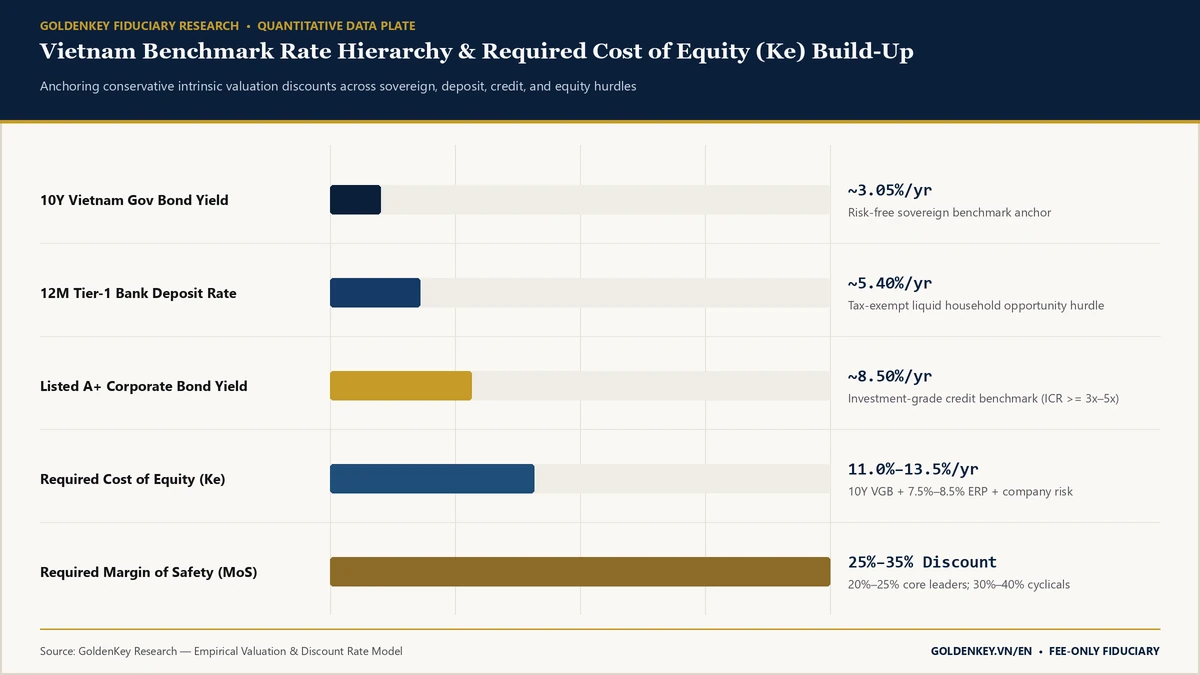
Rather than extrapolating peak-year boom earnings linearly across the next decade, analysts must estimate normalized earnings and Free Cash Flow across a full 5-to-7-year business cycle. In Vietnam, the Required Cost of Equity ($K_e$) must be anchored on the 10-year Vietnam Government Bond (VGB) yield (~3.05%/year) plus Vietnam's Equity Risk Premium (7.5%–8.5%) adjusted for company-specific risk—placing institutional discount rates in the 11.0% – 13.5%/year band. An equity becomes compelling only when its Conservative Forward Earnings Yield (E/P) or Free Cash Flow Yield (FCF/EV) decisively clears 12-month Tier-1 bank deposit rates (~5.4%/year) and A+ corporate bond yields (~8.5%/year).
2.2. Net Tangible Asset Backing and Net Cash Position
For banks, financial institutions, and asset-heavy infrastructure operators, Price-to-Tangible-Book-Value (P/TBV) paired with provisioning buffer quality provides a vital second valuation anchor. Notably, Vietnam's listed industrial and engineering sectors feature debt-free enterprises whose Net Cash (cash plus term deposits minus total debt) equals 25%–40% of market capitalization—constituting a tangible balance-sheet Margin of Safety against economic downturns.
2.3. Fixed-Income Parallels: Credit Margin of Safety in Corporate Bonds
Few remember that Benjamin Graham originally formulated Margin of Safety not for equities, but for Corporate Bonds. For a bondholder, Margin of Safety lies not in buying a discounted bond price, but in the surplus cushion of operating earnings (EBIT) over annual interest obligations. Graham stipulated that an investment-grade bond must maintain an Interest Coverage Ratio (ICR = EBIT / Interest Expense) of at least 3.0x – 5.0x consistently across multiple years including recessionary troughs—a standard directly applicable to Vietnam's corporate bond market today.

3. Comprehensive Comparison: Fiduciary Value Investing vs. Short-Term Price Speculation
| Comparison Criterion | Intrinsic Value Investing (Margin of Safety) | Short-Term Price Speculation |
|---|---|---|
| Nature of Underlying Asset | Fractional ownership of an operating enterprise, CFO stream, and productive net assets. | Electronic ticker symbol acquired in hopes of resale to a later buyer (Greater Fool Theory). |
| Basis for Entry Decision | Market price discounted 25%–35% below conservative Intrinsic Value (Pm << V0). | Trading-syndicate rumors, limit-up breakout candles, and fear of missing out (FOMO). |
| Response to a −15% to −20% Drop | Re-verifies fundamentals; if intact, Margin of Safety has widened for disciplined accumulation. | Panic capitulation at trough prices or automated brokerage Force-Sell Margin liquidation. |
| Use of Margin Debt | Zero Margin Lending—preserving unconditional holding-period autonomy across volatility. | Heavy 1:1 or 2:8 margin leverage turning routine market pullbacks into permanent capital loss. |
| Frictional Drag (Taxes & Fees) | Minimized (< 0.3%/year) across 2-to-5-year holding horizons, maximizing after-tax compounding. | Consumes 3.5%–6.0% of capital/year via rapid turnover plus 11%–13%/year margin interest. |
| Primary Risk Governed | Permanent capital impairment from fundamental misappraisal or falling into a Value Trap. | Daily price variance and multi-session limit-down liquidity lockups in speculative names. |
4. Identifying and Avoiding "Value Traps" on Vietnam's Stock Exchanges
Mechanically screening for low P/E or P/B < 1.0 without sector-cycle insight steers investors straight into Value Traps—equities that look optically cheap on automated screeners while true intrinsic worth erodes quarter after quarter. Three classic value traps in Vietnam warrant strict exclusion:
- Cyclical Peak Earnings Trap (Low P/E at Commodity Tops): Steel, fertilizer, chemical, and shipping producers frequently report record earnings 4x–5x above mid-cycle norms right as global commodity prices peak, compressing trailing four-quarter P/E to 4.5x–6.0x. Once commodity spreads normalize the following year, earnings drop 70%, driving realized P/E to 18x–20x alongside steep share-price drawdowns. For cyclicals, the inverse rule holds: accumulate only when P/B nears historical troughs at industry cycle bottoms backed by a low-debt balance sheet.
- Illiquid Impaired Asset Trap (Low P/B on Frozen Book Value): A real-estate or construction company trading at 0.55x P/B offers zero 45% Margin of Safety if 70% of its stated book equity sits trapped in legally stalled projects unable to launch sales for years, or in unprovisioned overdue receivables.
- Permanent Governance Discount: Even when operating cashflows appear sound, if controlling insiders repeatedly execute dilutive private placements, siphon profits to privately owned related parties, or withhold cash dividends indefinitely from minority shareholders, the valuation discount persists permanently rather than converging to intrinsic value.
Practical Checklist: 5 GoldenKey Fiduciary Rules for Applying Margin of Safety
- ✓Rule 1 — Value with a Blunt Pencil, Never Complex Spreadsheets Justifying High Multiples: If an investment requires assuming 25% annual growth for 10 uninterrupted years merely to justify today's share price, zero Margin of Safety exists.
- ✓Rule 2 — Require MoS ≥ 25% Before Committing Core Sizing: Hold short-term deposits or investment-grade bonds earning positive real yields patiently until "Mr. Market" offers quality franchises at a genuine discount.
- ✓Rule 3 — Never Trade Corporate Governance Quality for Optical Cheapness: Acquiring a transparent sector leader at a 20% discount to intrinsic value is vastly safer than buying an opaque issuer at a 50% discount.
- ✓Rule 4 — Turn Zero-Margin Discipline into a Competitive Edge: During market-wide cross-collateralized margin calls, unleveraged cash holders are the sole participants capable of acquiring A-grade franchises at a 35%–40% Margin of Safety.
- ✓Rule 5 — Separate Price from Value When Rebalancing: Once market price rallies 20%–30% above conservative Intrinsic Value ($V_0$), Margin of Safety has turned negative—signaling systematic partial profit harvesting into fixed-income tiers.
Published under the Investment Knowledge practice and compiled independently by the GoldenKey Invest Research & Wealth Governance Council under our Three-Pillar Fiduciary Mandate: No Client Fund Custody — No Discretionary Order Execution — No Guaranteed Return Promises (with zero hidden brokerage or issuer distribution kickbacks). All data series, quantitative models, and regulatory frameworks cited herein are presented strictly for institutional research and objective investor due diligence; they do not constitute an offer, solicitation, or recommendation to buy, sell, or hold any specific security or corporate bond tranche.