

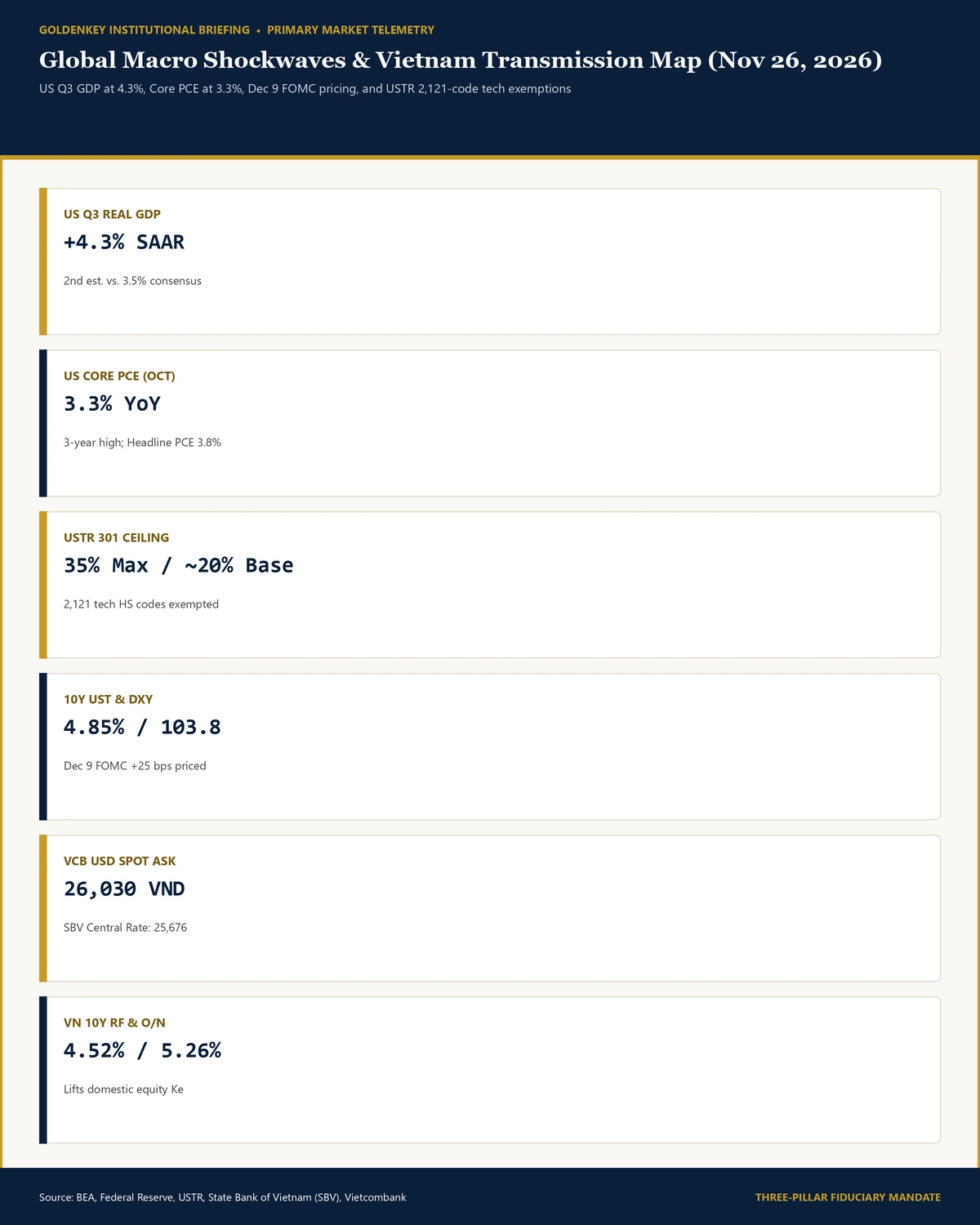
Executive Summary (November 26, 2026): Global capital markets entered the US Thanksgiving holiday anchored by three macro catalysts shaping cross-border capital allocation: (1) The second estimate of US Q3 2026 real GDP rose +4.3% SAAR (handily beating the 3.5% consensus) while October Core PCE reached a 3-year high of 3.3% YoY, prompting interest-rate futures to price a base-case 25 bps rate hike at the December 9, 2026 FOMC meeting; (2) Wall Street staged a decisive intraday reversal on November 25, followed by broad European and Asian equity gains on November 26; and (3) USTR’s preliminary 35% Section 301 tariff proposal functions as an opening bilateral negotiation ceiling ahead of Q1 2027 consultations.
1. US Growth Upside Surprise: Q3 GDP at 4.3%, Core PCE at 3.3%, and December 9 FOMC Pricing
Data released by the US Bureau of Economic Analysis (BEA) ahead of the Thanksgiving break confirmed that the world’s largest economy is expanding well above trend. The second estimate showed US Q3 2026 real GDP advancing 4.3% (SAAR), outpacing the 3.5% consensus estimate on resilient household services consumption and sustained artificial intelligence data-center capital expenditure (Capex).
Accompanying above-trend growth is persistent inflation stickiness: headline October 2026 PCE rose 3.8% YoY, while the Federal Reserve’s preferred gauge — Core PCE — accelerated to 3.3% YoY, its highest reading in three years. This macro combination led Fed funds futures to price a base-case 25-basis-point (+25 bps) rate hike at the December 9, 2026 FOMC meeting from the 3.75%–4.00% target band to 4.00%–4.25%, keeping the 10-year US Treasury yield anchored near 4.85% and the Dollar Index (DXY) firm around 103.8.
2. Wall Street’s November 25 Reversal, Nvidia CreditWatch Pressure, and Global Rebound on November 26
International equity price action across November 25–26 underscored institutional capital’s rapid absorption of policy headlines. Early in the November 25 session, Treasury yield pressure and tariff headlines briefly dragged the S&P 500 down 3.2% and the Nasdaq Composite down 4.5%. However, institutional buying stepped in decisively once desks parsed the hardware tariff exemption annex:
- Dow Jones Industrial Average reversed into positive territory, advancing +0.33% (+164 points) to 50,182.95 on industrial and financial sector leadership.
- S&P 500 pared losses to close at 7,182.78 (-0.30%), while the Nasdaq Composite narrowed its decline to 23,585.80 (-0.60%).
- Nvidia declined -3.9%: Pressured by dual headwinds after S&P placed the chipmaker on CreditWatch Negative citing hyperscaler cloud Capex concentration risk alongside tightened export controls on AI server routing through Southeast Asia.
- November 26 Session (US Cash Markets Closed for Thanksgiving): US equity index futures gained +0.5%, transmitting broad risk-on recovery across European and Asian bourses bolstered by the technology hardware tariff exemption list.
3. Decoding USTR’s Proposed 35% Ceiling & Section 301 Probe Across 14 Trading Partners
USTR’s Section 301 initiation dossier covering 14 large trade-surplus partners — referencing a preliminary maximum tariff rate of 35% — requires rigorous trade-law interpretation. First, the 35% figure represents an opening negotiating ceiling rather than an immediate border levy: statutory procedure mandates written public comments through January 5, 2027, followed by public hearings in late January 2027 (January 25, 2027) prior to any final determination at the end of Q1 2027.
Second, USTR explicitly exempted 2,121 eight-digit HS product codes covering servers, semiconductors, and electronic components to safeguard US technology supply chains. Under our base-case bilateral negotiation framework for early 2027, effective tariff implementation tends to converge toward the ~20% zone paired with stricter regional value-content rules of origin and bilateral trade-balance commitments.
| Global & Domestic Macro Variable | Closing Print (Nov 25–26, 2026) | Transmission Mechanism to Vietnam Markets |
|---|---|---|
| US Q3 GDP (2nd Est.) & Core PCE | +4.3% SAAR / 3.3% YoY (Headline PCE 3.8%) | Prices +25 bps Dec 9 FOMC hike; keeps DXY structurally firm |
| Wall Street & Global Futures | Dow 50,182.95 (+0.33%, +164 pts); S&P 7,182.78 (-0.30%); Nasdaq 23,585.80 (-0.60%) | US futures +0.5% on Nov 26 & green Asian session stabilize sentiment |
| USTR Section 301 (14 Partners) | Preliminary ceiling 35%; 2,121 HS codes exempted | Comments due Jan 5, 2027; Q1 2027 talks point toward ~20% |
| USD/VND & SJC Gold Bullion | VCB Ask 26,030; SJC VND 129.5–134.5M | SBV Central Rate at 25,676; narrows domestic monetary easing room |
| VND Funding & Cost of Capital | 10Y VGB (Rf) 4.52%; VNIBOR O/N 5.26% | Big-4 12M deposits at 5.20%–5.40%; lifts equity discount rate Ke |
Source: BEA, Federal Reserve, USTR, State Bank of Vietnam (SBV), and Vietcombank updated November 26, 2026.
4. Three Transmission Channels Into Vietnam and Portfolio Governance
Tracked across our Vietnam macroeconomic data terminal, external macro shocks propagate into domestic capital markets via three direct transmission channels:
(1) FX and Monetary Liquidity Channel:Hawkish Fed repricing pushed Vietcombank’s USD ask rate to 26,030 VND/USD (~26,010–26,040 intraday band; SBV Central Reference Rate at 25,676 VND/USD) while keeping SJC gold bullion elevated at VND 129.50–134.50 million/tael, anchoring SBV policy firmly on exchange-rate stability. (2) Cost of Equity (Ke) Channel: A domestic risk-free benchmark Rf of 4.52%, VNIBOR O/N at 5.26%, and Big-4 12-month deposit rates at 5.20%–5.40% raise valuation hurdle rates; within fixed income, allocators should screen issuers rigorously via our corporate bond safety checklist, restricting holdings to CAMELS-compliant / HNX CBIS Grade A+ bank bonds satisfying Decree 200/2026/ND-CP and Circular 138/2026/TT-BTC. (3) Sector Dispersion Channel: US-exposed export manufacturers face headline-driven volatility during trade consultations, whereas CAMELS-tier commercial banks, domestic infrastructure beneficiaries, and multi-market software exporters anchor earnings resilience.
To conduct an independent fiduciary audit of portfolio sensitivity to Federal Reserve policy, FX volatility, and 2027 tariff scenarios free of brokerage commission conflicts, investors may review our Fee-Only advisory structure — currently featuring a 50% fee reduction (Tier 3 Portfolio Forensic Audit at VND 4,750,000 and VND 7,500,000; Tier 4 Ongoing Wealth Retainer at VND 24,000,000/year and VND 42,000,000/year; Tier 5 Bespoke Family Wealth Architecture from VND 60,000,000) — on the GoldenKey Invest Advisory Fee Schedule.
Regulatory Compliance & Three-Pillar Fiduciary Mandate: Compiled from primary disclosures by the BEA, Federal Reserve, USTR, and SBV as of November 26, 2026. GoldenKey Invest strictly upholds the Three-Pillar Fiduciary Mandate (No Client Fund Custody — No Discretionary Order Execution — No Guaranteed Return Promises or Brokerage Kickbacks) pursuant to Article 24(5) of Decree 156/2020/ND-CP and Personal Data Protection Law No. 91/2025/QH15; this analysis does not constitute specific securities transaction advice.