

For investors transitioning into financially independent retirement, family reserve funds earmarked for major capital commitments over the next 2–3 years, or business owners who have recently completed a corporate divestment and require an institutional safe harbor for a lifetime of accumulated wealth, the foremost priority is not chasing volatile 20% annual equity swings — it is “Real Capital Preservation.” Preserving real capital requires solving two opposing risks simultaneously: preventing any nominal principal impairment from credit defaults or deep market drawdowns, while refusing to let headline CPI inflation (~3.6%–4.0% per annum) silently erode the purchasing power of an unoptimized savings deposit book.
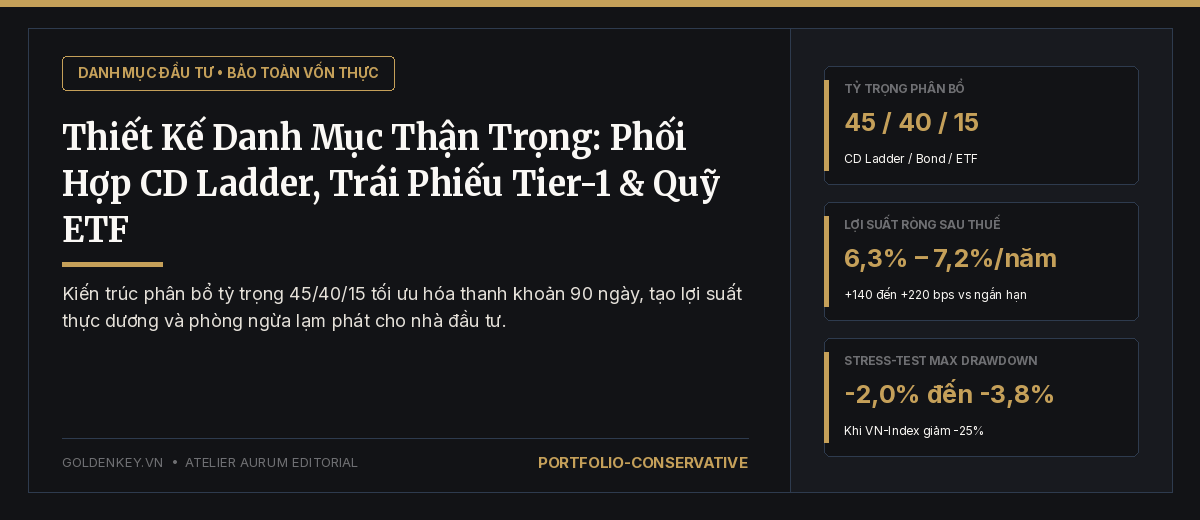
- Target 45 / 40 / 15 Structural Allocation: Allocates 45% to a 4-rung Term Deposit & Certificate of Deposit (CD) Ladder, 40% to Tier-1 commercial bank bonds (VCB, TCB, MBB, ACB) paired with Vietnam Government Bonds (VGBs) and open-ended bond funds, and 15% to low-cost domestic index ETFs (VN30 / VN100).
- Superior Expected Net Return Over Traditional Deposits: Delivers an estimated blended after-tax portfolio yield of 6.3%–7.2% per annum — outperforming standard short-tenor retail savings by 140 to 220 basis points and generating positive real purchasing-power compounding of +2.6% to +3.5% annually.
- Ultra-Low Maximum Drawdown Profile: Even under a severe stress-test scenario in which the VN-Index falls -25% over twelve months, contractual interest cash flows from the 85% defensive fixed-income sleeve absorb nearly all mark-to-market volatility from the 15% ETF sleeve, containing temporary portfolio-wide drawdown within -2.0% to -3.8%.
- Rolling 90-Day Natural Liquidity: The 4-rung CD ladder ensures that 11.25% of total portfolio capital matures naturally every three months without ever incurring early-redemption demand-rate penalties (0.1% per annum).
- ▪Target 45 / 40 / 15 structural allocation: 45% in a 4-rung Term Deposit & CD Ladder, 40% in Tier-1 bank bonds and open-ended bond funds, and 15% in domestic index ETFs (VN30 / VN100).
- ▪Superior expected net return: Generates 6.3%–7.2% after-tax annual yield, compounding real purchasing power by +2.6% to +3.5% per year above headline CPI inflation.
- ▪Ultra-low maximum drawdown control: Under a -25% VN-Index shock, contractual income from the 85% defensive sleeve cushions equity volatility, containing portfolio drawdown within -2.0% to -3.8%.
- ▪Rolling 90-day liquidity: The 4-rung CD ladder unlocks 11.25% of total portfolio capital at par every quarter, eliminating early-withdrawal interest forfeiture.
1. Engineering a 4-Rung Term Deposit & Certificate of Deposit Ladder (4-Rung CD Ladder — 45% Portfolio Weight)
The most common structural dilemma facing traditional depositors in Vietnam is the maturity trap: parking 100% of cash in 1–3 month deposits to cover unexpected household contingencies locks investors into low regulatory rate ceilings (roughly 3.2%–3.9% per annum, barely matching or trailing realized inflation); conversely, concentrating all liquidity into a single 12–18 month savings certificate to capture 5.0%–5.6% per annum means that an unexpected withdrawal in month 10 retroactively reprices the entire accrued interest balance down to the non-term demand rate of 0.1% per annum.
A 4-Rung Liquidity Ladder resolves this trade-off through simple, institutional-grade cash-flow staggering. Assuming an investor allocates 45% of total capital (for example, VND 1.8 billion out of a VND 4.0 billion portfolio) to this liquidity sleeve, the capital is divided into four equal tranches of VND 450 million each. At inception: Rung 1 is placed in a 3-month deposit, Rung 2 in a 6-month deposit, Rung 3 in a 9-month deposit, and Rung 4 in a 12-month primary-market Certificate of Deposit (CD) or term deposit.
After the first 90 days, when Rung 1 matures, if the household has no immediate disbursement need, 100% of principal and interest from Rung 1 rolls into a new 12-month maturity. Ninety days later, Rung 2 matures and likewise rolls into a 12-month tenor. Consequently, within just nine months of operation, all four rungs earn the full 12-month yield premium (or hold digital bank-issued CDs transferable on secondary platforms while preserving accrued holding-period interest), while guaranteeing a predictable cash maturity at the start of every single quarter.
1.1. Counterparty Selection Criteria for the Liquidity Tier
GoldenKey recommends diversifying the CD Ladder across at least two commercial banks belonging to the State-owned Big 4 or Top 6 private joint-stock commercial banks with industry-leading Capital Adequacy Ratios (CAR) and liquidity buffers, while segregating investment custody accounts from daily retail card-payment accounts to harden digital banking security.

2. Enhancing Fixed Yield via Tier-1 Bank Bonds (40%) and Inflation Protection via Domestic ETFs (15%)
The second structural pillar, accounting for 40% of the portfolio, comprises publicly offered Tier-2 subordinated capital bonds issued by Vietnam’s premier Tier-1 commercial banks (such as Vietcombank, Techcombank, MB Bank, and ACB issues transparently listed on the HNX exchange) alongside reputable open-ended fixed-income funds. From a fundamental credit standpoint, principal loss probability at Domestic Systemically Important Banks (D-SIBs) approaches the lowest tier in the private economy, while their Yields to Maturity (typically floating at the average 12-month state-owned Big 4 reference deposit rate plus a +1.2% to +1.8% spread, delivering ~6.0%–6.8% per annum) automatically insulate bondholders should interest-rate cycles turn higher.
The question most frequently raised by conservative senior clients is: “Why doesn’t a capital-preservation mandate stop at 100% Bank Deposits and Bank Bonds — why include a 15% sleeve in domestic equity ETFs?” The answer lies in Harry Markowitz’s Efficient Frontier mathematics. Because deposit and bond coupons are capped by nominal interest-rate ceilings, if urban healthcare and living-cost inflation accelerates to 4.5%–5.0% annually over a decade, a 100% fixed-income portfolio stagnates in real purchasing-power terms.
By adding a calibrated 15% allocation to low-cost ETFs tracking the VN30 or VN100 indices (such as E1VFVN30 or FUESSVFL/FUEVN100 — automatically diversifying across Vietnam’s 30–100 largest listed corporations and eliminating single-issuer bankruptcy risk), this measured growth sleeve lifts long-term portfolio compound return by 1.0%–1.4% per annum without disturbing the investor’s psychological peace of mind.
2.1. Sustainable 4.0%–4.5% Annual Distribution Cash Flow Without Touching Principal
With blended cash interest from CD rungs and bank bond coupons generating roughly 5.4%–5.8% per annum across the 85% fixed-income core, retired investors can comfortably draw 3.5%–4.0% of total portfolio value annually for living expenses, while residual interest plus capital appreciation from the 15% ETF sleeve is reinvested so nominal principal keeps pace with CPI inflation.
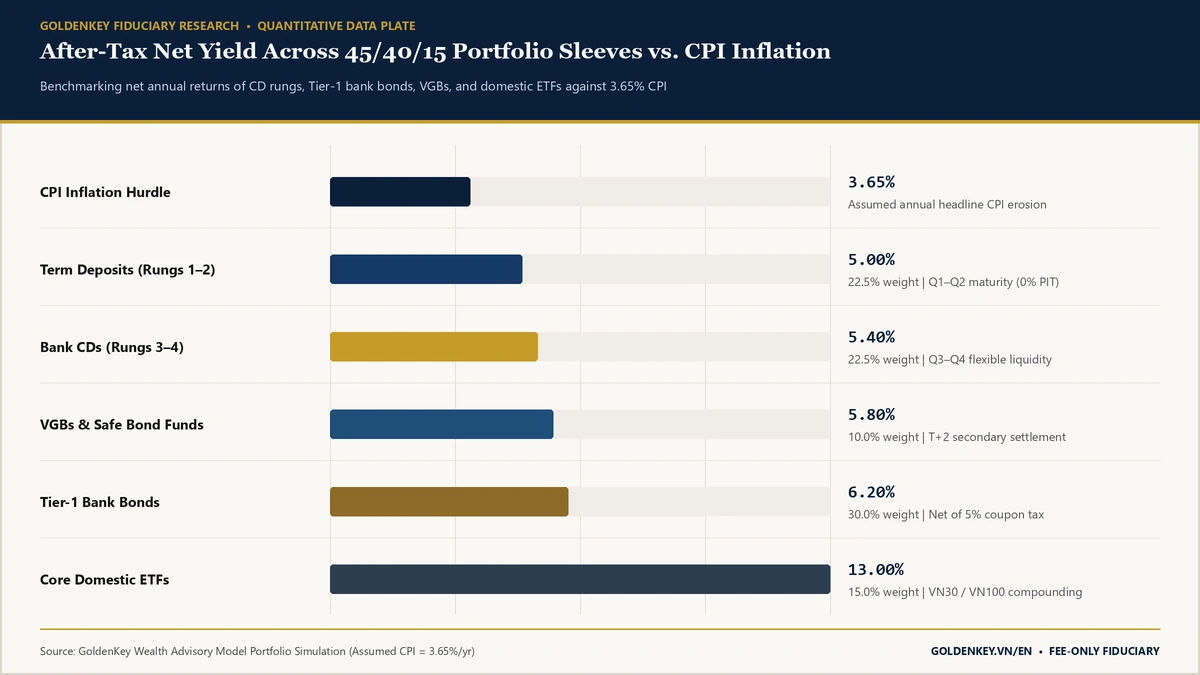
| Portfolio Asset Sleeve | Target Weight | Allocated Capital (VND m) | Expected After-Tax Net Yield | 1-Year Base Case | Stress-Test (VN-Index -25%) |
|---|---|---|---|---|---|
| Term Deposit Ladder Rungs 1–2 (Maturing Q1–Q2) | 22.5% | 900m | 5.0% / yr (0% tax) | +45.0m | +45.0m |
| Certificate of Deposit (CD) Rungs 3–4 (Maturing Q3–Q4) | 22.5% | 900m | 5.4% / yr (flexible liquidity) | +48.6m | +48.6m |
| Tier-1 Bank Bonds (Floating Reference + Spread) | 30.0% | 1,200m | 6.2% / yr (net of 5% coupon tax) | +74.4m | +74.4m |
| Vietnam Government Bonds / Conservative Open Bond Funds | 10.0% | 400m | 5.8% / yr (T+2 liquidity) | +23.2m | +22.0m |
| Core Domestic Index ETFs (E1VFVN30 / FUEVN100) | 15.0% | 600m | 13.0% / yr (long-term) | +78.0m | -150.0m (unrealized) |
| Total Conservative Model Portfolio | 100.0% | 4,000m | 6.73% / yr (+3.08% Real) | +269.2m (+6.73%) | +40.0m (+1.00% net positive) |
3. Portfolio Stress-Testing and Semi-Annual Disciplined Governance Rules
A defining operational advantage of the Conservative 45/40/15 Portfolio is its low-maintenance elegance: investors never need to monitor intraday market tickers or react to speculative noise. Full portfolio governance requires just two scheduled semi-annual reviews (in June and December), taking no more than 45 minutes per session.
If a strong equity rally lifts the ETF sleeve from 15% to 19% of total portfolio value over twelve months, the investor systematically trims the 4% overweight back to target and recycles realized gains into maturing CD rungs or Tier-1 bank bonds — locking equity upside into hard cash reserves. Conversely, in a severe equity downturn where a -25% drop compresses the ETF weight from 15% down to ~11.5%, the investor simply redirects a portion of newly collected bond coupons and maturing CD interest to replenish the 3.5% ETF shortfall at discounted valuations without touching household living budgets.
3.1. Target Investor Mandates Best Suited to This Architecture
This standardized allocation blueprint is purpose-built for: (1) Independent retirement reserves for parents and individuals aged 55+; (2) Dedicated family capital pools earmarked for home purchases or overseas university tuition over a 2-to-4-year horizon; and (3) Ring-fenced strategic family reserves for business owners insulated from commercial operating risks.
Quantitative 3-Scenario Matrix & Thesis Invalidation Triggers
All CD rungs and Tier-1 bank bonds service 100% of principal and interest on schedule; the 15% ETF sleeve compounds alongside VN30 corporate earnings growth, enabling total portfolio wealth to outpace CPI inflation by over +3.0% per annum.
A +22% annual advance in the VN30 basket propels the conservative mandate toward near-double-digit returns despite holding only 15% in equities; rebalancing rules harvest excess gains into fresh term deposits.
As demonstrated in Table 1, +VND 190 million in contractual interest from the 85% fixed-income core more than offsets the -VND 150 million unrealized mark-to-market decline in the 15% ETF sleeve, leaving year-end portfolio value slightly positive (+1.0%) with 100% of initial principal intact.
Warning Thresholds & Thesis Invalidation Triggers:
- The capital owner faces a full lump-sum disbursement requirement for fixed-asset acquisition within under 6 months — requiring immediate transition of the 15% ETF sleeve and longer-dated bonds into short-term deposits matched to settlement dates.
- Headline CPI surges above 6.5% per annum while bank reference deposit rates lag — requiring higher allocation to wider-spread floating-rate notes and real inflation-hedging assets.
- Any bank issuer in the fixed-income basket experiences Capital Adequacy Ratio (CAR) erosion toward statutory minimums — triggering rotation into higher-buffer Tier-1 bank counterparties.
- Step-by-Step Guide to Structuring a 4-Rung CD Ladder — Maturity schedules modeled for VND 600 million, VND 1.2 billion, and VND 4.0 billion mandates.
- Tier-1 Bank Bond Dossiers (TCB202402, VCB202501, MBB202402) — Coupon formulas, tenors, and HNX secondary-market liquidity metrics.
- Domestic ETF Total Expense Ratio (TER) & Tracking Comparison — Selecting the most transparent index vehicles for the 15% inflation-hedge sleeve.
This thematic research report has been independently prepared by the Research & Asset Allocation Division of GoldenKey Invest to provide a quantitative data framework and academic due-diligence methodology for private investors and family portfolios.
GoldenKey operates strictly under its Three-Pillar Fiduciary Mandate (No Client Fund Custody — No Discretionary Order Execution — No Guaranteed Return Promises) alongside full research independence: (1) No brokerage commissions or undisclosed distribution fees from issuers; (2) No proprietary trading that conflicts with client portfolios; and (3) No short-term speculative trading calls or unrealistic fixed-return guarantees. Every capital allocation decision must be evaluated against each investor’s distinct risk tolerance, liquidity horizon, and maximum drawdown capacity.