

READING TIME: 11 MIN • EMPIRICAL RESEARCH MONOGRAPH
Unlike common equities — where uncapped upside potential compensates investors for earnings volatility — the payoff profile of Corporate Bonds is mathematically asymmetric in the opposite direction: the best-case outcome for a bondholder is collecting 100% of par principal plus a fixed ~8%–9% p.a. coupon at maturity, whereas the worst-case issuer default can impair 50% to 100% of principal across multi-year insolvency workouts.
Because fixed income exhibits “capped upside, full downside” convexity, institutional credit underwriting never begins with the retail question “How many percentage points above bank deposits does this tranche pay?” Instead, it begins and ends with one forensic test: “Through which verifiable cash flows, liquid assets, and binding legal covenants will this issuer service principal and interest on time even during a severe recession?” Below is the 6-Pillar Corporate Bond Credit Underwriting Framework designed by GoldenKey Invest’s Research Council and applied uniformly across our HNX CBIS Bond Library.
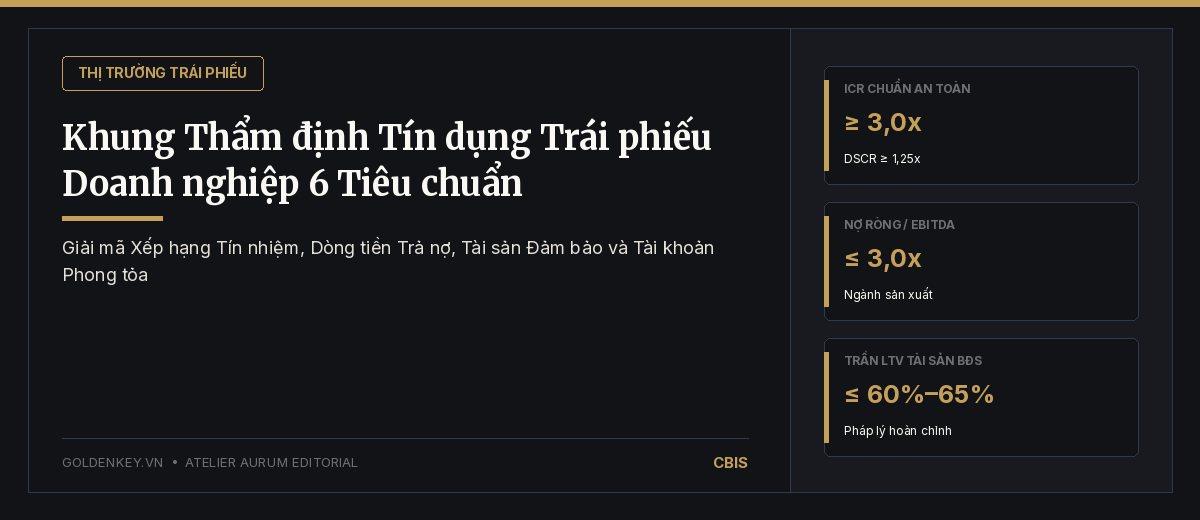
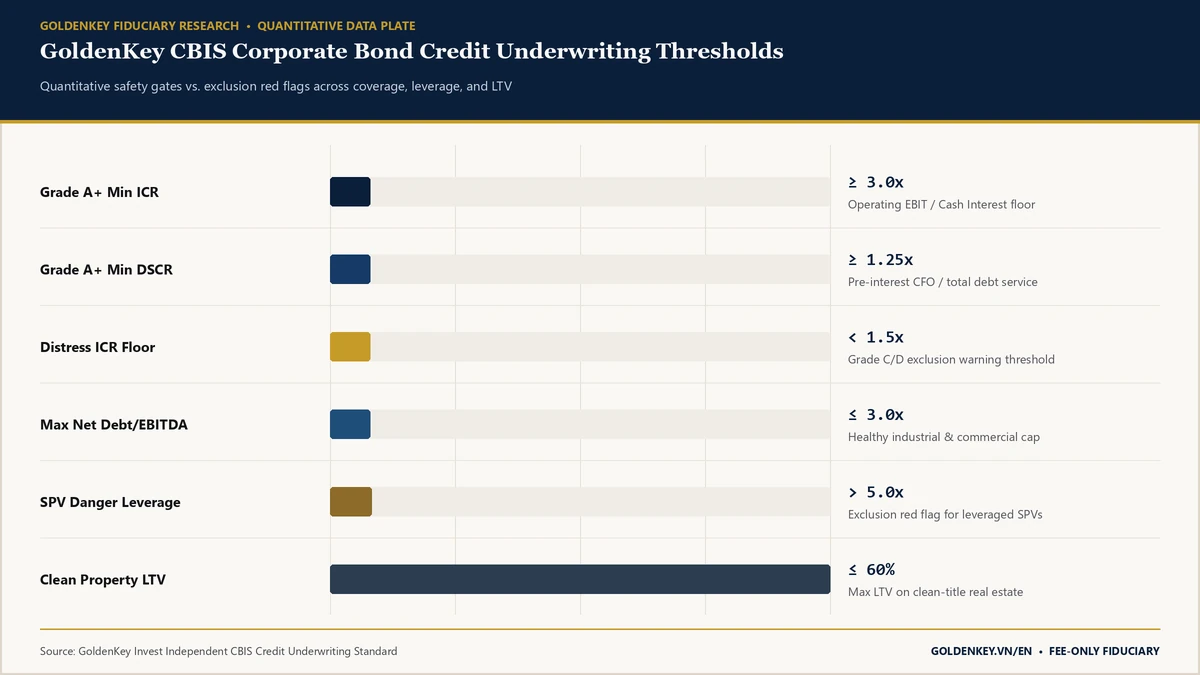
- ▪Pillar 1 — Operating Cash Flow (CFO & ICR) Is the Primary Repayment Source: Collateral liquidation is strictly a last-resort backstop; investment-worthy issuers must maintain an Interest Coverage Ratio (ICR) ≥ 3.0x backed by recurring positive CFO.
- ▪Pillar 2 — Sector-Calibrated Financial Leverage: Net Debt / EBITDA across manufacturing and commercial corporates should remain ≤ 3.0x – 3.5x; avoid thinly capitalized special-purpose vehicles (SPVs) levered 5–10x equity.
- ▪Pillar 3 — Independent Credit Rating: Scrutinize ratings from Ministry of Finance-licensed agencies; prioritize Investment Grade tiers (AAA, AA, A, BBB) and monitor rating Outlooks (Stable / Positive / Negative).
- ▪Pillars 4, 5 & 6 — Substantive Collateral Packages, Escrow Ring-Fencing & Protective Covenants: Guard aggressively against internal-share collateral traps (Wrong-Way Risk); prioritize unconditional bank payment guarantees and Debt Service Reserve Accounts (DSRAs).
1. Forensic Breakdown of the 6 Institutional Credit Underwriting Pillars
Pillar 1: Primary Cash-Flow Repayment Capacity & Interest Coverage Ratio (ICR)
In institutional commercial banking and debt capital markets, the cardinal underwriting rule holds: “Lend against primary operating cash flows, never lend merely hoping to foreclose on pledged collateral.” Two mandatory coverage ratios must be verified across three consecutive years of audited financial statements:
Pillar 2: Balance-Sheet Leverage & Debt Maturity Wall Concentration
Beyond headline Debt-to-Equity (D/E), credit analysts compute Net Debt / EBITDA = (Short-Term Debt + Long-Term Debt − Cash & Term Deposits) / EBITDA. For industrial and commercial issuers, healthy leverage sits below 3.0x; for regulated power and water utilities backed by long-term power purchase agreements (PPAs), acceptable leverage extends to 4.0x – 4.5x. Crucially, inspect the long-term debt footnotes to map the issuer’s Debt Maturity Wall: if trillions of VND in competing tranches mature 3–6 months ahead of your bond, refinancing bottleneck risk escalates sharply.
Pillar 3: Independent Credit Rating Verification
Adoption of independent credit ratings from Ministry of Finance-licensed domestic agencies (such as FiinRatings, VIS Rating, and Saigon Ratings) marks a structural milestone in Vietnamese debt transparency. Domestic rating scales span from AAA (highest solvency, comparable to top state-owned banks) through AA, A, and BBB (investment-worthy credit profiles) down to speculative/distressed tiers BB, B, CCC, and D. Beyond the headline Issuer Rating, investors must verify the specific Issue Rating on the tranche itself and the agency’s Rating Outlook (Stable / Positive / Negative) — a BBB issuer placed on Negative Watch faces elevated downgrade probability within 6–12 months.

Pillar 4: Piercing the “Collateral Illusion” & Wrong-Way Risk
Countless individual investors suffered losses because marketing brochures advertised “130% Secured Collateral” without disclosing collateral composition. Forensically, Collateral Packages fall into four vastly unequal quality tiers:
- Tier 1 (Gold Standard): Unconditional, Irrevocable Payment Guarantee from a Tier-1 Commercial Bank or Multilateral Facility (e.g., ADB’s CGIF): If the issuer misses a single VND of principal or coupon, the guarantor bank is legally obligated to pay bondholders directly.
- Tier 2 (Strong): Legally Unencumbered Completed Real Estate (clean land-use certificates, operating factories, or prime urban commercial properties) or Pledged CDs structured at a conservative Loan-to-Value ratio (LTV ≤ 60%–65%, i.e., VND 160 billion of independently appraised value backing VND 100 billion of bonds).
- Tier 3 (High Caution): Future-Formed Project Receivables & Development Rights — if zoning or permitting stalls project launches, collateral foreclosure and liquidation can drag out over years.
- Tier 4 (Severe Hazard — Wrong-Way Risk): 100% Pledged Common Shares of the Issuer Itself or Group Affiliates. Precisely when an issuer suffers a liquidity crisis and defaults on its bonds, its listed share price typically collapses −60% to −80% or locks limit-down with zero bids — vaporizing collateral coverage at the exact moment bondholders need recovery.
Pillars 5 & 6: Ring-Fenced Escrow Governance, Bondholder Representative & Financial Covenants
Institutional bond indentures establish a dedicated Escrow & Debt Service Reserve Account (DSRA) at an independent supervisory bank: offering proceeds are released strictly against verified construction invoices and engineering milestones set forth in the prospectus, while project collections are swept 15–30 days ahead of payment dates into the DSRA under oversight of an independent Bondholder Representative. Accompanying Financial Covenants cap maximum D/E leverage, prohibit common cash dividends unless the DSRA is fully funded, and enforce Cross-Default clauses triggering immediate acceleration if the issuer defaults on any bank facility.
2. GoldenKey CBIS 6-Pillar Credit Scoring Matrix
| Underwriting Pillar | Grade A / A+ (Core Investment Tier) | Grade B (Watchlist / Selective) | Grade C / D (Exclusion Red Flag) |
|---|---|---|---|
| 1. Interest Coverage (ICR & CFO) | ICR ≥ 3.0x; recurring positive CFO for ≥ 3 consecutive years. | ICR 1.8x – 2.9x; cyclical working-capital swings in CFO. | ICR < 1.5x or core operating losses with deeply negative CFO. |
| 2. Net Debt / EBITDA Leverage | ≤ 3.0x (or Tier-1 Bank Basel II/III CAR ≥ 11.5%). | 3.1x – 4.5x with visible deleveraging as assets commission. | > 5.0x or thinly capitalized project SPVs. |
| 3. Independent Credit Rating | Rated AAA, AA, A (or BBB+ Stable/Positive Outlook). | Rated BBB / BB+ mitigated by strong tangible collateral. | Rated B / CCC or below, serial downgrades, or opaque disclosure. |
| 4. Collateral Package Quality | Tier-1 Bank Payment Guarantee or clean-title property (LTV ≤ 60%). | Industrial plant/machinery or liquid VN30 shares with top-up triggers. | Unsecured despite weak financials, or pledged illiquid affiliate stock. |
| 5. Use of Proceeds & Escrow | Transparent capex/working capital; supervisory bank Escrow & DSRA. | Legitimate bank-loan refinancing backed by operating project cash. | Circular capital routing across multi-layered unlisted BCC contracts. |
| 6. Audit & Protective Covenants | Unqualified Big-4 audit opinion; strict leverage & cross-default covenants. | SSC-approved auditor; standard bondholder covenants. | Qualified audit opinion, prior payment delays, or serial extensions. |
Practical Checklist: 10-Minute Self-Audit Before Subscribing to Any Corporate Bond
- ✓Step 1 — Screen Issuer Pedigree: Restrict focus to listed sector leaders or commercial banks publishing quarterly audited/reviewed financials — avoid newly incorporated shell LLCs lacking operating history.
- ✓Step 2 — Compute ICR Directly: Divide (Pre-Tax Profit + Interest Expense) by Interest Expense from the latest audited income statement — reject immediately if below 2.5x.
- ✓Step 3 — Audit Collateral Substance: If pledged collateral consists solely of the issuer’s own shares, treat the tranche as effectively Unsecured and demand Tier-1 standalone credit strength.
- ✓Step 4 — Read the Independent Credit Rating Report: Inspect the agency’s “Rating Sensitivities” section to identify exact quantitative downgrade triggers.
- ✓Step 5 — Run Our Online Bond Safety Checklist: Score all 6 pillars quantitatively on GoldenKey’s interactive tool prior to committing capital.
Published under Bond Market by the Research & Wealth Governance Council of GoldenKey Invest in strict adherence to our Three-Pillar Fiduciary Mandate: No Client Fund Custody • No Discretionary Order Execution (zero hidden issuer or brokerage kickbacks) • No Guaranteed Return Promises. All primary data series, quantitative models, and statutory references serve independent educational and institutional due-diligence purposes and never constitute solicitation to buy, sell, or hold any equity or fixed-income security.