
READING TIME: 10 MIN • EMPIRICAL PUBLICATION
Nearly four decades after Vietnam's Doi Moi economic reforms and deep integration into global value chains, the domestic private capital market is entering a historic inflection point: the first generation of founding entrepreneurs (born in the 1960s–1970s) is preparing to transfer operating enterprises and wealth accumulated over 25–35 years to the next generation (NextGen). Simultaneously, a rapidly expanding cohort of senior corporate executives, physicians, technology engineers, and SME owners holding investable net worth from several billion to hundreds of billions of VND faces an urgent need for a disciplined, conflict-free, and legally sound Private Wealth Management & Family Office framework.
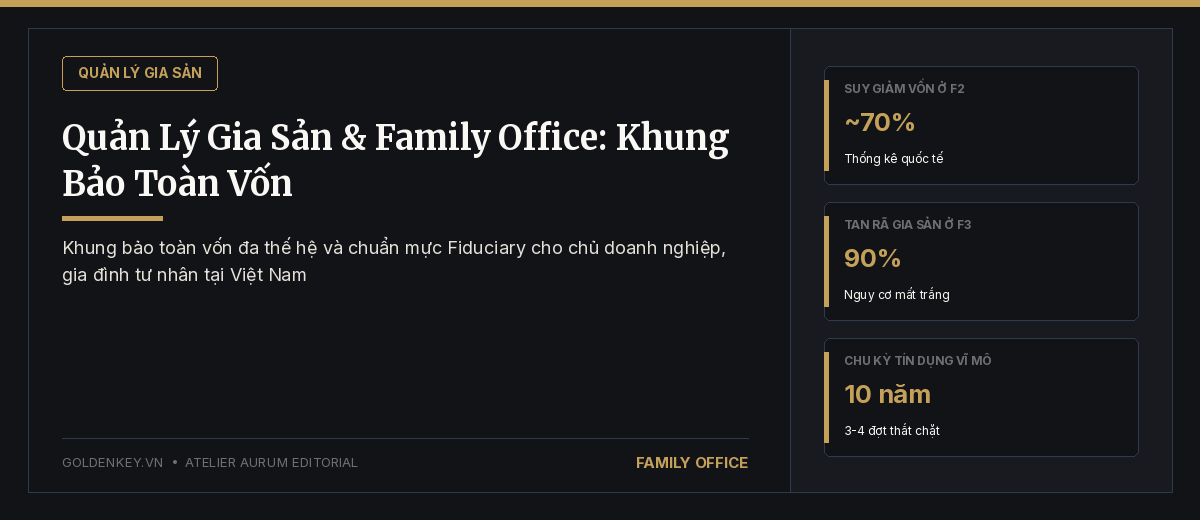
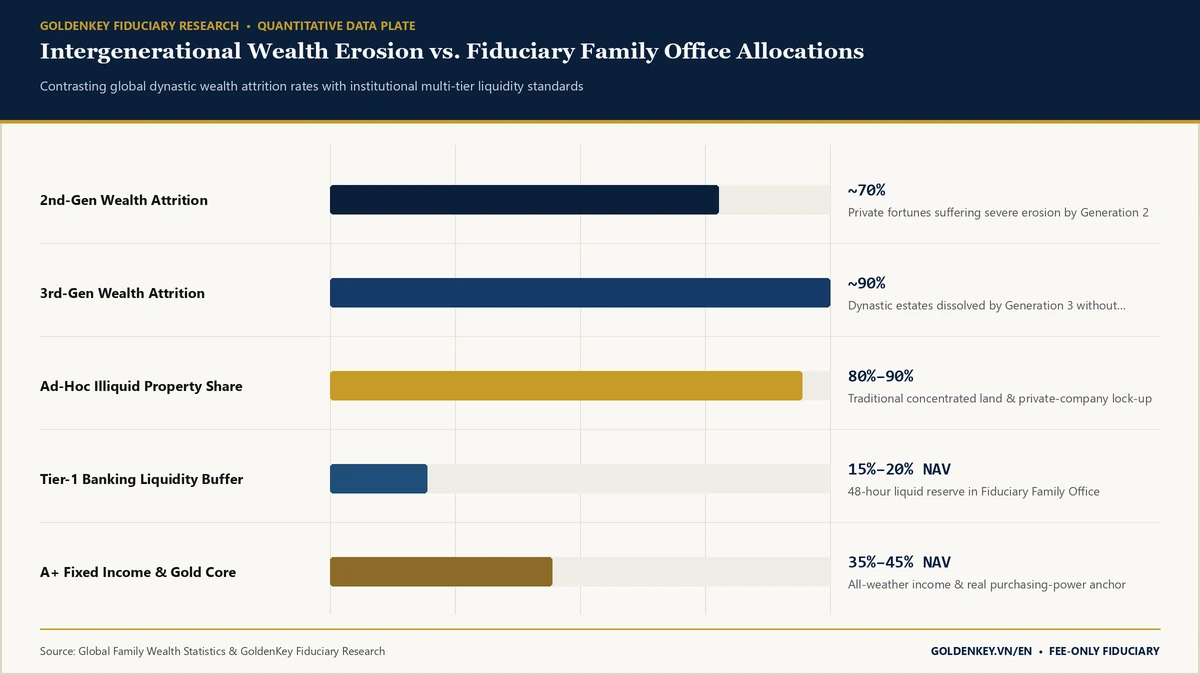
Yet the classic East Asian adage—"No family stays rich across three generations" (echoing international empirical studies showing nearly 70% of private fortunes suffer severe erosion in the second generation and 90% dissolve by the third)—stems from a fundamental structural truth: the skill set that drives Wealth Creation is the exact opposite of the discipline required for Wealth Preservation. Building a fortune demands intense concentration and bold commercial risk-taking inside a narrow industry; preserving wealth across decades demands multi-asset risk dispersion, transparent governance architecture, and conflict-free Independent Fiduciary Advisory.
- ▪Shifting from "Opportunistic Deal-Making" to "Perpetual Endowment Stewardship": Family wealth should be governed like a University Endowment Fund—prioritizing protection against real capital impairment ahead of return maximization.
- ▪Separating Product-Push Private Banking from Independent Fiduciary Advisory: Only an Independent Fiduciary Advisor operating under the Three-Pillar Fiduciary Mandate—receiving zero bond or insurance distribution commissions—can align 100% with a family's long-term capital safety.
- ▪Synchronizing All Four Forms of Family Capital: Beyond Financial Capital, holistic stewardship safeguards Core Operating Business Capital, cultivates NextGen Human Capital, and codifies Family Legal & Governance Structures.
- ▪Engineering Multi-Tier Liquidity for Macro Shocks: Resilient estates maintain immediate liquidity across regulated public markets (Tier-1 Deposits, A+ Corporate Bonds, Prime ETFs/Equities) rather than locking 95% of net worth inside frozen real estate.
1. The Structural Divide Between "Retail Stock Picking" and "Holistic Private Wealth Management"
Many assume Wealth Management simply means buying stocks or placing savings deposits with extra zeros attached. Once household net worth surpasses baseline living self-sufficiency (from VND 5 billion and 20 billion to VND 100+ billion), however, the optimization problem transforms across four dimensions:
- From Single-Trade Return Maximization to Holistic Household Balance-Sheet Optimization: Retail speculators ask, "Which stock will jump 30% next quarter?" Holistic Wealth Management examines the consolidated family balance sheet and liability profile: what share of net worth is locked in physical property, is the family business cross-collateralized against the primary home, and does net after-tax passive income already cover international university tuition and senior healthcare?
- Governing Legal Title, Tax Compliance, and Asset Legitimacy: At substantial wealth scales, holding assets with defective legal documentation (informal handwritten land transfers, regulatory-arbitrage investment cooperation contracts, or nominee-held titles) carries litigation and total-loss risks far exceeding listed equity volatility.
- Defending Real Purchasing Power Across 10-Year Credit & Interest-Rate Cycles: Over a 20-to-30-year generational horizon, every economy traverses at least three to four monetary tightenings, sector recessions, and asset boom-bust freezes. Private Wealth governance constructs an All-Weather Portfolio engineered never to suffer liquidity paralysis at cyclical troughs.
2. Traditional Product-Push Private Banking vs. Independent Fiduciary Advisory (Three-Pillar Fiduciary Mandate)
In recent years, numerous domestic financial institutions have launched Priority and Private Banking tiers across Vietnam. While delivering refined lounge hospitality and seamless payment convenience, traditional product-distribution models embed a Structural Conflict of Interest that every wealth owner must discern clearly:
When a relationship manager is compensated via sales KPIs to place unit-linked life insurance policies or distribute affiliated corporate bond tranches paying commissions several times higher than standard deposits, financial advice inevitably tilts toward the commission payer rather than client principal safety. Conversely, the Fiduciary Standard (Supreme Duty of Loyalty) places client interests unconditionally first through GoldenKey Invest's Three-Pillar Fiduciary Mandate:
- No Client Fund Custody (100% Direct Legal Ownership): Every term deposit, certificate of deposit, listed corporate bond, and equity share remains custodied 100% in the client's own legal name at premier custodian banks and licensed brokerages—eliminating misappropriation or custody counterparty risk to absolute zero, reinforced by No Discretionary Order Execution.
- Zero Hidden Issuer Kickbacks (Conflict-Free Credit & Equity Research): Our Research Council evaluates corporate bonds strictly on audited financial statements, debt-service cashflows, and realized Interest Coverage Ratio (ICR) via the HNX Corporate Bond Information System (CBIS)—assigning Warning grades (C/D) to over-leveraged tranches free from any distribution quota pressure.
- No Guaranteed Return Promises: Upholding empirical financial economics by transparently modeling base, upside, and stress scenarios alongside explicit Thesis Invalidation Triggers.

3. Structural Comparison: Ad-Hoc Household Investing vs. Institutional Family Office Governance
| Wealth Governance Pillar | Traditional Ad-Hoc Model in Vietnam | Fiduciary Private Wealth / Family Office |
|---|---|---|
| Asset-Class Allocation | 80%–90% concentrated in illiquid land plots and capital locked inside a private operating firm. | Balanced multi-tier structure: Tier-1 bank liquidity (15%–20%), A+ Bonds/Gold (35%–45%), Index ETFs/Blue-Chips & income-yielding property. |
| Investment Due Diligence | Driven by informal social referrals, personal relationships, or uncritical trust in branch counter branding. | Independent vetting against a 6-point bond credit checklist and forensic Operating Cash Flow (CFO) audit. |
| Leverage & Collateral Control | Cross-pledges family homes for corporate working-capital loans; risks losing both in recessions. | Legally ring-fenced via an Asset Firewall—the Family Sanctuary Vault never guarantees commercial debt. |
| NextGen Onboarding | Keeps financial records opaque or hands over control abruptly during a health crisis without preparation. | Integrates NextGen early into the Family Investment Council with a ring-fenced training mandate. |
| Reporting & Legal Custody | Fragmented holdings lacking consolidated NAV tracking or net after-tax real return measurement. | Quarterly consolidated net-worth reporting; 100% direct-name custody at Tier-1 financial institutions. |
4. A 4-Stage Roadmap to Establish a Lean / Virtual Family Office for Vietnamese Households
A household stewarding VND 10 billion to VND 100+ billion in investable wealth does not need to spend billions of VND annually on full-time in-house overhead to capture institutional Family Office discipline. Instead, a Lean / Virtual Family Office can be operationalized systematically across four sequential stages:
- Stage 1 — Inventory & Consolidated Household Balance-Sheet Audit: Catalog every asset at realistic net liquidation value (stripping out aspirational asking prices), classify holdings by liquidity horizon (T+0, T+2, under 6 months, over 1 year), and reconcile against all direct and contingent debt obligations.
- Stage 2 — Liquidity Restructuring & Non-Standard Asset Cleanup: Systematically unwind unsecured personal loans, remote non-yielding land plots, and weak corporate bonds; migrate proceeds into a regulated 4-Tier Wealth Pyramid.
- Stage 3 — Engineering Self-Sustaining Passive Cashflow Coverage: Calibrate the fixed-income and dividend core (Tier-1 bank CDs + A+ Corporate Bonds + reliable cash-dividend equities) so net after-tax annual cashflows automatically cover 100% of baseline household expenses.
- Stage 4 — Codifying the Family IPS & Second-Generation Mentorship: Adopt a written Family Investment Policy Statement and convene semi-annual family wealth reviews to transmit risk-governance culture naturally to adult heirs.
Practical Checklist: 5 Diagnostic Criteria for Assessing Household Wealth Health
- ✓Criterion 1 — Tier-1 Liquidity Ratio: Does your household hold at least 15%–25% of total net worth in listed securities or Tier-1 bank instruments convertible into legal cash within 48 business hours without forced property sales?
- ✓Criterion 2 — Independence from Sales Conflicts: Was your current portfolio constructed from independent empirical analysis, or assembled from pitches by commission-driven product salespeople?
- ✓Criterion 3 — Net Cashflow Self-Sufficiency: Do realized cashflows from deposit interest, bond coupons, cash dividends, and net rental income already exceed total annual household living expenses?
- ✓Criterion 4 — Clean Direct-Name Legal Title: Are 100% of property title certificates, VSDC depository accounts, and bank accounts legally standardized in direct family names with zero nominee-holding exposure?
- ✓Criterion 5 — Continuity Readiness: Do your spouse and adult children know the consolidated directory of official custodian accounts and foundational capital-protection rules in the event of an unexpected absence?
Published under the Wealth Management practice and compiled independently by the GoldenKey Invest Research & Wealth Governance Council under our Three-Pillar Fiduciary Mandate: No Client Fund Custody — No Discretionary Order Execution — No Guaranteed Return Promises (with zero hidden brokerage or issuer distribution kickbacks). All data series, quantitative models, and regulatory frameworks cited herein are presented strictly for institutional research and objective investor due diligence; they do not constitute an offer, solicitation, or recommendation to buy, sell, or hold any specific security or corporate bond tranche.