

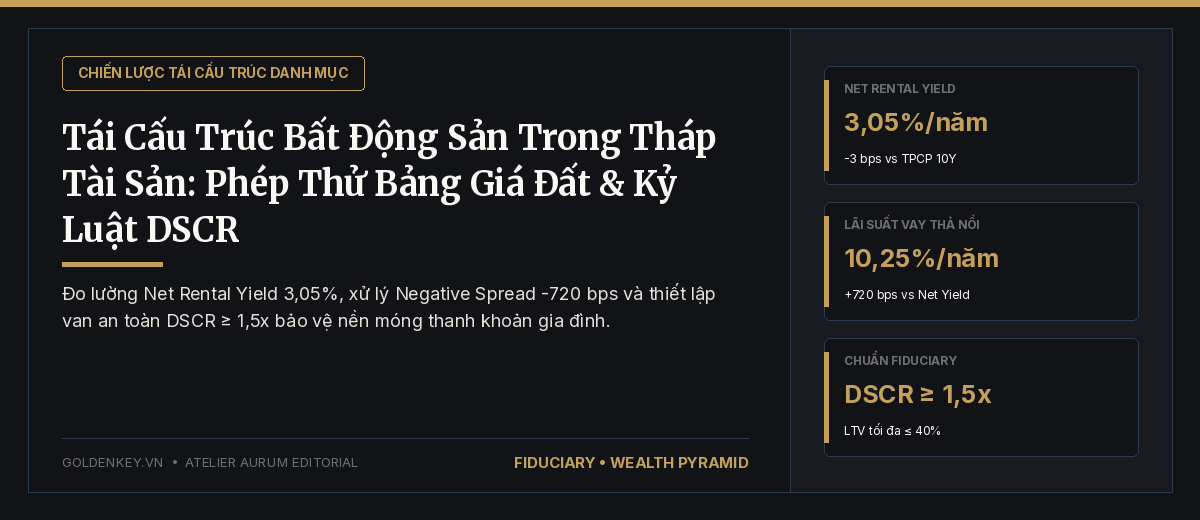
Restructuring Real Estate Within the Wealth Pyramid: The 2026 Land Price Tariff Test, Negative Carry Traps, and DSCR ≥ 1.5x Leverage Discipline
Entering full statutory implementation of the 2024 Land Law — anchored by annually updated, market-aligned municipal land price tables taking effect in 2026 — the traditional balance-sheet structure of affluent Vietnamese households faces a structural reckoning. With 65%–70% of household net worth locked inside illiquid, zero-cashflow speculative land plots while floating mortgage rates average 10.25% p.a., the generational dogma that “land only goes up” is colliding head-on with first-principles financial mathematics.
1. Extreme Asset Concentration and the Breakdown of the “Land Never Loses” Fallacy
Across multiple generations of Vietnamese capital accumulation, acute asset concentration has become the norm: physical property routinely accounts for 65% to over 70% of household net worth. During prior eras of rapid monetary expansion and subsidized teaser borrowing, leveraged land banking was bailed out by nominal price appreciation outpacing debt service. Viewed through an independent Fiduciary lens anchored on primary disclosures as of November 22, 2026 from the State Bank of Vietnam (SBV) and Ministry of Finance, however, that dynamic has inverted into a silent capital-destruction engine.
Real estate credit currently absorbs 21.3% of total economy-wide bank credit. Crucially, a large share of household leverage finances peri-urban subdivision plots or agricultural parcels awaiting residential conversion. As monetary policy normalizes past promotional grace periods (the Teaser Rate Cliff), commercial bank floating mortgage rates have reset to 9.80%–11.50% p.a., with the effective system-wide mean standing at 10.25% p.a.
Carrying zero-cashflow property holdings against double-digit floating borrowing costs is a slow-motion liquidity crisis. “Paper losses” (unrealized drawdowns) are not benign accounting entries; they represent compounding opportunity-cost erosion and a relentless monthly drain on disposable household income required to service principal and interest. Building a resilient household balance sheet begins with rigorous cashflow planning to verify true free liquidity surplus before committing capital to illiquid real assets.
2. Deconstructing the Destructive Negative Carry Trap (-720 bps Negative Spread)
The single most prevalent analytical error among individual property investors is conflating Gross Rental Yield with net economic return. Standardized metropolitan market surveys through November 2026 show Gross Rental Yields averaging 4.30% p.a. in Hanoi and 3.85% p.a. in Ho Chi Minh City, yielding a two-city weighted average of 4.08% p.a.
Under GoldenKey Invest’s Standardized Cash-Flow Verification Framework, however, Normalized Net Rental Yield must deduct all mandatory statutory and economic operating expenses:
Normalized Net Rental Yield Formula:
Net Rental Yield = [Gross Yield × (1 - 10% Tax)] - CapEx Maintenance Reserve (1.0%) - Structural Vacancy Allowance (Gross Yield × 5%)
Specifically, combined personal income tax and VAT on annual rental revenue exceeding VND 100 million absorbs 10% of gross receipts; interior depreciation and structural maintenance require a minimum 1.0% annual capital reserve; and tenant-turnover vacancy averages 5% (0.6 months/year). After full cost accounting, normalized urban residential Net Rental Yield stands at just 3.05% p.a.
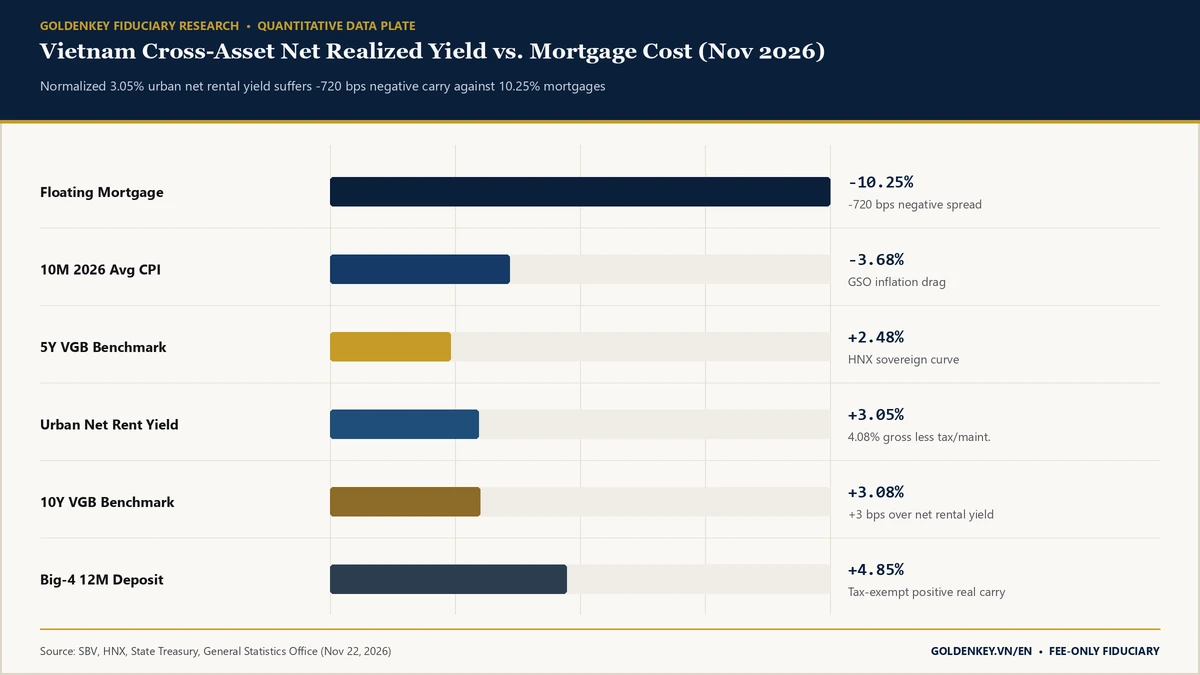
Benchmarking a 3.05% p.a. Net Rental Yield against competing domestic capital-market instruments exposes three acute valuation anomalies:
- Sub-Sovereign Risk-Free Yield: Per Hanoi Stock Exchange (HNX) secondary quotes and State Treasury auction results on November 20, 2026, the 10-year Vietnam Government Bond benchmark (VGB 10Y) yields 3.08% p.a., with primary auction clearing yields at 3.12% p.a. Earning 3.05% on physical property — 3 to 7 bps below sovereign risk-free debt — means landlords bear illiquidity, tenant-default, and physical-obsolescence risks for zero risk premium.
- Inferior to Positive-Real-Yield Term Deposits: Twelve-month retail deposit rates stand at 4.85% p.a. across Big-4 state-owned commercial banks and 5.80% p.a. at major private joint-stock banks. Against 10-month 2026 average CPI inflation of 3.68% reported by the General Statistics Office (GSO), tax-exempt bank deposits deliver effortless positive real carry with zero operational overhead.
- Destructive Leveraged Negative Carry: Financing a 3.05% Net Rental Yield asset with a 10.25% floating mortgage locks the borrower into a punishing Negative Spread of -7.20% p.a. (-720 basis points).
| Asset Class / Funding Benchmark | Nominal Rate | Tax & Operating Drag | Net Realized Yield | Spread vs. Net Rent (3.05%) | Primary Data Source |
|---|---|---|---|---|---|
| Average Floating Mortgage Rate | 10.25% p.a. | Base + 3.8% margin | -10.25% p.a. | -720 bps (Capital Bleed) | SBV / Commercial Bank Tariffs |
| 12M Deposit — Major Joint-Stock Banks | 5.80% p.a. | 0.00% (PIT Exempt) | +5.80% p.a. | +275 bps | Published Bank Rate Schedules |
| 12M Deposit — Big 4 (Agri, CTG, VCB, BID) | 4.85% p.a. | 0.00% (PIT Exempt) | +4.85% p.a. | +180 bps | State-Owned Bank Rate Schedules |
| Urban Residential Rental Property | 4.08% p.a. (Gross) | 10% tax, 1% maint., 5% vac. | +3.05% p.a. | 0 bps (Reference Baseline) | Standardized Metro Field Survey |
| Headline Inflation (10M 2026 Avg CPI) | 3.68% p.a. | Not applicable | -3.68% p.a. | -63 bps (Purchasing-Power Drag) | General Statistics Office (GSO) |
| 10-Year Vietnam Government Bond (VGB) | 3.08% p.a. | 0.00% operating drag | +3.08% p.a. | +3 bps (Zero Sovereign Credit Risk) | HNX / State Treasury |
| 5-Year Vietnam Government Bond (VGB) | 2.48% p.a. | 0.00% operating drag | +2.48% p.a. | -57 bps | HNX Benchmark Yield Curve |
Table 1: Cross-asset comparison of funding costs, net realized yields, and basis-point spreads across core Vietnamese capital channels (Data as of November 22, 2026).
The arithmetic of a -720 bps Negative Spread is unforgiving: every VND 1 billion of mortgage debt financing a rental unit bleeds VND 72 million in net cash outflow annually. Merely to break even against 10.25% borrowing costs and 3.68% CPI inflation, nominal property prices would need to compound uninterruptedly at ≥8.50% p.a. across the entire loan life — an implausible assumption amid moderated credit growth and anti-speculation land reform. Investors can evaluate risk-adjusted return trade-offs across liquid and illiquid instruments via our Asset Class Comparison framework.
3. Household Balance-Sheet Stress-Testing and Cross-Tier Contagion Mechanics
In institutional wealth architecture, asset tiers are separated by strict liquidity bulkheads. Excessive property leverage breaches those bulkheads, igniting Cross-Tier Contagion through the collapse of the household Debt Service Coverage Ratio (DSCR).
Debt Service Coverage Ratio (DSCR) Identity:
DSCR = Monthly Net Disposable Operating Cash Flow / Total Monthly Principal & Interest Debt Service
International Fiduciary standards mandate a minimum household DSCR ≥ 1.50x and a maximum portfolio Loan-to-Value (LTV ≤ 40%). Whenever DSCR falls below 1.0x, the household enters Technical Insolvency.
Consider an empirical stress test on an affluent household holding a VND 3.33 billion property financed with VND 2.0 billion in bank debt (60% LTV) over a 20-year amortization schedule (VND 8.33 million/month straight-line principal), backed by VND 30 million/month in net disposable salary and business cash flow:
-
Base Case (10.25% p.a. Floating Mortgage Rate): Monthly interest equals VND 17.08 million, bringing total monthly debt service (Principal + Interest) to VND 25.41 million. Resulting
DSCR = 30 / 25.41 = 1.18x. Although VND 4.59 million/month remains positive, the household operates well below the 1.50x Fiduciary safety floor. - Stress Case (+200 bps Rate Shock to 12.25% p.a. + 15% Income Dip): Monthly interest rises to VND 20.42 million, lifting monthly debt service to VND 28.75 million. If an economic slowdown trims net disposable household cash flow by 15% (to VND 25.50 million/month), DSCR immediately collapses to 0.87x.
At DSCR < 1.0x, the household suffers a monthly cash deficit of VND 3.25 million (~VND 40–45 million/year). To avoid Non-Performing Loan (NPL) classification and bank foreclosure, the family is forced to raid its 6–12 month Emergency Reserve held in Tier 1 (Liquidity & Capital Preservation) — a reserve strictly earmarked for medical emergencies or income interruption.
Against a typical VND 180 million emergency reserve, negative carry from the upper-tier property drains the family’s entire foundational liquidity shield within 12 to 18 months. Once Tier 1 is exhausted, forced liquidation into an illiquid property market routinely inflicts 25%–40% fire-sale discounts. Preventing cross-tier contagion requires ring-fencing core household reserves inside staggered Term Deposit Solutions (CD Ladders) completely unencumbered by property debt.
4. The 2026 Market-Linked Land Tariff Shock: Structural Reckoning for Zero-Cashflow Land Plots
If floating mortgage rates represent an immediate liquidity test, the statutory transition taking effect January 1, 2026 under the 2024 Land Law delivers a permanent structural shock to unimproved speculative land banking.
Abolishing central government land-price brackets in favor of annually updated municipal land price tables calibrated to market transaction values fundamentally alters holding and conversion economics:
- Surging Land-Related Fiscal Assessments: Preceded by Ho Chi Minh City People’s Committee Decision No. 79/2024/QD-UBND (which raised interim street-level land schedules by 3.0x to 7.0x through end-2025), full national transaction-database integration starting in 2026 projects municipal land tariff increases averaging 2.5x to 6.8x across Hanoi, Ho Chi Minh City, and key economic corridors.
- 150%–320% Surge in Residential Land-Use Conversion Levies: For investors holding peri-urban agricultural or perennial-crop parcels hoping to convert title to residential land for subdivision, statutory land-use conversion fees jump by 150% to over 320%. A suburban parcel previously budgeted at VND 500 million for residential conversion may now require VND 1.5 billion to over VND 2.1 billion in upfront fiscal levies.
- Crystallizing Permanent Capital Impairment: Step-function conversion levies wipe out five years of anticipated paper gains overnight. Parcels unable to fund conversion remain legally frozen from subdivision, turning zero-cashflow land into stranded capital burdened by ongoing interest carry and market-linked transfer taxes.
Rather than remaining trapped in title-impaired speculative parcels exposed to statutory repricing, disciplined allocators are rotating released capital into transparent fixed-income instruments screened via our Bond Screening & Dossier Hub to lock in contractual coupon cash flows.
5. Four-Step Fiduciary Real Estate Restructuring Protocol
To restore household balance-sheet resilience ahead of the 2026 land-tariff regime, GoldenKey Invest outlines a four-step institutional restructuring protocol:
Step 1: Forensic Asset Audit & Portfolio Triage
Segregate all existing property holdings into two strictly defined buckets:
- Core Cash-Flow Real Estate: Prime urban properties holding clean pink-book title, occupancy > 90%, and normalized Net Rental Yield > 3.5% p.a. These assets qualify for retention within Tier 2 of the Wealth Pyramid.
- Zero-Cashflow & Speculative Holdings: Peri-urban subdivision lots, unconverted agricultural parcels, bare-shell units incapable of leasing, or properties yielding < 2.5% net. Schedule this bucket for disciplined divestment.
Step 2: DSCR Stress Audit & Mandatory Deleveraging
Run an immediate household stress test assuming a +200 bps floating-rate shock (12.25% p.a.). Whenever DSCR < 1.50x or aggregate LTV > 40%, execute accelerated principal paydowns to restore debt coverage above institutional safety thresholds.
Step 3: Decisive Divestment of Stranded Zero-Cashflow Assets
Accept a pragmatic 10%–15% discount off peak asking prices to exit stranded zero-cashflow parcels cleanly ahead of full 2026 tariff enforcement. First-principles arithmetic confirms that crystallizing a modest near-term discount is vastly cheaper than bleeding 10.25% p.a. mortgage carry while absorbing 150%–320% land-conversion cost inflation.
Step 4: Balanced Reallocation Across the 4-Tier Fiduciary Wealth Pyramid
Redeploy liberated cash proceeds systematically across the four-tier Fiduciary architecture:
- Fortify Tier 1 (Liquidity & Capital Shield: 20%–25%): Ring-fence 6 to 12 months of household living expenses inside a Big-4 commercial bank CD Ladder yielding 4.85% p.a., legally and operationally isolated from all credit facilities.
- Rebuild Tier 2 (Fixed Income & Core Yield Real Estate: 35%–45%): Allocate into 10-year Vietnam Government Bonds (3.12% auction yield) and high-grade corporate bonds alongside unlevered (or LTV ≤ 30%) core income-producing urban real estate generating positive net cash carry.
- Compound Tier 3 (Core Equity Growth: 20%–30%): Accumulate broad-market index ETFs (VN30, VNFinLead) and wide-moat listed leaders paying recurring cash dividends with T+2 institutional liquidity.
- Cap Tier 4 (Opportunistic Convexity: 5%–10%): Restrict high-conviction long-horizon land banking strictly to ≤10% of net worth under an absolute covenant: 100% unlevered equity funding (LTV = 0%), zero debt financing.
6. Conclusion: Fiduciary Resolve at a Structural Inflection Point
Macroeconomic normalization and the 2024 Land Law do not mark the end of real estate investing in Vietnam; rather, they mark the definitive end of indiscriminate debt-fueled land speculation. In the post-2026 institutional regime, real estate returns to its fundamental economic role: either a productive cash-yielding asset serving urban housing and commerce, or an unlevered long-duration store of equity capital.
Enduring dynastic prosperity is never measured by hectares of illiquid suburban land frozen on paper, but by monthly free cash flow and the unshakeable solvency of Tier-1 liquidity across every credit cycle. Auditing portfolio carry, divesting stranded zero-cashflow plots, enforcing DSCR ≥ 1.5x, and respecting tiered liquidity firewalls define true fiduciary stewardship.
Fiduciary Standard Statement & Three-Pillar Mandate
This research report was prepared independently by the GoldenKey Invest Wealth Research Desk using 100% primary disclosures from the State Bank of Vietnam (SBV), Ministry of Finance, State Treasury, Hanoi Stock Exchange (HNX), and General Statistics Office (GSO) as of November 22, 2026. GoldenKey Invest strictly upholds its Three-Pillar Fiduciary Mandate:
- No Client Fund Custody under any arrangement or vehicle.
- No Discretionary Order Execution or Hidden Kickbacks from securities issuers, real estate developers, or financial institutions.
- No Guaranteed Return Promises; all capital-allocation frameworks prioritize risk governance and long-term purchasing-power preservation.
This article contains no solicitation to buy, sell, or hold any specific security or property development. Household portfolio restructuring must be calibrated to individual debt schedules, liquidity horizons, and verified disposable cash flows.