

READING TIME: 10 MIN • EMPIRICAL RESEARCH MONOGRAPH
Across developed global financial centers and major Asian economies alike, the Fixed-Income / Debt Capital Market rivals or exceeds equity market capitalization, serving as the primary medium- and long-term funding artery for sovereign infrastructure and industrial corporations. In Vietnam, however, the rapid expansion and subsequent 2021–2023 shakeout of corporate debt imparted a lasting lesson: most individual investor losses stemmed from failing to distinguish the statutory boundary between Publicly Offered Corporate Bonds and Private Placement Corporate Bonds — or worse, signing unregulated “fractional investment cooperation contracts” engineered to circumvent Professional Securities Investor (PSI) eligibility rules.
Entering 2025–2027, following a comprehensive statutory overhaul (evolving from Decrees 153/65/08 to the unified legal regime of Decree 200/2026/ND-CP, Circular 138/2026/TT-BTC, and Law No. 23/2026/QH16 Amending and Supplementing the Law on Securities) alongside mandatory custody at the Vietnam Securities Depository and Clearing Corporation (VSDC) and centralized trading on HNX’s dedicated Private Placement Bond System, Vietnam’s fixed-income market now operates under rigorous legal stratification and transparent disclosure.
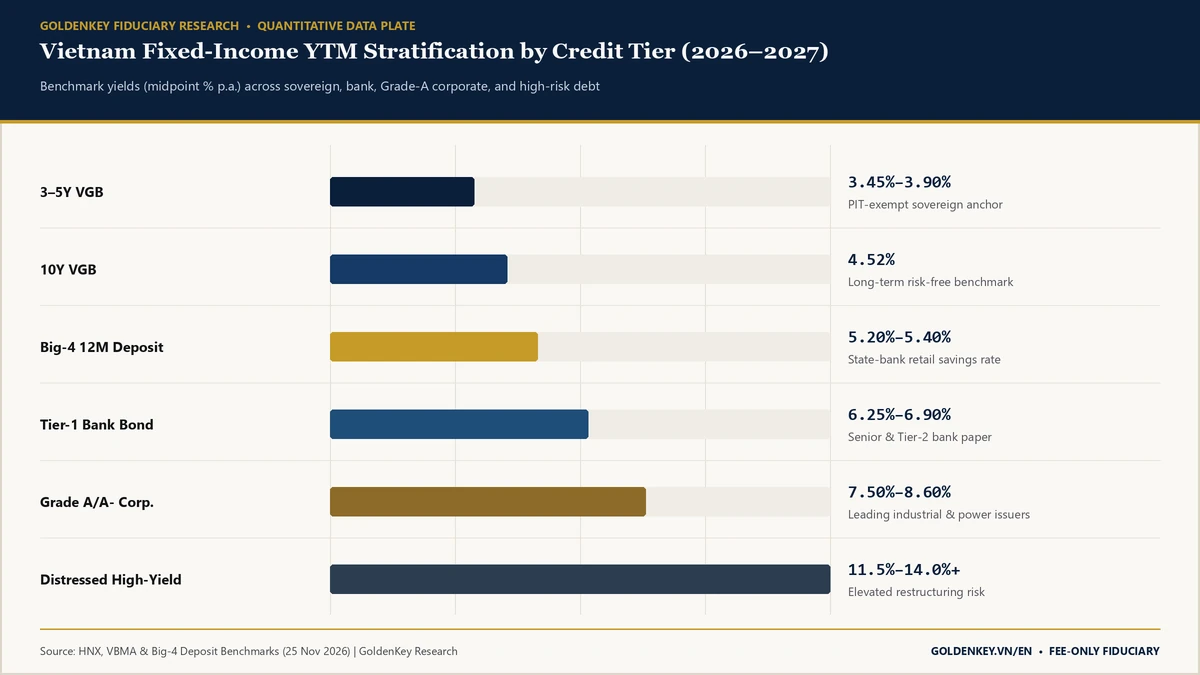
- ▪Vietnam Government Bonds (VGBs): Sovereign local-currency debt carrying zero domestic default risk; the 10-year benchmark yield (4.52% p.a. as of 25 Nov 2026) anchors economy-wide risk-free pricing and trades predominantly among institutions.
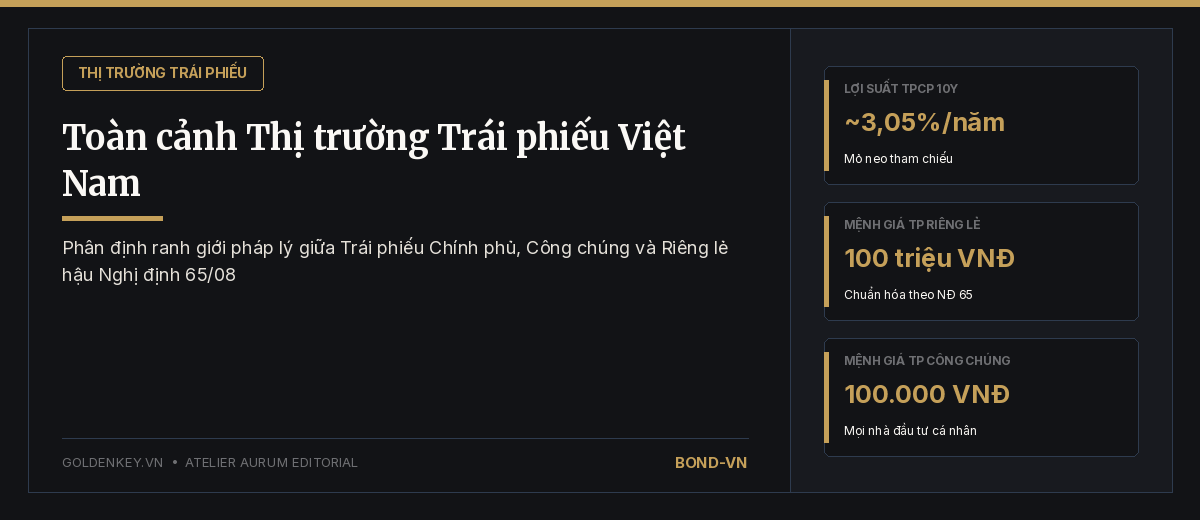
- ▪Publicly Offered Corporate Bonds: Vetted and licensed directly by the State Securities Commission (SSC), listed on HNX at a standard VND 100,000 par value — legally open to all individual investors with full prospectus protection.
- ▪Private Placement Corporate Bonds: Restricted strictly to qualified Professional Securities Investors (PSIs) under statutory rating and collateral mandates, carrying a VND 100 million standard par value (per Decree 200/2026/ND-CP & Law 23/2026/QH16), VSDC registration, and centralized HNX secondary trading.
- ▪Zero Tolerance for “Pooled Co-Investment / Nominee Contracts”: Every legitimate bond holding must be registered directly in the investor’s own name at VSDC.
1. Segment 1: Vietnam Government Bonds (VGBs) — The Sovereign Risk-Free Anchor
Issued directly by the State Treasury of Vietnam (alongside Government-guaranteed bonds of the Vietnam Bank for Social Policies, Vietnam Development Bank, and municipal bonds), Vietnam Government Bonds (VGBs) represent the highest sovereign credit standing in Vietnamese dong. Across HNX’s primary auction and specialized secondary platforms, standard benchmarks span 5-, 10-, 15-, and 20-to-30-year tenors.
Although individual investors rarely purchase VGBs directly due to wholesale lot sizes and nominal yields (roughly 3.15% p.a. at 2Y and 4.52% p.a. at 10Y as of 25 November 2026, exempt from personal income tax) below retail bank deposit rates, tracking the 10-year VGB benchmark is indispensable: the Credit Spread of any Corporate Bond over its matched-maturity VGB is the single most objective market gauge of issuer credit risk.
2. Segment 2 vs. Segment 3: Publicly Offered Bonds vs. Private Placement Corporate Bonds
Understanding this statutory divide is foundational for every household and fiduciary allocator before deploying fixed-income capital:
2.1. Publicly Offered Corporate Bonds
To issue bonds to the general public under the Law on Securities, an issuer must clear stringent substantive gates vetted and licensed directly by the State Securities Commission (SSC): paid-in charter capital of at least VND 30 billion, profitable operations in the preceding fiscal year, zero accumulated losses and zero overdue liabilities exceeding one year, board-approved issuance and repayment plans, and a full public Prospectus (paired with mandatory credit ratings per statutory thresholds). Immediately post-offering, public bonds must list on HNX’s centralized exchange. Every retail investor — without needing PSI certification — can buy and sell listed public bonds transparently via a standard securities account or licensed open-ended bond funds.
2.2. Private Placement Corporate Bonds (Standardized Under Decree 200/2026/ND-CP, Circular 138/2026/TT-BTC & Law No. 23/2026/QH16)
Designed to let corporations raise capital rapidly from institutional treasuries and sophisticated investors without mass-media solicitation, Vietnam’s private placement channel has been thoroughly fortified under Decree 200/2026/ND-CP, Circular 138/2026/TT-BTC, and Law No. 23/2026/QH16:
- Standardized VND 100M Par Value & Centralized Custody: Minimum par value is set at VND 100,000,000 (VND 100 million) or multiples thereof. Every private placement tranche must register at VSDC and trade exclusively on HNX’s Centralized Private Placement Bond System — ending opaque off-exchange bilateral transfers.
- Strict PSI Eligibility, Mandatory Credit Ratings & Collateral Mandates (Law 23/2026/QH16 & Decree 200/2026/ND-CP): Participation by Professional Securities Investors (PSIs) is tightly coupled with mandatory independent credit ratings, legally valid Collateral Packages or bank payment guarantees, and ongoing supervision by an independent Bondholder Representative under Circular 138/2026/TT-BTC.
- Transparent Workout & Disclosure Governance: Retaining the ≥ 65% par-value bondholder supermajority threshold for maturity extensions or asset swaps (inherited from Decree 08/2023/ND-CP transitional workouts) while enforcing audited capital-utilization filings and timely principal/coupon reporting on the HNX Corporate Bond Information System (CBIS).

3. Comparative Legal Matrix Across Vietnam’s Three Legitimate Bond Segments
| Statutory & Operational Criterion | Vietnam Government Bonds (VGBs) | Publicly Offered Corporate Bonds | Private Placement Corporate Bonds |
|---|---|---|---|
| Issuer & Regulatory Approval | State Treasury issues directly per national budget plan. | Profitable corporates; substantively vetted & licensed by SSC. | JSCs / LLCs self-certify dossier compliance and disclose via HNX CBIS. |
| Eligible Investor Base | Financial institutions (Banks, Insurers, Funds) & Individuals. | All Individual & Institutional Investors (unrestricted). | Institutions & Professional Securities Investors (PSIs) subject to rating/collateral rules. |
| Standard Par Value | VND 100,000 / bond | VND 100,000 (or multiples of VND 100,000) | VND 100,000,000 (VND 100M / bond per Decree 200/2026/ND-CP). |
| Trading Venue & Custody | VSDC custody; specialized HNX VGB platform. | VSDC custody; mandatory HNX listing (transparent order book). | VSDC registration; centralized HNX Private Placement trading system. |
| Personal Income Tax (PIT) | PIT-exempt on VGB coupon interest. | 5% withholding tax on coupons + 0.1% transfer tax on gross sale value. | 5% withholding tax on coupons + 0.1% transfer tax on gross sale value. |
| Wealth Pyramid Fit | Risk-free benchmark (or indirect via open-ended bond funds). | Primary Core Vehicle for Individual Fixed-Income Allocators. | Strictly for large-ticket PSIs equipped with forensic credit underwriting. |
4. Three Legal Pitfalls Individual Investors Must Strictly Avoid
Even under today’s tightened statutory framework, unregulated grey-market schemes occasionally target yield-seeking savers. GoldenKey Invest’s Underwriting Council highlights three non-negotiable “Red Light” rules:
- Never sign a “Business Cooperation Contract (BCC) / Nominee Trust Agreement” to buy private placement bonds indirectly: When non-PSI individuals wire funds to an unlicensed intermediary to hold bonds in its name, you have zero legal standing as a registered bondholder at VSDC. Should the intermediary become insolvent, you are merely an unsecured general creditor with zero direct claim on the bond’s collateral.
- For Household Fixed-Income Allocations Below VND 2 Billion: The safest, most diversified legal route is purchasing listed Publicly Offered Bonds of Tier-1 Banks and blue-chip industrials directly, or subscribing to SSC-regulated Open-Ended Bond Mutual Funds holding 15–25 vetted bond and CD positions.
- Verify Every Bond Ticker Directly on HNX CBIS Before Wiring Funds: Look up the exact bond code on HNX’s Corporate Bond Information System (CBIS) to verify historical coupon timeliness, audited use-of-proceeds filings, and collateral agent identity.
Practical Checklist: 5-Step Legal Verification Prior to Bond Settlement
- ✓Step 1 — Confirm Offering Classification: Check the Prospectus to verify whether the tranche is a Public Offering (holding an SSC Registration Certificate) or a Private Placement.
- ✓Step 2 — Verify Direct-Name Custody at VSDC: Ensure 100% of purchased units settle directly into your personal securities depository sub-account registered at VSDC.
- ✓Step 3 — Benchmark Credit Spread Realism: Compare offered YTM against matched-tenor VGBs and Big-4 12M deposits; reject outlier high-yield tranches immediately.
- ✓Step 4 — Inspect Early-Redemption Options (Call vs. Put): Distinguish an issuer’s Call Option from a bondholder’s Put Option — never rely on verbal “buyback anytime” assurances absent binding indenture covenants.
- ✓Step 5 — Diversify Across Uncorrelated Issuers: Spread fixed-income capital across at least 3–4 issuers in distinct sectors (Tier-1 Banking, Power/Infrastructure, Leading Manufacturing) or pair with open-ended bond funds.
Published under Bond Market by the Research & Wealth Governance Council of GoldenKey Invest in strict adherence to our Three-Pillar Fiduciary Mandate: No Client Fund Custody • No Discretionary Order Execution (zero hidden issuer or brokerage kickbacks) • No Guaranteed Return Promises. All primary data series, quantitative models, and statutory references serve independent educational and institutional due-diligence purposes and never constitute solicitation to buy, sell, or hold any equity or fixed-income security.