

READING TIME: 10 MIN • EMPIRICAL PUBLICATION
Before analyzing any corporate valuation dossier, a disciplined investor must master the Market Microstructure of the venue where capital is matched, cleared, and custodied. Across Vietnam's equity market, structural differences in listing eligibility, daily reference-price calculation, ceiling–floor fluctuation bands, and order-matching protocols across the three centralized trading boards—the Ho Chi Minh Stock Exchange (HOSE), the Hanoi Stock Exchange (HNX), and the Unlisted Public Company Market (UPCoM)—directly govern liquidity risk and corporate governance quality.
Alongside domestic trading rules, Vietnam's capital market during 2025–2027 is undergoing its most consequential institutional overhaul in over two decades: removing the 100% pre-funding requirement for foreign institutional investors (Non-Prefunding under Circular 68/2024/TT-BTC), modernizing core IT infrastructure and Central Counterparty (CCP) clearing, and advancing directly into FTSE Russell Secondary Emerging Market status on a trajectory toward MSCI standards.
- ▪Distinct Transparency Stratification (HOSE > HNX > UPCoM): HOSE concentrates industry leaders meeting the strictest listing thresholds (charter capital ≥ VND 120 billion, two consecutive profitable years, zero accumulated losses), whereas UPCoM serves as a registration board with wide ±15% daily bands and lighter disclosure requirements.
- ▪Beware the "VWAP Reference Price" Distortion on UPCoM: Unlike HOSE and HNX, which anchor on the prior session's closing price, UPCoM computes its daily reference price via volume-weighted average price (VWAP)—enabling intraday swings approaching 30% in thinly traded names.
- ▪T+2 Settlement Cycle (Afternoon T+2 Availability): Sale proceeds and purchased shares across all three boards clear through VSDC prior to 12:00–13:00 on business day T+2, enabling order placement immediately in the T+2 afternoon session.
- ▪Structural Valuation Re-Rating from Emerging Market Upgrade: Entering Emerging Market indices not only unlocks billions of USD in global passive ETF and active institutional mandates, but compels Vietnamese issuers to elevate corporate governance and bilingual disclosure.
1. Dissecting Listing Standards and Order-Matching Mechanics Across HOSE, HNX, and UPCoM
Under the unified regulatory oversight of the State Securities Commission (SSC) and the Vietnam Exchange (VNX), publicly traded equities in Vietnam are segmented across three boards with markedly different risk-screening thresholds:
1.1. HOSE — Large-Cap Flagship and Highest Governance Standard
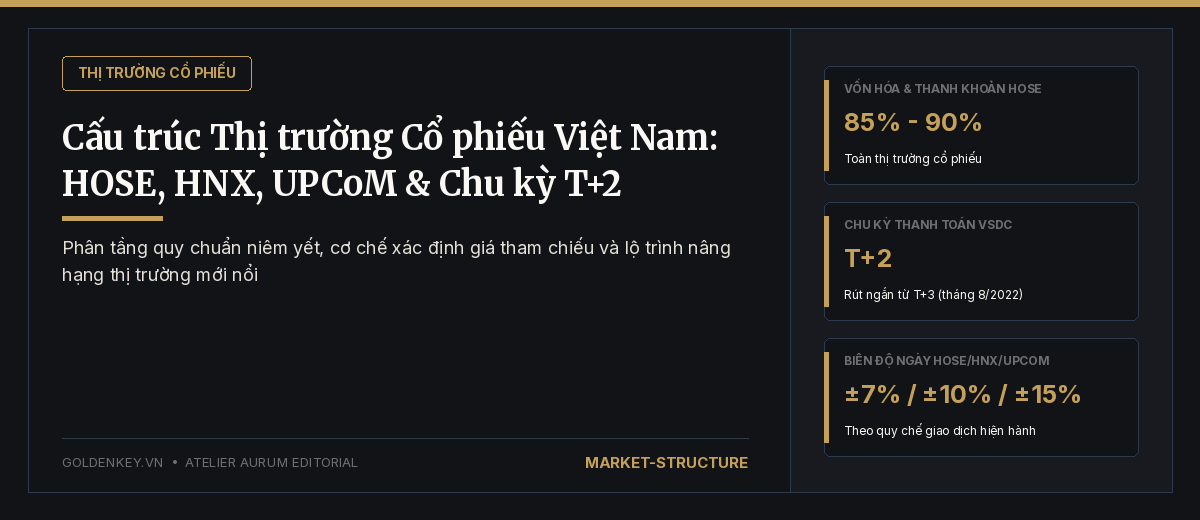
HOSE commands roughly 85%–90% of total market capitalization and matched order-book liquidity across Vietnam's listed equity universe, serving as the home of the benchmark VN-Index and VN30 indices. To list on HOSE (under Decree 155/2020/ND-CP implementing the Law on Securities), an enterprise must clear rigorous vetting: paid-in charter capital of VND 120 billion or more, two consecutive profitable fiscal years preceding listing application, most recent annual Return on Equity (ROE) of at least 5%, zero overdue payables exceeding one year, zero accumulated losses on audited financial statements, and at least 20% of voting shares held by a minimum of 300 non-major shareholders.
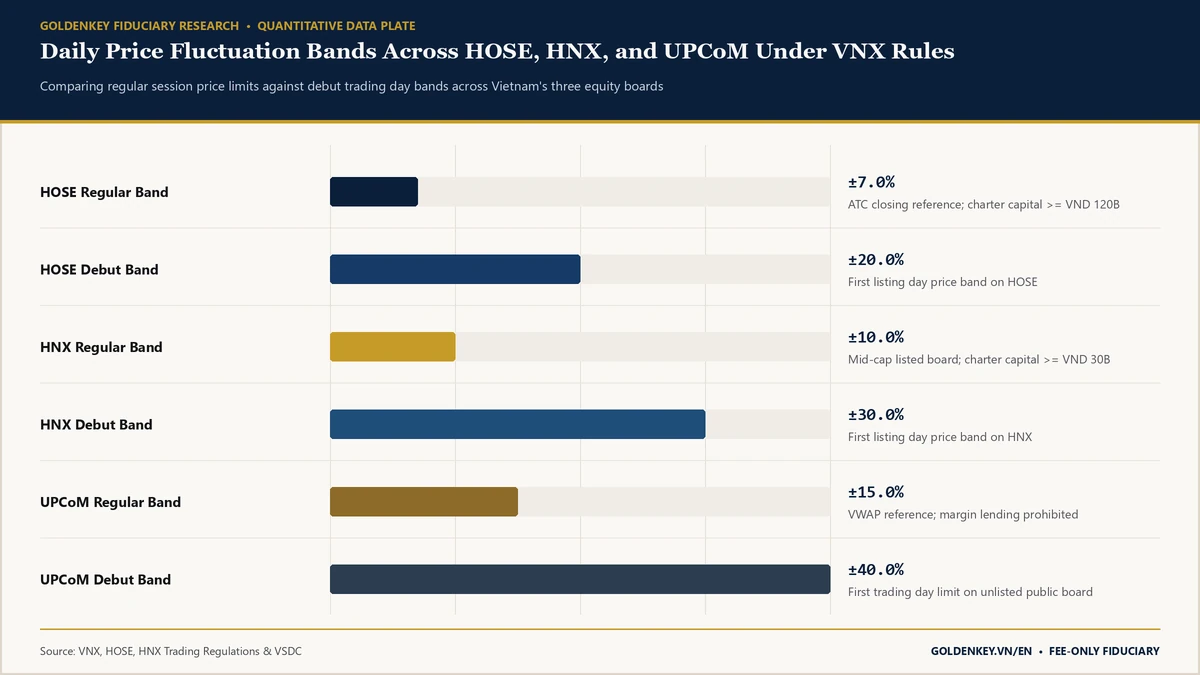
Each HOSE trading day opens with a 15-minute Periodic Opening Call Auction (ATO: 09:00 – 09:15) designed to absorb overnight information and establish an equilibrium opening price; continues through Continuous Order Matching (09:15 – 11:30 and 13:00 – 14:30); and concludes with a 15-minute Periodic Closing Call Auction (ATC: 14:30 – 14:45) governed by a tight daily fluctuation band of ±7% around the prior session's closing price (standard board lot in multiples of 100 shares).
1.2. HNX Listed Board and the UPCoM Registration System
The HNX listed board serves mid-cap and growth enterprises (paid-in charter capital of VND 30 billion or more, profitable prior fiscal year, ROE ≥ 5%), operating with a ±10% daily fluctuation band plus a Post-Close Trading Session (PLO: 14:45 – 15:00) executing strictly at the closing price. By contrast, UPCoM is not a formal "listed exchange" but a registered trading venue for unlisted public companies—encompassing both major equitized state-owned enterprises awaiting formal listing transfer and distressed companies compulsorily delisted from HOSE or HNX. Given its wide ±15% daily band and absence of ATO/ATC call auctions, individual investors transacting on UPCoM must strictly use Limit Orders (LO) after verifying order-book depth to avoid severe illiquidity slippage.
| Regulatory Criterion | HOSE (Prime Listed) | HNX (Mid-Cap Listed) | UPCoM (Registered Public) |
|---|---|---|---|
| Minimum Capital & Profitability | Capital ≥ VND 120B; 2 consecutive profitable years; ROE ≥ 5%; no accumulated losses. | Capital ≥ VND 30B; prior year profitable; ROE ≥ 5%; no accumulated losses. | Public company (capital ≥ VND 30B) or delisted issuers transferred down. |
| Regular Daily Price Band | ±7% (Debut trading day: ±20%) | ±10% (Debut trading day: ±30%) | ±15% (Debut trading day: ±40%) |
| Reference Price Determination | Closing price (ATC) of the most recent trading session. | Closing price of the most recent trading session. | Volume-Weighted Average Price (VWAP) of prior session board-lot trades. |
| Primary Order Types | ATO, LO, MP (continuous session), ATC; board lot of 100 shares. | LO, MTL/MAK/MOK, ATC, PLO (14:45–15:00); board lot of 100 shares. | Continuous matching via LO orders only (09:00–11:30 & 13:00–15:00). |
| Margin Lending Eligibility | Eligible after ≥ 6 months listed with clean audit and positive earnings. | Eligible after ≥ 6 months listed subject to SSC risk criteria. | Ineligible for Margin Lending under SSC risk-management rules. |
2. T+2 Clearing & Settlement Mechanics and Cashflow Discipline
Since August 2022, the Vietnam Securities Depository and Clearing Corporation (VSDC) shortened securities settlement completion from T+3 afternoon to prior to 12:00–13:00 noon on business day T+2 (colloquially referred to by local traders as the T+2.5 cycle). Specifically, shares purchased on Monday (Day T+0) are formally credited to the investor's depository account by midday Wednesday (Day T+2), granting full legal authority to place sell orders starting at 13:00 Wednesday afternoon.
Conversely, when shares are sold on Monday, net sale proceeds (after brokerage commission and the statutory 0.1% personal income tax on gross transfer value) settle automatically into cash balances by midday Wednesday with zero cash-advance fees. A critical practical note for individual investors: brokerages routinely offer "Automated Cash Advance on Unsettled Sales" to fund immediate purchases on T+0 or T+1, yet this facility is economically a 1-to-2-day bridge loan carrying annualized interest rates of 11%–14% per annum. Absent a compelling valuation dislocation, waiting 24–36 hours for natural T+2 settlement eliminates unnecessary frictional interest drag.

3. Structural Impact of the Emerging Market Upgrade Trajectory (FTSE Russell & MSCI)
Within the global equity classification frameworks governed by FTSE Russell and MSCI, graduating from Frontier Market status—where Vietnam has accounted for an outsized 30%–35% index weight—into the Emerging Market cohort catalyzes three structural shifts for long-horizon investors:
- Upgrading Institutional Investor Mix: Aggregate Assets Under Management (AUM) benchmarked to Emerging Market indices dwarf Frontier Market mandates by orders of magnitude. Crucially, national pension funds, Sovereign Wealth Funds, and major long-only mutual funds prohibited by charter from Frontier Markets gain formal mandate authorization upon Emerging Market inclusion.
- Sharp Dispersion by Float-Adjusted Cap, Liquidity, and Foreign Ownership Limit (FOL): Not all 1,600+ tickers across Vietnam's three boards benefit equally. FTSE Emerging Index screening rules isolate roughly 20 to 35 premier large-cap equities on HOSE that simultaneously satisfy Free-Float Market Capitalization thresholds, robust average daily trading value, and available Foreign Ownership Room.
- Elevating Corporate Governance & Minority Shareholder Protection: The Ministry of Finance's phased mandate requiring large public companies to publish periodic and extraordinary disclosures simultaneously in Vietnamese and English eliminates information asymmetry, compelling listed issuers to tighten audit discipline and related-party transaction transparency.
Practical Checklist: 5 Execution Discipline Rules Across Vietnam's Three Equity Boards
- ✓Rule 1 — Anchor Strictly on the Prime Listed Exchange (HOSE): Dedicate at least 85%–90% of family equity allocations to prime HOSE-listed enterprises with over five years of clean audited financial history.
- ✓Rule 2 — Always Use Limit Orders (LO) Outside the VN30 Basket: Avoid large market orders (MP/ATO/ATC) in mid-cap names, and exercise strict caution around UPCoM's VWAP reference-price mechanism.
- ✓Rule 3 — Understand Upgrade Mechanics Without Chasing Rumors: Never chase upgrade headlines at stretched P/E multiples; focus on sector leaders with genuine operating cashflow, available foreign room, and international governance standards at reasonable valuations.
- ✓Rule 4 — Respect the T+2 Settlement Rhythm: Refrain from high-interest unsettled-cash advances to churn portfolios weekly; maintain a dedicated independent liquidity reserve.
- ✓Rule 5 — Monitor Exchange Warning / Control Lists: Exclude from long-term portfolios any issuer placed under warning, supervision, or trading restriction by HOSE/HNX due to delayed audited filings or accumulated losses.
Published under the Equity Market practice and compiled independently by the GoldenKey Invest Research & Wealth Governance Council under our Three-Pillar Fiduciary Mandate: No Client Fund Custody — No Discretionary Order Execution — No Guaranteed Return Promises (with zero hidden brokerage or issuer distribution kickbacks). All data series, quantitative models, and regulatory frameworks cited herein are presented strictly for institutional research and objective investor due diligence; they do not constitute an offer, solicitation, or recommendation to buy, sell, or hold any specific security or corporate bond tranche.