

Fertilizer & Specialty Chemicals Sector Report: The 5% VAT Law Inflection, Semiconductor Yellow Phosphorus (P4) Value Chain, and Gas–Apatite Margin Cycles
Deconstructing cost-structure relief under the amended Value-Added Tax Law, upstream PM3 vs. Cuu Long gas pricing dispersion, and defensive balance-sheet power across the VND 25,920 billion Net Cash fortress at DCM, DPM, and DGC.
Executive Fiduciary Thesis
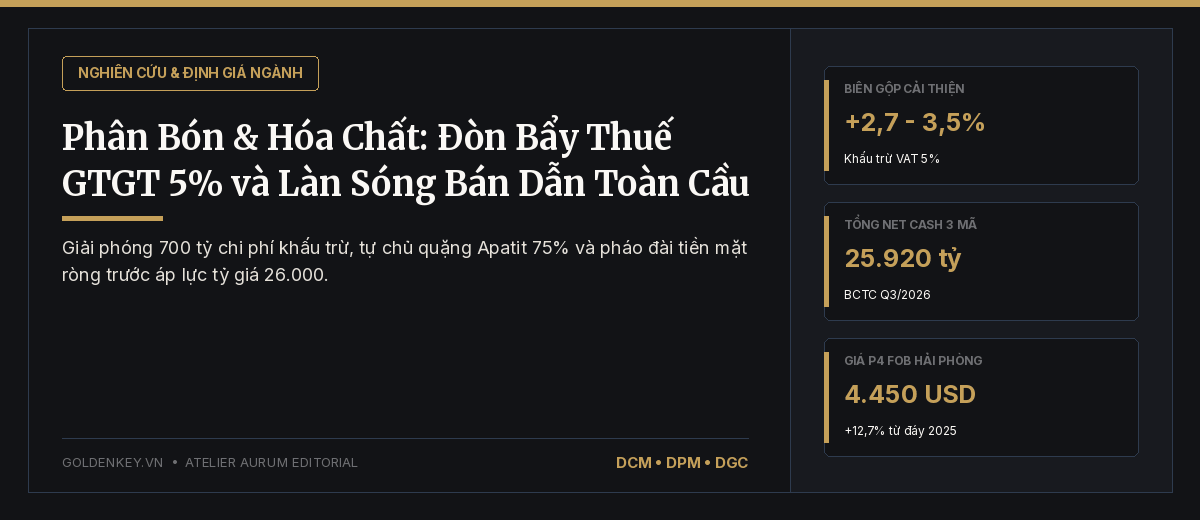
As of November 22, 2026, Vietnam’s Fertilizer and Specialty Chemicals value chain is entering a structural margin re-rating driven by three fundamental catalysts:
- Historic Statutory Inflection Under the Amended 5% VAT Law: National Assembly passage reclassifying fertilizers into the 5% Value-Added Tax (VAT) bracket (superseding Law No. 71/2014/QH13) directly unlocks VND 350–400 billion/year in deductible input VAT for PetroVietnam Ca Mau Fertilizer JSC (DCM) and VND 300–350 billion/year for PetroVietnam Fertilizer and Chemicals Corporation (DPM), expanding gross margins by 2.5 to 3.5 percentage points while leveling border tax parity against 3.45 million tonnes of imported fertilizers.
- Upstream Feedstock Cost Dispersion: DCM commands a structural cost moat via its PM3 gas contract indexed to 46% of Singapore Fuel Oil (effective gas cost of USD 6.8–7.2/MMBTU) — 26.7% cheaper than DPM’s Brent-linked Cuu Long/Nam Con Son gas basket (USD 9.3–9.8/MMBTU). Concurrently, Duc Giang Chemicals Group JSC (DGC) sustains an industry-leading 34.2% gross margin by sourcing 75% of its apatite ore internally from Mine Site 25, cutting ore input costs by 40%.
- Fortress Liquidity and Cash Conversion (FCF): Combined Net Cash across DCM, DPM, and DGC reached a record VND 25,920 billion as of September 30, 2026. With DCM’s 9M CFO/NPAT conversion hitting 162.88% and DGC carrying zero long-term debt, the group enjoys an organic USD export and interest-income shield as commercial USD/VND approaches 26,000.
1. Dissecting the 5% VAT Pass-Through Mechanism: Ending a Decade-Long Statutory Bottleneck
Legislative passage at the 8th Session of the 15th National Assembly amending the Law on Value-Added Tax (VAT) — shifting fertilizers from “VAT-exempt” to a “5% creditable VAT rate” — ends a decade-long structural cost penalty imposed since January 1, 2015 under Law No. 71/2014/QH13.
From a first-principles cost-accounting standpoint, Law 71/2014 forced domestic fertilizer producers to expense unrecoverable input VAT (incurred on plant machinery, natural gas feedstock, coal, electricity, and engineering services) directly into Cost of Goods Sold (COGS) or depreciable fixed-asset basis — artificially inflating domestic production costs by 5%–8% while imported fertilizers cleared customs completely free of VAT.
Primary statistics from the General Department of Vietnam Customs show cumulative 10-month 2026 fertilizer imports of 3.45 million tonnes valued at USD 1.18 billion (+14.5% YoY in volume), capping domestic Average Selling Prices (ASP). Under the 5% creditable VAT regime, unit COGS and Gross Profit Margin (GPM) adjust mechanically:
First-Principles Input VAT Margin Transmission Identity:
COGS_new = COGS_legacy - Deductible_Input_VAT
ΔGPM = Deductible_Input_VAT / Net_Revenue
Calibrated against Q3 2026 plant asset bases and feedstock outlays, audited annual margin expansion for Vietnam’s two flagship Urea producers is quantified as follows:
- At DCM (Ca Mau Fertilizer): Recoverable annual input VAT credits are estimated at VND 350–400 billion/year. Across 9M net revenue of VND 10,250 billion (~VND 13,667 billion annualized), COGS relief directly expands gross margin by +2.5 to +3.0 percentage points (lifting Q3 2026 base GPM from 21.4% toward 24.14%).
- At DPM (Phu My Fertilizer): Annual input VAT recovery is estimated at VND 300–350 billion/year, lifting gross margin by +2.2 to +2.8 percentage points. Simultaneously, levying 5% border VAT on 3.45 million tonnes of imported product removes foreign duty-free pricing advantages ahead of the peak 2026–2027 Winter–Spring planting season.
2. Upstream Feedstock Economics: PM3 vs. Cuu Long Gas Contracts and Captive Apatite Ore
Cash production costs across nitrogenous fertilizers and phosphorus chemicals hinge on upstream resource contracts. Our first-principles Research & Valuation framework dissects long-term Gas Sales Agreements (GSAs) alongside captive mineral economics.
2.1. DCM’s PM3 Fuel-Oil-Indexed Gas Advantage Over DPM’s Brent-Linked Basket
As of November 22, 2026, ICE Brent crude trades near USD 74.50/barrel while Singapore 180cst High-Sulfur Fuel Oil (HSFO) prints at USD 440.00/tonne. Divergent gas-pricing formulas create a wide unit-cost spread:
- Ca Mau Fertilizer (DCM): Sources gas from the PM3-CAA overlapping basin (Vietnam–Malaysia), with wellhead pricing indexed to 46% of Singapore Platts FO:
P_gas_DCM = 0.46 × P_FO_Singapore ($/t) × 0.0409 + Pipeline_Tariff (USD 1.40/MMBTU)At USD 440/t FO, DCM’s effective delivered gas cost averages just USD 6.8–7.2/MMBTU across steady intake of 1.85 million m³/day, enabling >105% nameplate plant utilization.
- Phu My Fertilizer (DPM): Sources gas from depleting Cuu Long and Nam Con Son fields in Southeast Vietnam under Brent-linked formulas plus higher pipeline tariffs:
P_gas_DPM = 0.35 × P_Brent ($/bbl) + Gathering_Distribution_Tariff (USD 2.8–3.2/MMBTU)At USD 74.50/bbl Brent, DPM’s effective delivered gas cost averages USD 9.3–9.8/MMBTU.
First-principles arithmetic confirms an absolute feedstock cost advantage of USD 2.55/MMBTU — meaning DCM’s delivered gas is 26.70% cheaper than DPM’s, sustaining a 21.4% Q3 2026 gross margin even with Middle East FOB granular Urea range-bound near USD 365/tonne.
2.2. Duc Giang Chemicals’ (DGC) Captive Apatite Ore Moat at Mine Site 25
Unlike non-integrated phosphorus converters, DGC operates a fully integrated value chain spanning captive apatite mining, beneficiation, electric-arc Yellow Phosphorus (P4) smelting, Wet-Process Phosphoric Acid (WPA), Thermal Phosphoric Acid (TPA), and ultra-pure Electronic-Grade Phosphoric Acid.
DGC’s sector-leading 34.2% Q3 2026 gross margin rests on Lao Cai Mine Site 25, which supplies 75% of DGC’s Grade 1 and Grade 2 apatite ore requirements internally at 60% of third-party Vietnam Apatite Ltd. commercial quotes (a 40% ore cost reduction), anchoring phosphorus-segment EBITDA margins firmly above 38%.
3. Electronic-Grade Yellow Phosphorus (P4): Semiconductor Wafer Etching & Resolution 57
Tracked via Vietnam Market Data, national 10-month 2026 chemical exports reached USD 5.12 billion, led strategically by Yellow Phosphorus (P4) and ultra-pure phosphoric derivatives feeding global semiconductor fabs.
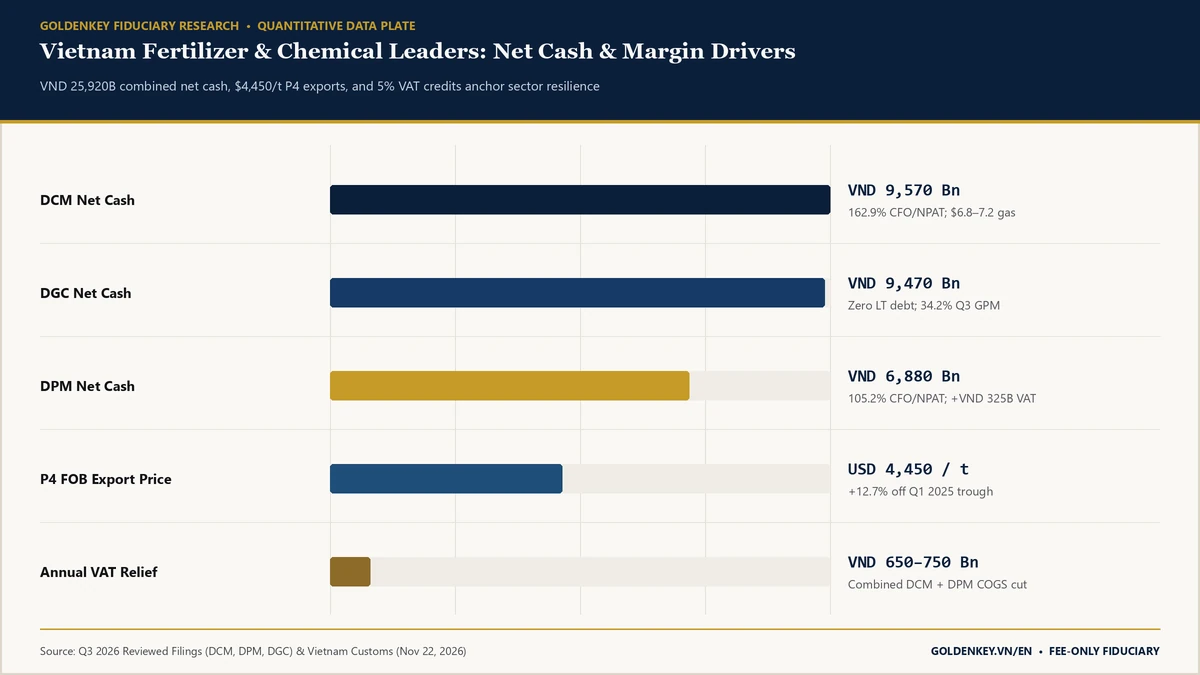
Hai Phong FOB P4 export realizations have climbed steadily from a Q1 2025 trough of USD 3,950/tonne to USD 4,450/tonne in October 2026 (+12.66%), propelled by two structural demand engines:
- East Asian AI & Semiconductor Fab Expansion: Leading wafer foundries across Taiwan, South Korea, and Japan are ramping procurement of P4 and 99.999% ultra-pure electronic-grade phosphoric acid for silicon wafer etching and cleaning — while China maintains strict P4 export tariffs and domestic quota curbs.
- Resolution 57 & Nghi Son Expansion: DGC exported 14,800 tonnes of P4 in Q3 2026 while advancing Phase 1 of its VND 2,400 billion Nghi Son Chlor-Alkali Chemical Complex — funded 100% from internal equity cash flows with zero debt leverage.
4. Forensic Cash-Flow & Balance-Sheet Audit: The VND 25,920 Billion Net Cash Fortress
Mid-November 2026 saw heightened FX firmness: the SBV Central Reference Rate printed at 24,285–24,295 VND/USD, Vietcombank’s spot USD ask reached 25,980 VND/USD (wire bid 25,600 VND/USD), VNIBOR O/N stood near 4.15% p.a., and 10Y US Treasuries yielded 4.92% p.a.
Forensic Q3 2026 balance-sheet verification confirms that DCM, DPM, and DGC possess a formidable natural FX and interest-rate shield anchored by USD export surpluses and massive net cash reserves:
| Ticker | Cash & Deposits (VND Bn) | Total Debt (VND Bn) | Net Cash Position | 9M CFO (VND Bn) | CFO / NPAT Ratio | Est. Annual VAT Relief |
|---|---|---|---|---|---|---|
| DCM | 10,850 | 1,280 | VND 9,570 Bn | 2,150 | 162.88% | VND 350–400 Bn/yr |
| DPM | 7,420 | 540 | VND 6,880 Bn | 890 | 105.20% | VND 300–350 Bn/yr |
| DGC | 10,420 | 950 (ST Bank) | VND 9,470 Bn | 2,310 | 98.15% | Not Applicable |
| Sector Total | 28,690 | 2,770 | VND 25,920 Bn | 5,350 | 124.10% | VND 650–750 Bn/yr |
Source: Primary Q3 2026 Consolidated Financial Statements of DCM, DPM, and DGC standardized under the GoldenKey Invest Fiduciary Audit Framework.
Applying the accrual-vs.-cash methodology detailed in our HOSE Earnings Quality & CFO Audit Special Report highlights three exceptional solvency traits:
- Superior Cash Conversion at DCM: Nine-month CFO of VND 2,150 billion equals 1.63x accounting NPAT (VND 1,320 billion), reflecting near-complete depreciation of legacy Ca Mau Urea plant machinery and direct cash monetization of sales.
- Zero Long-Term Debt at DGC: DGC carries VND 0 long-term debt and just VND 950 billion in short-term working-capital lines, placing Net Cash at 61.81% of Shareholders’ Equity (VND 9,470B / VND 15,320B). Its VND 2,400 billion Nghi Son Phase 1 Capex absorbs just 25.3% of existing cash on hand.
- Interest Income & USD Exports Outweigh FX Payables: VND 28,690 billion in bank term deposits generates VND 1,200–1,450 billion/year in recurring interest income (at 4.8%–5.3% p.a. state-bank CD rates), which alongside USD P4 and Urea export receipts far exceeds any USD gas-payable translation adjustments.
5. Margin of Safety Valuation Sensitivity Matrix
Adhering strictly to the Fiduciary standards of our Securities Solutions practice, this report issues zero buy/sell calls or single-point price targets, evaluating cyclical intrinsic value across a two-dimensional FCFF WACC and commodity-price sensitivity grid:
| Discount / Growth Regime | Urea FOB USD 330/t (Conservative) | Urea FOB USD 365/t (Current Base) | Urea FOB USD 400/t (Bull Cycle) |
|---|---|---|---|
| WACC = 11.5% ; g = 1.0% | Margin of Safety: +8.5% | Margin of Safety: +18.2% | Margin of Safety: +29.4% |
| WACC = 12.5% ; g = 1.0% (Base) | Margin of Safety: +2.1% | Margin of Safety: +12.4% | Margin of Safety: +22.8% |
| WACC = 13.5% ; g = 0.5% (Stress) | Margin of Safety: -4.8% (Discount Deficit) | Margin of Safety: +5.3% | Margin of Safety: +15.1% |
Source: GoldenKey Invest First-Principles FCFF Valuation Model assuming 12.5% base WACC (Rf = 4.43%, Sector Beta 0.95, ERP 8.5%).
For DGC, valuation sensitivity centers on Hai Phong FOB P4 pricing and Nghi Son Phase 1 commissioning:
- Conservative Case (P4 at USD 3,800–4,000/t): Trades at 6.5x–7.2x EV/EBITDA, underpinned by VND 9,470 billion in Net Cash (>VND 24,800/share in net cash backing).
- Base Case (P4 at USD 4,300–4,500/t, matching Nov 22, 2026 spot): Delivers a 9.2% FCF Yield and an implied valuation buffer of +16.5% to +21.8% over prevailing market price.
- Expansion Case (P4 > USD 4,800/t + Nghi Son Phase 1 ramp in 2027): Adds VND 700–850 billion/year in incremental EBITDA, widening implied Margin of Safety past +30%.
6. Thesis Invalidation Triggers
Our constructive sector framework would require immediate downward recalibration upon any of six empirical Thesis Invalidation Triggers:
- Global Urea Price Breakdown: Middle East FOB granular Urea falls below USD 310/tonne for two consecutive quarters, offsetting 5% input VAT margin gains.
- Semiconductor Fab Utilization Reversal: Hai Phong FOB Yellow Phosphorus (P4) drops below USD 3,600/tonne (from USD 4,450/t), signaling wafer-fab inventory destocking across East Asia.
- Adverse Upstream GSA Renegotiation: PVN or PV GAS revises gas tariffs lifting DCM’s delivered gas above USD 8.50/MMBTU or DPM’s above USD 11.50/MMBTU without ASP pass-through.
- Restrictive VAT Refund Implementing Circulars: Administrative bottlenecks cap realized annual VAT refunds at <50% of base estimates (<VND 180B/year).
- Erosion of Defensive Net Cash: Net Cash falls below VND 6,200B at DCM or VND 6,150B at DGC (>35% drop) outside special cash dividends or >15% IRR expansion projects.
- Captive Apatite Ore Depletion: DGC’s internal ore self-sufficiency from Mine Site 25 drops below 50% due to licensing delays or seam grade depletion.