
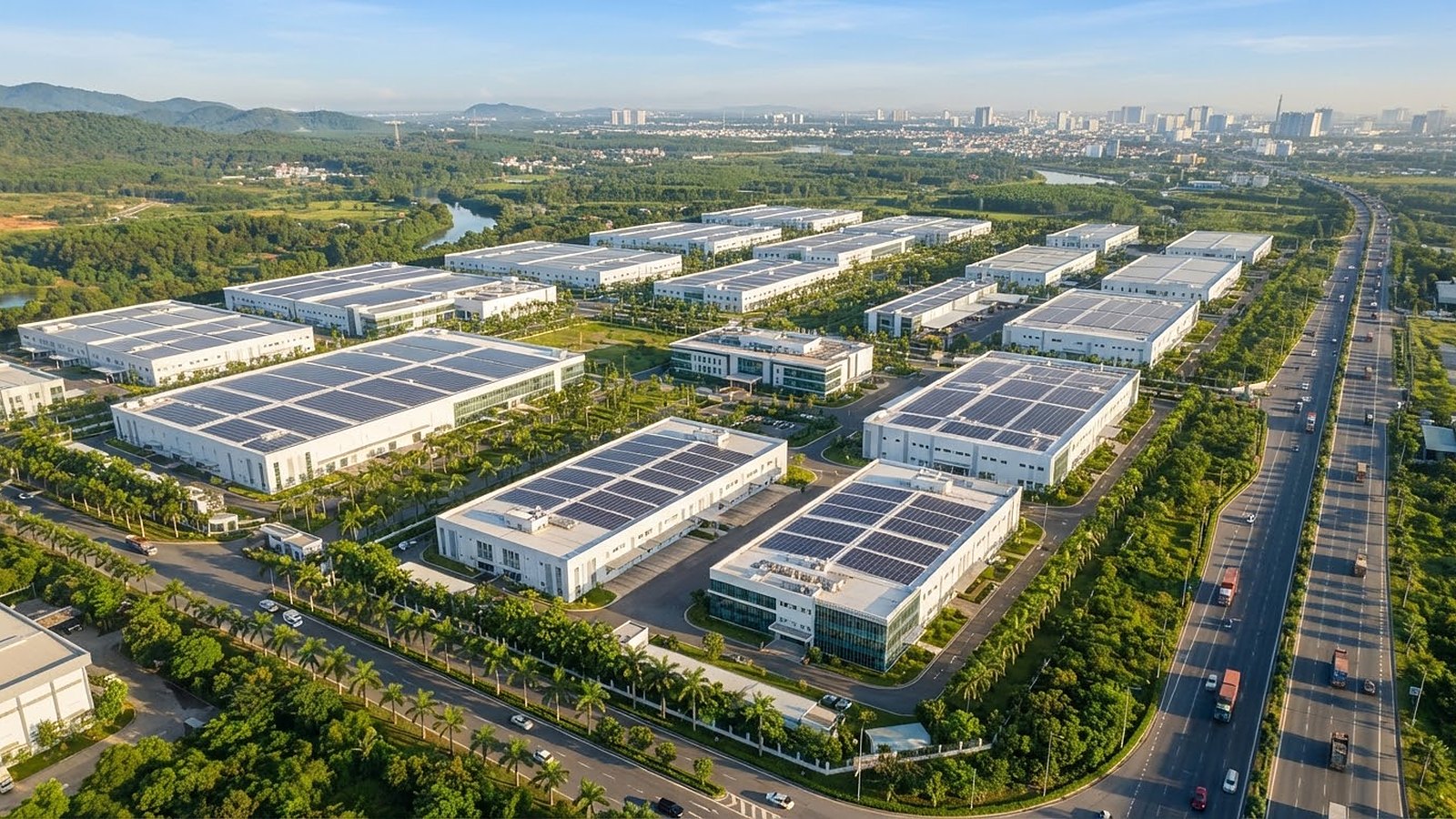
If high-tech FDI inflows and USD 820+ billion in annual trade turnover form the structural growth engine of Vietnam’s economy through 2026–2030, then Industrial Park Real Estate and Deep-Water Seaport Logistics serve as the physical “infrastructure tollbooths” capturing the most direct, durable, and cash-generative economics. Unlike residential property developers exposed to cyclical liquidity freezes, listed operators controlling cleared ready-to-lease industrial land banks and deep-water container berths capable of berthing transoceanic mother vessels command exceptional pricing power.
- High Occupancy & Resilient Industrial Land Lease Escalation: Occupancy across existing Tier-1 industrial parks reaches ~83% in Northern Vietnam and ~91% in Southern Vietnam, lifting 50-year lease rates by 6%–9% annually (to USD 135–185/sqm in the North and USD 180–260/sqm in prime Southern hubs).
- Ultra-Large Mother Vessel Era at Cai Mep–Thi Vai & Lach Huyen: Global shipping alliances deploying 160,000–240,000 DWT ultra-large container vessels on direct US East/West Coast and European mainlines drive 12%–15% annual throughput growth across Vietnam’s two deep-water port clusters, far outpacing draft-constrained river ports.
- Dual Earnings Catalyst from Higher Container Handling Tariffs: Phased upward revisions to statutory floor tariffs for international container stevedoring (under Ministry of Transport Circular 39 and subsequent deep-water adjustments) directly lift revenue by 8%–14% and expand gateway port EBITDA margins above 48%–55%.
- Sector-Leader Selection Criteria: Prioritize industrial park developers holding cleared Ready-to-Lease commercial land alongside sizable “Customer Advances / Unearned Revenue” balances, and integrated deep-water port operators such as GMD.
1. Industrial Park Real Estate: From Raw Land Leasing to Green High-Tech Ecosystems
Listed Industrial Park Real Estate developers enjoy a vastly superior cash-flow profile compared with residential developers: upon signing a Memorandum of Understanding (MOU) and definitive sublease agreement with an FDI manufacturer, the developer collects 85% to 95% of the entire 45–50 year lease contract value in hard cash within just 6 to 12 months alongside plot handover. Regardless of whether accounting revenue is booked upfront (upon risk transfer) or amortized over 50 years, physical cash sits in treasury to retire land-clearance debt and fund high cash dividends.
Entering 2026–2027, the primary bottleneck in Vietnam’s industrial park sector lies not in tenant demand (as electronics, semiconductor, medical-device, and solar manufacturers continue scouting factory sites), but in entitled, cleared land supply that has completed Prime Ministerial investment-policy approval, paddy/rubber land-use conversion, and market-aligned land-use fee assessment under the 2024 Land Law.
Rising site-clearance compensation and state land-lease fees on greenfield projects confer a formidable economic moat upon incumbent developers that accumulated hundreds or thousands of hectares of low-cost historical land banks (including rubber-plantation conversions and expansion zones across Bac Ninh, Hai Phong, Hung Yen, Ba Ria–Vung Tau, Binh Duong, and Long An). Selling leases at current market rates against legacy cost bases propels industrial land gross margins among top developers to 52%–65%.
1.1. Ready-Built Factories (RBF), Modern Logistics Warehouses, and On-Site ESG Standards
FDI suppliers serving Apple, Samsung, Foxconn, and LEGO increasingly mandate RE100 renewable-energy credentials, on-site rooftop solar, and international-grade closed-loop wastewater treatment. Industrial park operators integrating clean-water supply, internal substation power distribution, and Ready-Built Factories capture recurring utility and rental cash flows compounding at 12%–15% annually even after land plots reach full occupancy.
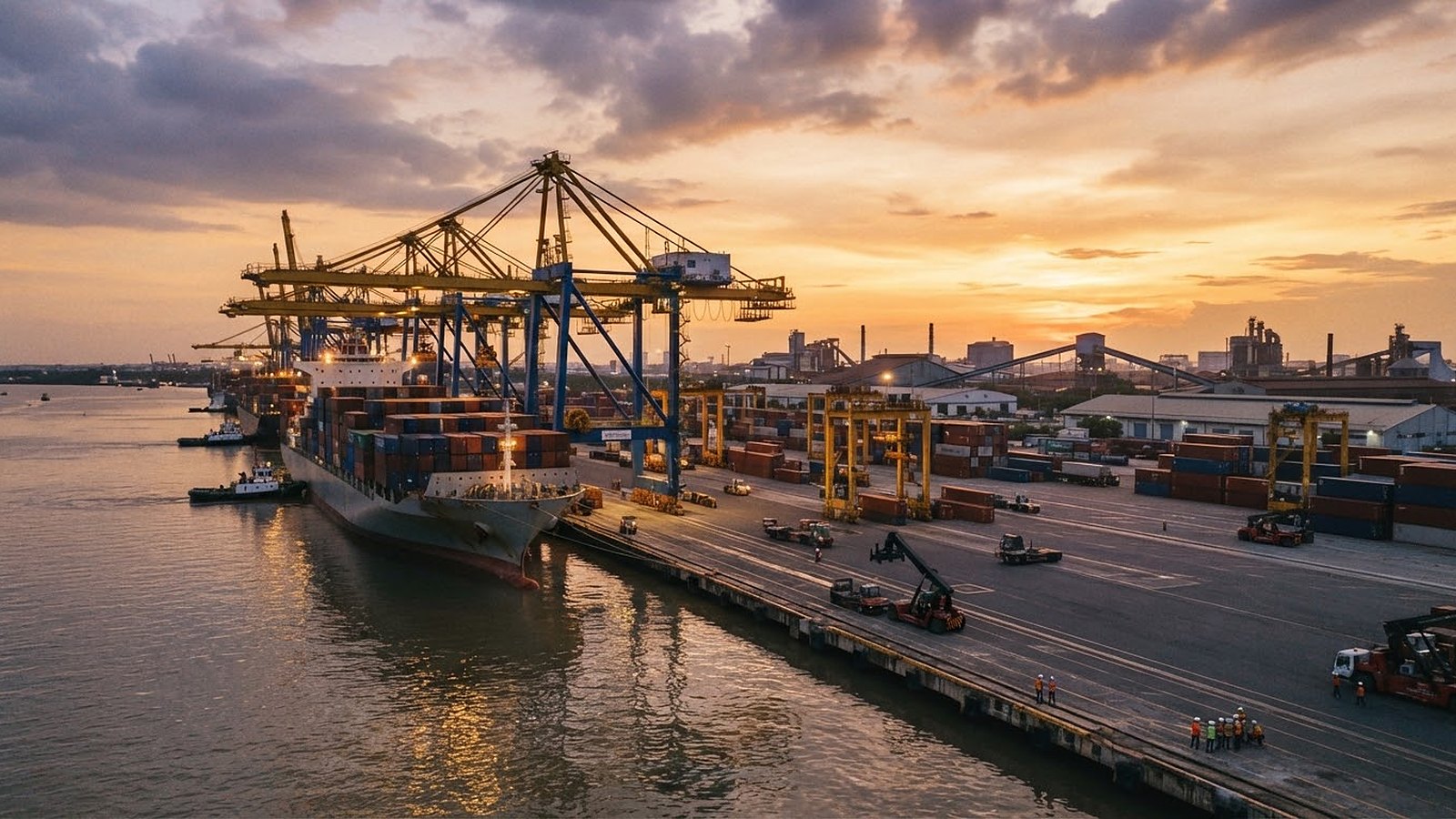
2. Cai Mep–Thi Vai & Lach Huyen Deep-Water Ports: Natural Monopoly Economics
In maritime port infrastructure, hydrographic draft is economic destiny. Inland river terminals constrained to -8.5m to -9.5m channel depth can accommodate only small intra-Asia feeder vessels (15,000–30,000 DWT), exposing operators to structural overcapacity and tariff discounting. Across Vietnam’s entire 3,260+ km coastline, only two international gateway port clusters combine natural channel depths of -14.5m to -16.5m with massive industrial hinterlands: Lach Huyen (Hai Phong) in the North and Cai Mep–Thi Vai (Ba Ria–Vung Tau / Southeast industrial corridor) in the South.
At Cai Mep–Thi Vai (home to flagship terminals such as Gemadept’s Gemalink joint venture with CMA CGM), mother vessels of 232,000–250,000 DWT (carrying over 24,000 TEU) berth directly for mainline sailings to the US West/East Coasts and Northern Europe without transshipping via Singapore or Hong Kong — trimming transit times by 5 to 7 days and saving exporters hundreds of US dollars per container. Similarly in the North, expanding deep-water berths at Lach Huyen are steadily consolidating cargo volumes from the Bac Ninh–Hai Duong–Hai Phong–Quang Ninh manufacturing belt.
Crucially, international container handling charges at Vietnamese deep-water terminals prior to 2024 stood 35%–45% below regional peers in Thailand (Laem Chabang), Malaysia, and Singapore. Regulatory floor-tariff increases flow almost directly to the bottom line per TEU handled with minimal incremental variable cost (as quay walls and Ship-to-Shore gantry cranes represent fixed costs), generating powerful operating leverage across leading port franchises.
2.1. Inland Waterway Barge Connectivity and Hinterland Infrastructure (Phuoc An Bridge, Bien Hoa–Vung Tau Expressway)
Cai Mep–Thi Vai’s final historical bottleneck — single-corridor road reliance on National Highway 51 — is being resolved decisively as the Bien Hoa–Vung Tau Expressway, Phuoc An Bridge, and inland waterway barge corridors linking directly to ICDs across Eastern Ho Chi Minh City, Binh Duong, and Dong Nai come online during 2026–2027, lifting effective cluster utilization to a new plateau.
| Supply-Chain Infrastructure Segment | Core Geographic Hubs | Occupancy / Utilization | Reference Lease / Tariff Rate | Benchmark Gross Margin | 2026–2027 Growth Catalyst |
|---|---|---|---|---|---|
| Tier-1 Industrial Parks — Northern Key Economic Zone | Bac Ninh, Hai Phong, Hung Yen, Quang Ninh | 82% – 86% | USD 135 – 185 / sqm / lease term | 50% – 62% | Electronics, semiconductor & R&D relocation |
| Tier-1 Industrial Parks — Southern Key Economic Zone | Binh Duong, Dong Nai, Ba Ria–VT, Long An | 89% – 93% | USD 180 – 260 / sqm / lease term | 54% – 66% | Rubber-land conversion & Ring Roads 3, 4 |
| Modern Ready-Built Factories & Warehouses (RBF/RBW) | Greater HCMC, Bac Ninh, Hai Phong | 84% – 88% | USD 4.8 – 5.8 / sqm / month | 58% – 68% | Recurring lease cash flow from mid-cap FDI & e-commerce |
| Cai Mep – Thi Vai Deep-Water Port Cluster | Ba Ria–Vung Tau / Southeast Region | 85% – 95% (Flagship berths) | USD 57 – 66 / 20ft–40ft TEU (new) | 44% – 52% | Gemalink Ph.2, Bien Hoa–VT Expwy & floor tariff hike |
| Lach Huyen Deep-Water Port Cluster | Dinh Vu – Cat Hai, Hai Phong | 78% – 88% (Expanding berths) | USD 54 – 63 / 20ft–40ft TEU | 42% – 49% | Direct US/EU mother vessels serving Northern IPs |
| Inland River Terminals & Hinterland ICDs | HCMC, Dong Nai, Upstream Hai Phong | 75% – 85% | USD 36 – 45 / TEU | 32% – 39% | Green inland barge feeders relieving highway congestion |
3. Investment Underwriting & Risk Governance Across Industrial Parks and Seaports
Despite compelling structural tailwinds, empirical value investors must avoid two recurring analytical pitfalls in this sector. First, when valuing Industrial Park developers, never extrapolate headline master-plan acreage advertised in corporate brochures; discount cash flows strictly from projects holding formal Investment Policy Approvals, >80% completed site clearance, and finalized state land-lease fee assessments. Balance-sheet line items “Long-Term Construction in Progress” and “Short-Term Advances from Customers” provide the truest leading indicators of earnings realization over the next four quarters.
Second, within maritime logistics, distinguish sharply between “Bulk/Container Vessel Charterers & Liner Operators” (whose earnings swing violently alongside global SCFI/BDI spot freight indices) and “Deep-Water Terminal & Hinterland ICD Owners” (such as GMD — where revenue compounds on physical container throughput multiplied by regulated handling tariffs, largely insulated from spot ocean-freight downturns).
3.1. EV/EBITDA and RNAV Valuation Benchmarks for the 2026–2028 Cycle
For flagship deep-water seaport operators, fair-value EV/EBITDA multiples sit at 9.5x–11.5x (in line with ASEAN gateway port peers delivering double-digit throughput growth). For industrial park developers, accumulating at a 20%–30% discount to Revalued Net Asset Value (RNAV) establishes an institutional Margin of Safety for long-term compounding.
Quantitative 3-Scenario Matrix & Thesis Invalidation Triggers
Realized FDI holds above USD 25–27 billion/year; deep-water berth expansions (including Gemalink’s next phase and new Lach Huyen terminals) ramp utilization rapidly via shipping-alliance volume commitments.
Billion-dollar high-tech manufacturing complexes push IP land lease escalation above 10%/year, while deep-water container tariffs converge toward ASEAN benchmarks — driving >22% annual EBITDA growth at gateway ports.
FDI tenants extend due-diligence timelines from MOU to definitive lease execution by 1–2 quarters awaiting global tariff clarity; container port throughput moderates to 5%–7% annual growth.
Warning Thresholds & Thesis Invalidation Triggers:
- Newly signed industrial park MOU pre-leasing area drops by more than 30% YoY for two consecutive quarters alongside declining customer advance balances.
- Prolonged regulatory bottlenecks in land-use fee valuation delay commercial plot handovers beyond 12 months.
- Clustered berth additions within a single port basin spark aggressive stevedoring tariff discounting among rival terminal operators.
- Independent Equity Valuation Dossier: Gemadept (GMD) — Natural-monopoly economics across Gemalink deep-water port and Nam Dinh Vu hubs.
- Corporate Bond Credit Dossier: KBC202501 — Evaluating debt-service cash flows backed by Bac Ninh and Hai Phong industrial land banks.
- GoldenKey Sector Research & Valuation Hub — Compare P/E, P/B, and RNAV discounts across listed industrial infrastructure peers.
This thematic research report has been independently prepared by the Research & Asset Allocation Division of GoldenKey Invest to provide a quantitative data framework and academic due-diligence methodology for private investors and family portfolios.
GoldenKey operates strictly under its Three-Pillar Fiduciary Mandate (No Client Fund Custody — No Discretionary Order Execution — No Guaranteed Return Promises) alongside full research independence: (1) No brokerage commissions or undisclosed distribution fees from issuers; (2) No proprietary trading that conflicts with client portfolios; and (3) No short-term speculative trading calls or unrealistic fixed-return guarantees. Every capital allocation decision must be evaluated against each investor’s distinct risk tolerance, liquidity horizon, and maximum drawdown capacity.