

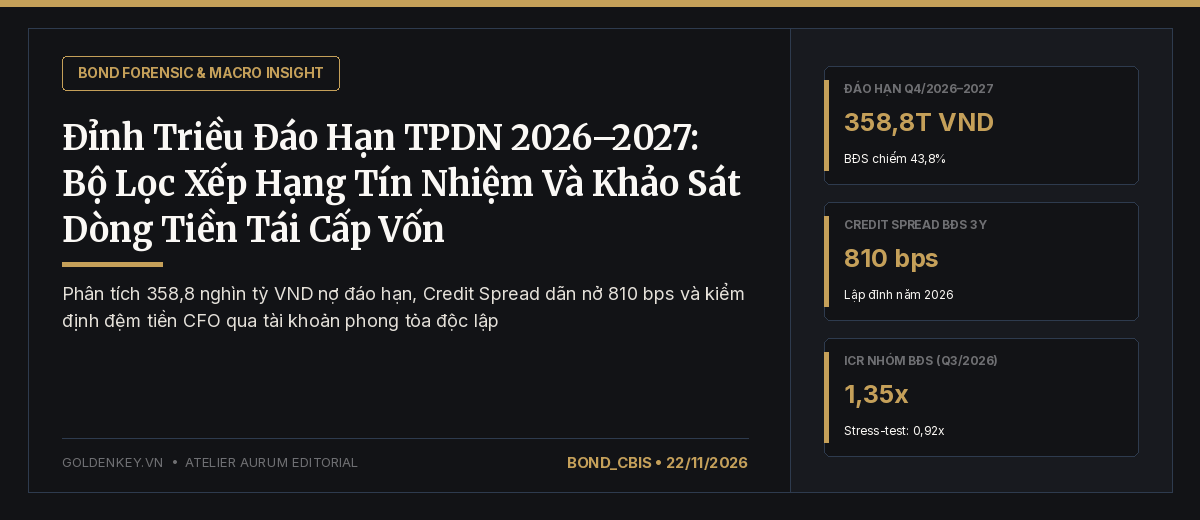
Vietnam’s fixed-income market enters a decisive juncture in late 2026 as a VND 358.8 trillion Corporate Bond maturity wall over the next 14 months (from Q4 2026 through full-year 2027) converges simultaneously with tighter monetary conditions and sweeping institutional reforms. As of 22 November 2026, the benchmark Vietnam Government Bond (VGB) yield curve on the Hanoi Stock Exchange (HNX) continued to steepen, with the 10-year tenor reaching 3.55% p.a. and the 3-year tenor at 2.75% p.a. This repricing reflects persistent external pressure as Vietcombank’s USD selling rate held near 25,980 VND/USD (approaching the upper intervention band anchored to the State Bank of Vietnam’s 24,288 VND/USD SBV Central Reference Rate), while the Overnight Interbank Rate (VNIBOR O/N) remained elevated at 4.85% p.a. and the 7-day Open Market Operations (OMO) rate stood at 4.00% p.a.
A rising risk-free funding floor has widened 3-year non-financial corporate Credit Spreads to 380–460 bps while pushing residential real estate Credit Spreads to 810 bps (implying a nominal refinancing cost of 10.85% p.a.). Crucially, as the synchronized statutory architecture comprising Law No. 23/2026/QH16 Amending and Supplementing the Law on Securities (16th National Assembly), Decree 200/2026/ND-CP, and Circular 138/2026/TT-BTC takes full effect — enforcing mandatory independent credit ratings and strict cash-flow surveillance over highly leveraged issuers — the window for technical debt rollovers across capital-intensive balance sheets has effectively closed. From an independent fiduciary underwriting perspective, navigating the 2026–2027 liquidity cycle demands rigorous verification of organic Operating Cash Flow (CFO), ring-fenced escrow account governance, and the real cash-realization quality of underlying Collateral Packages.
I. Decoding the VND 358.8 Trillion Maturity Wall: Term Structure and Cash-Flow Pressure per HNX/VBMA Data
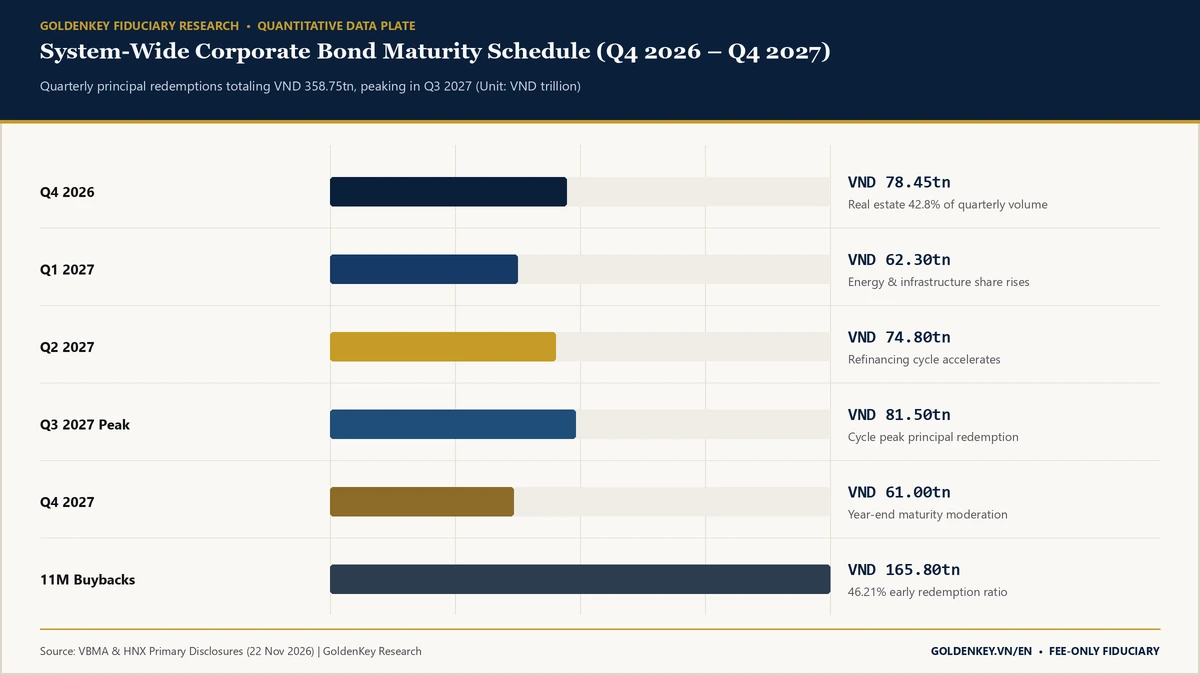
According to primary disclosures compiled by the Vietnam Bond Market Association (VBMA) and HNX as of 22 November 2026, total Corporate Bond principal scheduled to mature over the next 14 months (Q4 2026 through Q4 2027) stands at VND 358,750 billion. This redemption schedule forms a pronounced maturity wall whose liquidity pressure crests sharply in mid-2027.
Specifically, Q4 2026 accounts for VND 78,450 billion in scheduled redemptions. Entering 2027, full-year market-wide maturities reach VND 280,300 billion: Q1 2027 records VND 62,300 billion, Q2 2027 rises to VND 74,800 billion, and the cycle peaks in Q3 2027 at VND 81,500 billion before moderating to VND 61,000 billion in Q4 2027. The acute liquidity bottleneck in Q3 2027 stems from the clustering of 3-to-5-year Private Placement Corporate Bonds issued or restructured during the 2022–2024 transition window that now face hard principal settlement under the supervisory discipline of Decree 200/2026/ND-CP and Circular 138/2026/TT-BTC.
By issuer sector, credit risk remains heavily bifurcated, with Real Estate dominating at 43.8% of total maturing volume — equivalent to VND 122,770 billion in principal obligations. Commercial banks and financial institutions represent 34.2%, while energy, infrastructure, and manufacturing corporates account for the remaining 22.0%.
Dissecting the credit fundamentals across the two largest issuer cohorts reveals starkly divergent systemic risk profiles:
- Banking Sector (34.2% of maturing principal): Composed predominantly of subordinated Tier-2 capital notes or short-dated (1–3 year) funding bonds. Commercial banks enjoy direct access to the SBV’s OMO liquidity facility (4.00% p.a.) and interbank funding markets, alongside uninterrupted replacement issuance capacity supported by Basel II Capital Adequacy Ratios (CAR) under Circular 41/2016/TT-NHNN sustained above 11–12%. At Vietnam Technological and Commercial Joint Stock Bank (TCB), for instance, a robust equity base with BVPS at VND 17,601, P/B at 1.18x, and P/E at 7.7x enables fully proactive liquidity management.
- Real Estate Sector (43.8% of maturing principal): Developers’ refinancing capacity hinges on actual presales cash collection and the availability of legally unencumbered project collateral. With commercial lending rates constrained from falling further by FX pressures and elevated deposit Cost of Funds (COF), inventory absorption remains challenging.
A critical quantitative bright spot: during the first 11 months of 2026, corporate issuers proactively executed VND 165.8 trillion in early bond buybacks. Benchmarked against the 14-month maturity wall (VND 358.8 trillion), early liability retirement has absorbed an equivalent of 46.21%. This balance-sheet discipline materially lowers the probability of contagious systemic defaults compared with the 2022–2023 stress episode.
| Metric / Tenor | Value / Ratio | Composition / Benchmark Threshold | Primary Data Source |
|---|---|---|---|
| Q4 2026 Maturities | VND 78,450 bn | Real estate accounts for 42.8% of quarterly volume | HNX / VBMA (22 Nov 2026) |
| Q1 2027 Maturities | VND 62,300 bn | Rising share of energy & infrastructure issuers | HNX / VBMA (22 Nov 2026) |
| Q2 2027 Maturities | VND 74,800 bn | Entry into peak refinancing window | HNX / VBMA (22 Nov 2026) |
| Q3 2027 Maturities (Peak) | VND 81,500 bn | System-wide principal redemption peak in 2027 | HNX / VBMA (22 Nov 2026) |
| Q4 2027 Maturities | VND 61,000 bn | Year-end moderation in redemption outflows | HNX / VBMA (22 Nov 2026) |
| Cumulative 14-Month Wall | VND 358,750 bn | Real Estate: VND 122,770 bn (43.8%); Banks: 34.2% | HNX / VBMA (22 Nov 2026) |
| 11M 2026 Early Buybacks | VND 165,800 bn | Equivalent to 46.21% of 14-month principal obligations | HNX Disclosures (22 Nov 2026) |
| Benchmark 3Y VGB Yield (HNX) | 2.75% p.a. | Risk-free sovereign floor for refinancing pricing | HNX State Treasury Auctions |
| Non-Financial Bond Spread (3Y) | 380 – 460 bps | Base refinancing yield: 6.55% – 7.35% p.a. | HNX CBIS Pricing Framework |
| Real Estate Bond Spread (3Y) | 810 bps | Nominal refinancing yield: 10.85% p.a. | HNX CBIS Pricing Framework |
| Median Property ICR (Q3 2026) | 1.35x | Stress-test scenario (+250 bps): falls to 0.99x | Q3 2026 Reviewed Financials |
II. Steepening VGB Yield Curve and Widening Credit Spreads: Duration Risk and Marginal Funding Costs
To quantify marginal refinancing costs for corporate issuers facing 2026–2027 maturities, first-principles fixed-income pricing decomposes nominal refinancing yield (Yrefinance) into three building blocks:
Where Ygov(T) denotes the matched-maturity benchmark Vietnam Government Bond yield for tenor T, Credit Spread captures issuer-specific default risk conditioned on credit rating and sector dynamics, and Liquidity Premium compensates for secondary-market illiquidity on HNX.
Secondary trading and State Treasury primary auction results on HNX as of 22 November 2026 confirm a pronounced steepening yield curve across sovereign benchmarks: 1-year at 2.15% p.a.; 2-year at 2.48% p.a.; 3-year at 2.75% p.a.; 5-year at 3.12% p.a.; 7-year at 3.34% p.a.; 10-year at 3.55% p.a.; and 15-year at 3.82% p.a.
This sovereign steepening signals virtually zero near-term room for domestic monetary easing. Interbank VND–USD interest rate differentials remain under strain as U.S. Treasury yields hold elevated levels (2-year at 4.63% p.a. and 10-year at 4.92% p.a.). Commercial bank USD selling rates pinned near 25,980 VND/USD compel monetary authorities to maintain the OMO intervention floor at 4.00% p.a. to anchor domestic currency stability.
With the 3-year risk-free anchor Ygov(3Y) standing at 2.75% p.a. on 22 November 2026 (and repricing higher into the final week of November), corporate Credit Spreads have widened commensurately:
- Tier-1 Non-Financial Corporates (Manufacturing, Retail, Construction Materials): Three-year Credit Spreads trade within 380 – 460 bps (3.80% – 4.60%). Nominal refinancing yields sit at 6.55% – 7.35% p.a. — roughly 70–100 bps above 2023–2024 levels, yet still comfortably below operating ROIC. At Hoa Phat Group (HPG), for example, book value per share (BVPS) of VND 17,624, P/B of 1.16x, and P/E of 6.28x underscore ample interest-absorption capacity across large-scale industrial complexes.
- Residential Real Estate Developers: Credit risk premia have expanded to 810 bps (8.10%). Stacked atop the 2.75% 3-year VGB benchmark, nominal new-issue funding costs reach 10.85% p.a. At coupons exceeding 10.5%, net development margins erode rapidly, placing highly leveraged land-bank accumulators facing permitting delays under severe financial strain.
Institutional allocators should actively measure interest-rate sensitivity (Modified Duration) using the analytical framework in Interest Rate Risk (Duration), Reinvestment Risk, and Fixed-Income Portfolio Construction to contain mark-to-market drawdowns during yield repricing.
III. Mandatory Credit Rating Filters (Law No. 23/2026/QH16 & Decree 200/2026/ND-CP): The End of Technical Rollovers
The structural centerpiece reshaping Vietnam’s Corporate Bond market across 2026–2027 is statutory reform. Building upon the 2024–2026 capital-market overhaul, Law No. 23/2026/QH16 Amending and Supplementing the Law on Securities alongside Decree 200/2026/ND-CP and Circular 138/2026/TT-BTC establishes a binding credit-quality filter governing bond issuance and ongoing covenant surveillance.
Specifically, the statutory regime enforces a hard prerequisite: an independent credit rating issued by a Ministry of Finance-licensed rating agency is mandatory for any private placement issuer breaching either of two leverage thresholds:
▪ (Outstanding Issued Corporate Bonds ÷ Shareholders’ Equity) > 100% OR (Total Financial Liabilities ÷ Shareholders’ Equity) > 300%
This rule eliminates legacy “Ponzi-style” technical rollovers — issuing new tranches solely to retire maturing principal without underlying improvement in core Operating Cash Flow (CFO).
Under the mandatory rating filter, over-leveraged issuers confront a binary constraint:
- If rated: Elevated leverage and persistent negative CFO yield sub-investment-grade ratings (below BBB). Most institutional fiduciaries (life insurers, open-ended bond funds, bank treasuries) are barred by internal investment mandates from subscribing to sub-BBB paper.
- If unrated: Private placement registration dossiers fail statutory issuance eligibility outright.
The result is a structural flight to quality: institutional capital concentrates in A- and AA-rated issuers backed by conservative leverage and audited cash generation. Investors can apply our 6-Pillar Corporate Bond Credit Underwriting Framework to screen early distress indicators independently.
IV. Forensic Audit of Collateral Packages and Escrow Ring-Fencing
Fiduciary credit underwriting never equates “secured bonds” with “default-proof bonds.” Primary disclosures dissecting the Collateral Packages backing the VND 358.8 trillion maturing over the next 14 months reveal:
- Completed Real Estate (with clean land-use rights certificates): Accounts for 42.1% of outstanding par value.
- Listed and Unlisted Common Shares: Accounts for 31.5% of outstanding par value.
- Future-Formed Property Rights & Unsecured Tranches: Accounts for 26.4% of outstanding par value.
Crucially, 31.5% of maturing bonds are pledged with equity shares of the issuer itself or affiliated entities (wrong-way risk). During market drawdowns or issuer distress, pledged share prices drop precipitously. Under a -30% collateral valuation haircut stress test:
Stressed loan-to-value (LTVstressed) rapidly pierces covenant ceilings (typically 100%), triggering technical covenant breaches. Where issuers cannot top up collateral within cure windows, forced equity liquidation ensues, exposing bondholders to severe fire-sale slippage.
Consequently, effective bondholder protection rests on an Independent Ring-Fenced Escrow Account administered by a reputable supervisory bank.
Under this cash-waterfall architecture, bond creditworthiness requires satisfying two simultaneous technical covenants:
- Revenue Ring-Fencing: 100% of buyer installment collections from encumbered clean-title projects must route directly into the supervisory bank’s escrow account, with construction disbursements released strictly against verified physical completion milestones.
- Debt Service Priority: Escrowed balances are locked to satisfy bond principal and coupon obligations before any residual cash can be upstreamed to parent holdings or diverted via business cooperation contracts (BCCs).
The Escrow Debt Service Coverage Ratio (EDSR) is quantified as:
Whenever EDSR < 1.0x, the tranche carries material redemption-shortfall risk, warranting proactive portfolio screening via our Bond Safety Checklist.
V. Interest Coverage Ratio (ICR) Stress Test Across Listed Real Estate Issuers
An issuer’s organic debt-servicing resilience is captured by its Interest Coverage Ratio (ICR), defined as operating profit before interest and taxes (EBIT) divided by cash interest expense.
Consolidated data from Q3 2026 reviewed financial statements across residential property developers listed on HNX and HOSE indicate a sector median ICR of 1.35x — dangerously close to the 1.00x breakeven warning floor.
To test balance-sheet resilience against rising marginal refinancing costs, our stress test models a +250 bps floating-rate shock (from a 7.00% p.a. baseline to 9.50% p.a., or a +35.7% jump in interest expense) driven by higher VGB yields and wider Credit Spreads:
Under a +250 bps funding shock, the real estate sector’s median ICR slips to 0.99x, breaching the 1.00x solvency threshold where core EBIT no longer covers period interest charges.
Once ICR falls below 1.00x, leveraged issuers must execute defensive liquidity restructuring:
- Price discounts on completed inventory to accelerate cash conversion.
- Divestiture of legally clean project stakes via M&A transactions.
- Negotiated debt-to-property swaps (requiring ≥ 65% bondholder approval under Decree 200/2026/ND-CP and Circular 138/2026/TT-BTC) or maturity extensions paired with step-up coupons.
Investors can audit tranche-level credit metrics and cash-flow waterfalls across our Bond Screening & Research Hub and the quantitative HNX CBIS Bond Library.
VI. Thesis Invalidation Triggers
Anchored in primary market disclosures and macro conditions as of 22 November 2026, the conclusions of this forensic report would be partially or fully invalidated upon the materialization of any of the following empirical triggers:
- Macro Funding De-escalation: Overnight Interbank Rate (VNIBOR O/N) settles sustainably below 3.00% p.a. and Vietcombank’s USD selling rate retreats below 25,200 VND/USD, enabling the SBV to cut OMO intervention rates.
- Credit Spread Compression: Three-year non-financial Corporate Bond Credit Spreads compress below 220 bps over the HNX benchmark VGB curve (3Y at 2.75% p.a.).
- Regulatory Transition Extension: Authorities enact transitional provisions deferring mandatory independent credit ratings beyond 2028.
- Sustained CFO Rebound: Real estate developers’ Operating Cash Flow turns durably positive on end-user housing absorption, lifting median sector ICR above 2.50x for two consecutive quarters.
- Accelerated Early Redemptions: Cumulative early bond buybacks surpass 60% of the 14-month maturity wall (exceeding VND 215 trillion), neutralizing Q2–Q3 2027 peak redemption stress.
Three-Pillar Fiduciary Mandate • GoldenKey Invest
This research publication was compiled independently by GoldenKey Invest from 100% verified primary disclosures of VBMA, HNX, HOSE, and the State Bank of Vietnam (SBV) as of 22 November 2026. Adhering strictly to international fee-only fiduciary standards, GoldenKey Invest upholds our Three-Pillar Fiduciary Mandate:
- No Client Fund Custody: We never accept client deposits, hold custody of investor assets, or manage pooled discretionary capital accounts in any form.
- No Discretionary Order Execution (Zero Brokerage Kickbacks): We never execute trades on behalf of clients or accept hidden brokerage commissions, distribution fees, or issuer placement incentives.
- No Guaranteed Return Promises: Fixed-income securities carry inherent credit, duration, and liquidity risks. All quantitative models are presented as objective scenario matrices for institutional due diligence and never constitute solicitation or guaranteed return promises.