


READING TIME: 9 MIN • EMPIRICAL PUBLICATION
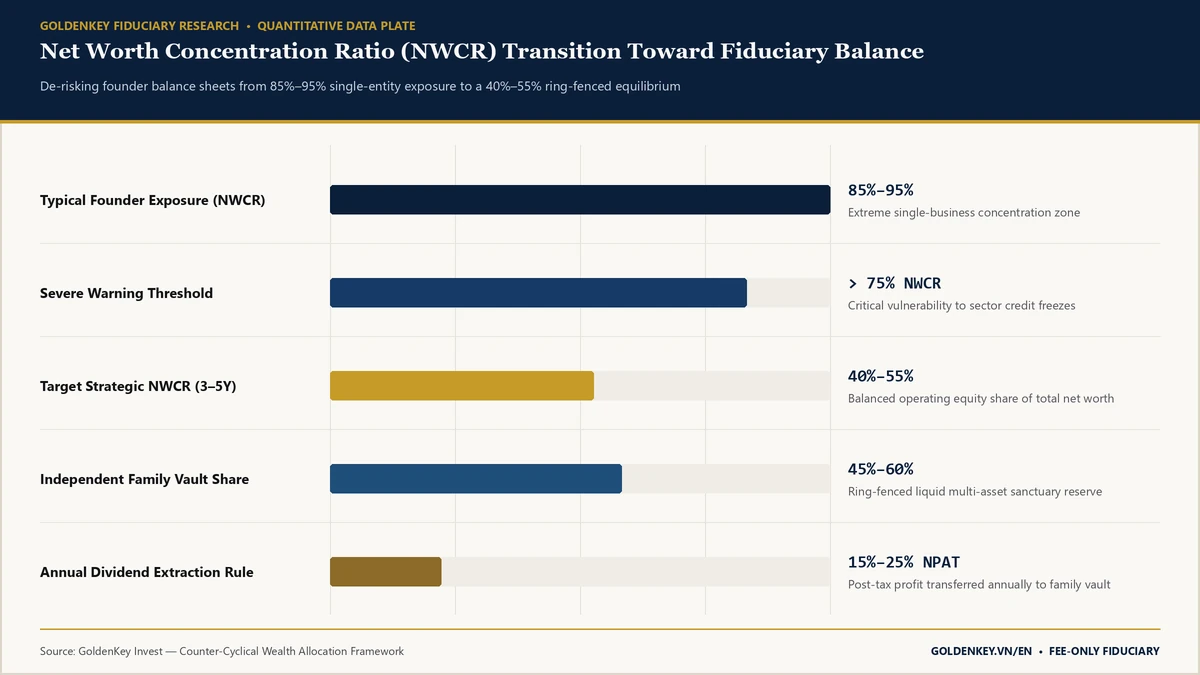
For private business founders and owner-operators in Vietnam, the enterprise they built from the ground up is the primary engine of both net worth and social standing. Viewed through the lens of quantitative risk management, however, having 85% to 95% of total household net worth alongside the family's sole income stream tied to a single operating legal entity (or a cluster of correlated real-estate projects) represents textbook Extreme Concentration Risk.
Empirical experience across Vietnamese macroeconomic cycles—from the 2011–2012 interest-rate shock and 2020–2021 pandemic supply-chain disruptions to the 2022–2023 credit crunch—demonstrates how entrepreneurs worth hundreds of billions of VND on paper can suffer personal household insolvency within 18 months of a sector freeze. The proximate cause is almost invariant: commingling household reserves with corporate working capital, while pledging the family's primary residence and personal savings certificates under cross-collateralized personal guarantees for corporate bank credit lines.
- ▪Diagnosing Founder "Double Jeopardy": During a cyclical industry downturn, corporate revenue contracts precisely as private equity valuation and pledged collateral values fall—absent an independent out-of-sector reserve, the household loses all defensive capacity.
- ▪Erecting a "Legal & Financial Firewall": Never pledge the Family Sanctuary Reserve (primary family residence, children's education trust, retirement corpus) as collateral for leveraged corporate expansion loans.
- ▪Disciplined Annual Dividend Extraction (15%–25% of Post-Tax Net Profit): During profitable expansion years, rather than blindly plowing 100% of retained earnings plus fresh debt into peak-cycle capacity, systematically extract lawful dividends to build a liquid Wealth Pyramid outside the firm.
- ▪Counter-Sector Personal Diversification: If your operating company is in Real Estate or Construction, your personal investment portfolio must hold zero real-estate equities or property bonds.
1. Anatomy of Risk Contagion When Corporate and Household Balance Sheets Commingle
During the initial startup survival phase (Years 0–5), committing all personal capital to get an enterprise off the ground is understandable. Once the business reaches scale with tens or hundreds of billions of VND in annual revenue, however, operating out of a "single shared treasury" creates three structural vulnerabilities:
- The Domino Effect of Personal Guarantees & Cross-Collateralization: Under Vietnam's Law on Enterprises, shareholders in a Limited Liability Company (LLC) or Joint-Stock Company (JSC) enjoy statutory limited liability capped at contributed charter capital. Yet the instant a founder pledges the land-use title deed of the family's primary home and signs an unconditional personal guarantee for a short-term corporate working-capital facility, that statutory "limited liability shield" is voluntarily waived in practice. Even a single major customer default can trigger bank foreclosure on the family residence.
- The Illusion of Peak-Cycle Leveraged Reinvestment: At the height of an industry boom, wide profit margins breed overconfidence: founders retain 100% of accumulated profits inside the company and double bank borrowings to build new plants and stock inventory right at the cyclical peak. When end-market demand unexpectedly contracts by 25%, five years of retained profits rapidly turn into slow-moving inventory and debt-service drag eroding equity.
- Perfect Positive Correlation in Personal Portfolios: Many construction, building-materials, or property-brokerage founders invest personal surplus cash right back into speculative land plots or listed real-estate stocks. When the property cycle turns down, both corporate cashflow and personal investments freeze simultaneously (correlation coefficient ρ ≈ +1.0).
2. The "Dual Ring-Fenced Architecture" and Annual Dividend Extraction Discipline
To resolve concentration risk without starving the core business of competitive capital, institutional Private Wealth governance establishes a Dual Ring-Fenced Architecture:
- Operating Business Circle (Controlled Commercial Risk): The company self-balances its capital structure using Operating Cash Flow (CFO), corporate plant/receivables collateral owned strictly by the corporate entity, and a dedicated corporate working-capital reserve. Every expansion project must demonstrate an Internal Rate of Return (IRR) exceeding corporate WACC on its own merits without encroaching on household survival assets.
- Family Sanctuary Vault (Inviolable Household Reserve): Funded transparently from executive compensation and annual corporate dividends/profit distributions after full settlement of Corporate Income Tax (CIT) and the 5% Personal Income Tax on capital investment. The golden rule: in every profitable fiscal year, extract 15% to 25% of post-tax net profit into the Family Circle to allocate across a liquid Wealth Pyramid (Tier-1 bank CD ladders, Physical Gold, out-of-sector A+ Corporate Bonds, and counter-cyclical Index ETFs/blue-chip equities).

3. Counter-Sector Diversification Matrix for Business Owners
A decisive portfolio-construction principle for business founders is the Core-Industry Exclusion Rule: securities and fixed-income holdings inside the Family Sanctuary Reserve must deliberately exclude the economic sector generating the founder's daily operating income:
| Founder's Primary Business Sector | Cyclical Profile & Macro Sensitivity | Assets to EXCLUDE from Personal Vault | PRIORITY Counter-Cyclical Assets |
|---|---|---|---|
| Real Estate, Construction, Building Materials, Interiors | Highly sensitive to lending rates and property credit cycles; severe illiquidity during market freezes. | Property bonds, Real Estate/Construction stocks, leveraged land speculation. | Tier-1 Bank Deposits/CDs, State-Owned/Tier-1 Bank Bonds, IT Export Equities, Essential Power–Water Utilities, Healthcare. |
| Import–Export Manufacturing, Textiles, Wood, Seafood | Exposed to US/EU consumer demand, ocean freight volatility, and USD/VND exchange rates. | Narrow export-cycle peers or issuers carrying heavy unhedged FX debt. | Physical Gold, domestic A+ Corporate Bonds, Consumer Staples ETFs & domestic Retail Banking leaders. |
| Retail Trade, F&B, Hospitality & Tourism | Swings sharply with domestic discretionary purchasing power and commercial lease costs. | Unlisted F&B franchise syndications, richly valued high-P/E retail stocks. | Quarterly-rolling CD ladders, A-rated Infrastructure/Energy Bonds, Industrial Park Real Estate & Seaport equities. |
| Software Technology, Professional Services, Healthcare | Strong cash generation and light fixed assets, but exposed to rapid technological disruption. | Unprofitable micro-cap tech speculation or high-volatility crypto tokens. | Balanced allocation: A+ Corporate Bonds, VN30/VNFIN Lead ETFs, cash-dividend core industrial producers. |
4. Stress-Test Scenario: The Tangible Value of an Asset Firewall
Consider two founders operating comparable industrial-materials distribution firms, each starting with VND 40 billion in book equity in 2026:
- Founder X (100% Concentrated): Retains all VND 40 billion inside the company and pledges the family's VND 20 billion villa to borrow an additional VND 50 billion for warehouse expansion. When end-market demand stalls for 18 months and lending rates rise to 10.5%/year, operating cashflow turns negative and credit lines tighten—exposing both the plant and the family home to distressed bank liquidation.
- Founder Y (Ring-Fenced Discipline): Over the preceding five profitable years, Mr. Y systematically extracted dividends to build an independent VND 18 billion Family Sanctuary Reserve (VND 4 billion in CD ladders, VND 8 billion in A+ bank/infrastructure bonds, VND 6 billion in ETFs & Physical Gold) legally insulated from corporate debt (maintaining prudent corporate equity of VND 25 billion with modest leverage). When the sector downturn hits, his household lifestyle and children's tuition remain completely unaffected thanks to over VND 1.2 billion in annual passive income from the Family Vault. Better still, as distressed competitors liquidate equipment and market share at fire-sale prices, Mr. Y holds the strategic optionality to extend a strictly capped shareholder loan (limited to ≤ 20% of the reserve) to consolidate market share right at the cyclical trough.
Practical Checklist: 5 Actions to Erect a Founder Family Financial Firewall
- ✓Action 1 — Strictly Segregate Bank Accounts: Immediately cease routing corporate customer receipts or vendor payments through personal spouse/founder bank accounts (eliminating tax audit risk while clarifying cashflows).
- ✓Action 2 — Release the Primary Family Residence from Corporate Liens: Make it Priority #1 over the next 12–24 months to amortize or substitute corporate collateral so the family home's title deed is removed from all business credit agreements.
- ✓Action 3 — Codify an Annual Dividend Extraction Mandate (15%–25%/yr): Institutionalize post-tax dividend transfers into the Family Sanctuary Reserve via annual board resolution prior to approving new expansion CapEx budgets.
- ✓Action 4 — Enforce the Counter-Sector Rule: Audit all personal stock and bond holdings, rotating into essential industries whose economic cycles run independent of your operating company.
- ✓Action 5 — Cap Any "Reverse Bailout" at 20%: Execute a written spousal covenant stipulating that even under the most severe corporate distress, no more than 20% of the Family Sanctuary Reserve may ever be injected back into a loss-making business.
Published under the Wealth Management practice and compiled independently by the GoldenKey Invest Research & Wealth Governance Council under our Three-Pillar Fiduciary Mandate: No Client Fund Custody — No Discretionary Order Execution — No Guaranteed Return Promises (with zero hidden brokerage or issuer distribution kickbacks). All data series, quantitative models, and regulatory frameworks cited herein are presented strictly for institutional research and objective investor due diligence; they do not constitute an offer, solicitation, or recommendation to buy, sell, or hold any specific security or corporate bond tranche.