

Quantitative Framework of SBV Monetary Policy Transmission: Decoding Base Money M0, Dual OMO–Sterilization Bill Valves, and Capital Market Transmission Lags
Deconstructing the State Bank of Vietnam’s multi-layered liquidity architecture as USD/VND tests the psychological 26,000 resistance: From the central bank balance-sheet identity and dual-corridor sterilization to the 4–8 week pass-through into sovereign bond yields and equity P/E ceilings.
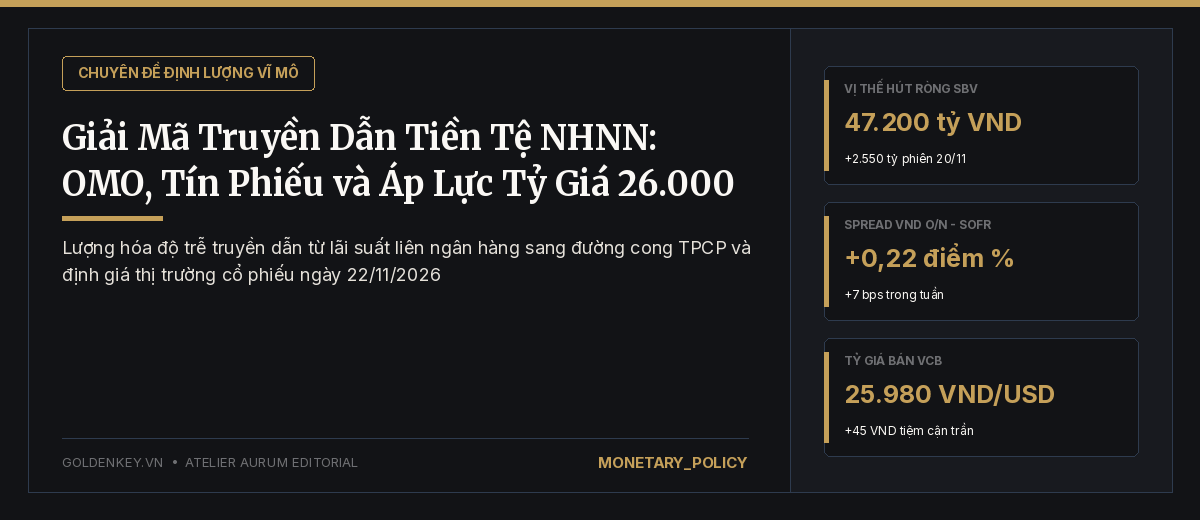
As of November 22, 2026, the monetary policy operating regime of the State Bank of Vietnam (SBV) is navigating a tightly calibrated dynamic equilibrium under direct pressure from the classic Impossible Trinity (Mundell-Fleming Trilemma). With commercial bank spot USD ask quotes (Vietcombank at 25,980 VND/USD) pressing against the psychological 26,000 VND/USD intervention threshold, monetary authorities have elected an indirect currency defense anchored by a cumulative net liquidity sterilization position of VND 47,200 billion via Open Market Operations (OMO).
By deploying parallel dual-valve operations — maintaining VND 78,450 billion in outstanding SBV Sterilization Bills alongside VND 31,250 billion in 7-day OMO Repo liquidity injections — the SBV has engineered a positive overnight interest-rate differential between VND interbank rates and the US Secured Overnight Financing Rate (SOFR) of +0.22 percentage points (+22 bps). This corridor structure neutralizes speculative USD carry-trade incentives while preserving targeted systemic liquidity under our institutional investment academy principles and the prudential framework of the 2024 Law on Credit Institutions. However, the macroeconomic trade-off of this equilibrium is an empirical 4-to-8-week Transmission Lag that is now steepening the Vietnam Government Bond (VGB) yield curve (10-year benchmark at 3.21% p.a.), lifting corporate Weighted Average Cost of Capital (WACC) and imposing a structural ceiling on equity P/E multiple expansion.
1. Central Bank Balance-Sheet Identity and the Boundaries of the “Impossible Trinity”
To interpret central bank liquidity operations rigorously rather than through narrative speculation, institutional analysts must anchor on first-principles accounting: the Central Bank Balance-Sheet Identity:
Under the Mundell-Fleming framework, an open economy whose trade-to-GDP ratio exceeds 160% like Vietnam cannot simultaneously achieve all three policy objectives: (1) Unrestricted cross-border capital mobility, (2) Exchange-rate stability, and (3) Autonomous monetary policy geared solely toward domestic credit expansion.
With the global US Dollar Index remaining firm and the 10-year US Treasury yield elevated at 4.92% p.a., the 10-year cross-border sovereign yield differential between the United States and Vietnam has widened to +1.71 percentage points (+171 bps). Were the SBV to suppress VND interbank rates aggressively to subsidize domestic credit growth, a deeply negative interest-rate spread would immediately accelerate foreign portfolio outflows while incentivizing commercial treasuries to hoard spot and forward USD (USD Carry Trade), driving USD/VND sharply through official intervention bands.
To arrest FX pressure without depleting sovereign foreign-exchange reserves (avoiding a contraction in ΔNFA toward the IMF’s 12-week import-cover adequacy floor), the SBV must tighten NDA directly. Issuing SBV Sterilization Bills compresses short-term base money ($M_0$), lifting Tier-2 interbank funding rates high enough to anchor the exchange rate — exemplifying disciplined macroeconomic risk management.
2. Dual-Corridor Sterilization Mechanics: SBV Bills Offset by Targeted OMO Repos
A recurring question across domestic trading desks asks: Why does the SBV simultaneously issue sterilization bills to drain VND while executing OMO Repo operations to inject VND into commercial banks? The answer lies in structural liquidity segmentation across Vietnam’s banking tiers, governed under the prudential standards of the 2024 Law on Credit Institutions.
As of November 22, 2026, primary disclosures from the State Bank of Vietnam and HNX record the following money-market configuration:
| Quantitative Monetary Metric | Observed Print (Nov 22, 2026) | Measurement Basis / Instrument | Primary Verifiable Source |
|---|---|---|---|
| SBV Central Reference Rate | 24,288 VND/USD | Official daily policy reference anchor | State Bank of Vietnam (SBV) |
| SBV Operations Desk USD Selling Rate | 25,450 VND/USD | Direct FX intervention backstop | SBV Operations Center |
| Commercial Bank Spot USD Ask (VCB) | 25,980 VND/USD | Systemic Tier-1 commercial bank quote | Vietcombank (VCB) |
| Overnight Interbank Rate (VNIBOR O/N) | 4.82% p.a. | Volume-weighted Tier-2 interbank average | State Bank of Vietnam (SBV) |
| US Secured Overnight Financing Rate (SOFR) | 4.60% p.a. | Risk-free overnight USD benchmark | Federal Reserve Bank of New York |
| Overnight Rate Spread (VND vs. USD) | +0.22 pct pts (+22 bps) | RVND_ON – RUSD_SOFR | GoldenKey Quantitative Synthesis |
| Outstanding SBV Sterilization Bills | VND 78,450 Billion | 14–28 day tenors; 4.15% p.a. clearing rate | SBV Open Market Operations Bulletin |
| Outstanding OMO Repo Injections | VND 31,250 Billion | 7-day tenor; 4.50% p.a. repo rate | SBV Open Market Operations Bulletin |
| Cumulative Net Liquidity Sterilization | VND 47,200 Billion | SBV Bills (78,450) – OMO Repo (31,250) | GoldenKey Quantitative Synthesis |
| 10-Year Vietnam Government Bond (10Y VGB) | 3.21% p.a. | HNX / VBMA secondary benchmark yield | HNX / VBMA |
| Sovereign Yield Curve Slope (VN 2Y–10Y) | +1.03 pct pts (+103 bps) | VN 10Y (3.21%) – VN 2Y (2.18%) | HNX Term-Structure Computation |
| Big-4 12-Month Retail Deposit Rate | 4.75% p.a. | Tier-1 retail deposit rate benchmark | State-Owned Commercial Bank Tariffs |
Primary balance-sheet data reveal sophisticated dual-valve calibration: State-owned commercial banks (the Big 4) structurally hold abundant excess VND liquidity alongside dominant foreign-exchange market share. Absorbing VND 78,450 billion via SBV Sterilization Bills at an auction rate of 4.15% p.a. drains idle VND liquidity from surplus tier-1 balance sheets, lifting the volume-weighted overnight interbank rate to 4.82% p.a.
Conversely, several mid-sized and smaller private joint-stock commercial banks face localized funding tightness as Loan-to-Deposit Ratios (LDR) hover near statutory ceilings. Unilateral liquidity drainage without a refinancing backstop could trigger secondary interbank dislocations. Injecting VND 31,250 billion through 7-day OMO Repos at 4.50% p.a. operates as a targeted prudential relief valve, supplying collateralized short-term working liquidity to ensure compliance with statutory ratios under the 2024 Law on Credit Institutions. The net synthesis is a VND 47,200 billion net sterilization stance that anchors Tier-2 interbank rates above USD SOFR without destabilizing systemic payment settlement.
3. Empirical Measurement of the 4-Stage Transmission Lag: From Tier-2 Money Markets to Equity P/E Multiples
Monetary policy adjustments do not reprice corporate earnings or equity multiples instantaneously; rather, they propagate sequentially across a 4-Stage Transmission Mechanism with quantifiable empirical lags:
Stage 1: Immediate Interbank Money Market Response (Lag: T+0 to T+3 Days)
When the SBV adjusts sterilization bill volumes or OMO repo allotments, pricing reprices within hours across the Tier-2 Interbank Market, directly altering overnight wholesale funding costs among commercial banks. Currently, the positive +22 bps overnight premium over USD SOFR effectively curtails speculative FX hoarding.
Stage 2: Sovereign Debt Market and the VGB Yield Curve (Lag: 2 to 4 Weeks)
Once overnight interbank rates remain anchored above 4.50% p.a. for more than two consecutive weeks, commercial banks — the dominant primary-market buyers of Vietnam Government Bonds — recalibrate asset-liability allocation. Elevated short-term wholesale funding costs compel bank bond desks to demand higher term yields at State Treasury auctions.
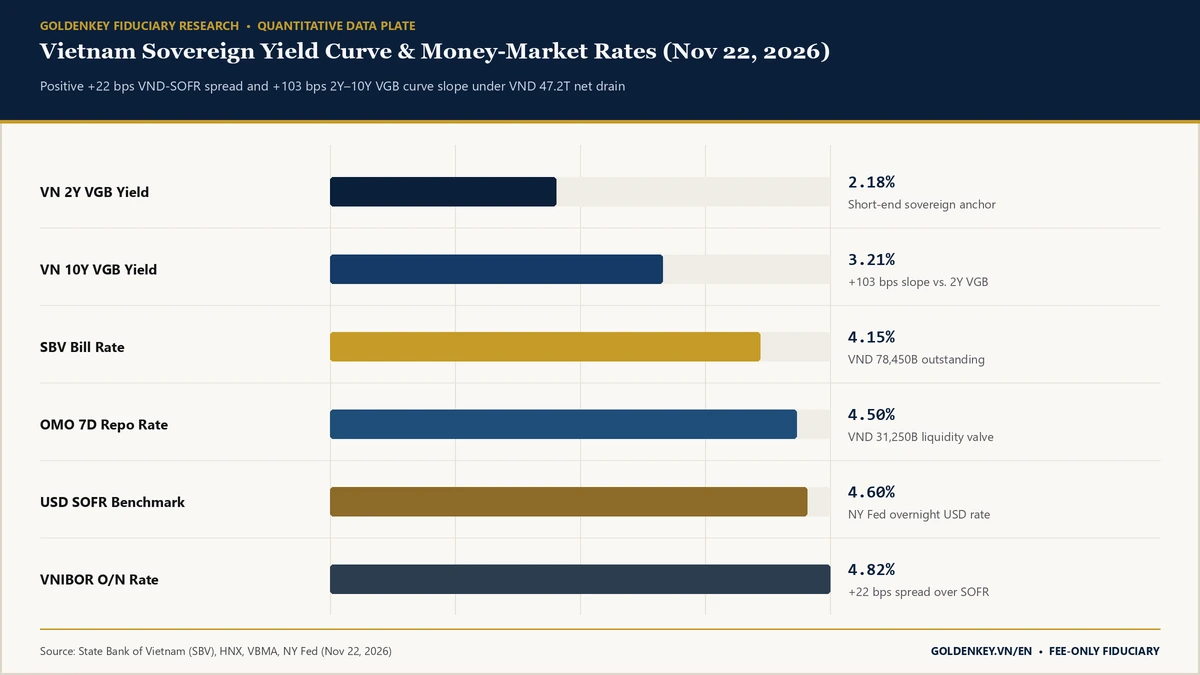
Market data as of November 22, 2026 confirm active Stage 2 transmission: the VGB curve exhibits a steep positive slope, with the spread between the 10-year yield (3.21% p.a.) and 2-year yield (2.18% p.a.) reaching +103 bps. Institutional readers can cross-reference this term-structure shift in our dedicated study on the 2Y–10Y sovereign yield curve and interbank rate dynamics.
Stage 3: Retail Deposit Markets and Commercial Credit Pricing (Lag: 4 to 6 Weeks)
Sustained wholesale funding pressure in Tier-2 markets progressively filters into Tier-1 customer deposit markets (household and corporate deposits). To defend Capital Adequacy Ratios (CAR) and regulatory LDR ceilings, joint-stock commercial banks lift rates on Certificates of Deposit (CDs) and longer-tenor retail deposits. Twelve-month deposit rates at Big-4 state-owned banks have established a firm floor at 4.75% p.a., definitively ending the ultra-low-rate cycle and signaling upward resets in floating lending rates for manufacturing and real estate borrowers at upcoming quarterly repricing dates.
Stage 4: Capital Market Valuation Multiples and Real Activity (Lag: 6 to 8 Weeks)
At the terminal stage of monetary pass-through, funding shifts reprice financial assets directly. Within Discounted Cash Flow (DCF) and Capital Asset Pricing Model (CAPM) frameworks, the domestic risk-free benchmark ($R_f$) anchored to the 10-year VGB yield has risen off cycle troughs to 3.21% p.a. Higher $R_f$ combined with rising marginal debt costs lifts listed corporates’ Weighted Average Cost of Capital (WACC) by 40–70 basis points.
On equity valuation multiples, the VN-Index (closing at 1,246.85 points on matched HOSE turnover of VND 15,420 billion) faces mechanical opportunity-cost compression. As sovereign bond yields and bank deposit rates climb, the market’s equilibrium P/E ceiling is constrained within a tight 12.5x–13.0x band. Expecting broad-based P/E multiple expansion while base money M0 remains net-sterilized by VND 47,200 billion lacks empirical foundation.
4. Fiduciary Liquidity Monitoring Matrix and Macro Invalidation Triggers
To equip institutional allocators and family offices with early-warning regime detection, GoldenKey Invest establishes the Fiduciary Liquidity Monitoring Matrix calibrated to empirical transmission lags and explicit primary Thesis Invalidation Triggers:
| Monitoring Channel | Primary Leading Indicator | Empirical Reading (Nov 22, 2026) | Thesis Invalidation Trigger |
|---|---|---|---|
| FX & Reserves Channel | VCB Spot USD Ask Rate | 25,980 VND/USD (Near intervention band) | Sustained breach above 26,050 VND/USD for >3 consecutive sessions, forcing outright SBV FX sales > USD 2 billion. |
| Rate Differential Channel | VNIBOR O/N Spread vs. USD SOFR | +0.22 pct pts (+22 bps) | Reversal into a persistent negative spread below -0.50 pct pts, accelerating foreign portfolio outflows. |
| OMO Sterilization Channel | Cumulative Net SBV Drain / Injection | Net Drain of VND 47,200 Billion | Pivot to net liquidity injection exceeding VND 30,000 billion before FX cools, pushing O/N below 3.00% p.a. |
| Long-Term Cost of Capital | Secondary 10Y VGB Yield (HNX) | 3.21% p.a. (2Y–10Y Slope: +103 bps) | Breakout in 10Y VGB yield above 3.80% p.a., triggering broad-based equity P/E multiple compression. |
To monitor these primary series systematically, investors can utilize the analytical templates in our Tools & Guides hub to track open-market liquidity directly from official SBV and HNX disclosures.
INSTITUTIONAL MACROECONOMIC AUDIT ASSESSMENT
Applying quantitative verification standards under the MACRO_MARKET audit profile (which structurally excludes corporate earnings-manipulation metrics such as Beneish M-Score and manufacturing gross margins as non-applicable to central bank balance sheets), our verification engine confirms:
- Fiduciary Verification Status: INDEPENDENTLY VERIFIED FROM PRIMARY SOURCES. Zero liquidity reporting distortion detected across official monetary disclosures.
- Portfolio Positioning Risk: Monetary transmission is entering Week 4 of intermittent OMO tightening. Rate-sensitive assets (equities trading at P/E > 20x and highly leveraged balance sheets) face intensifying discount-rate pressure over the coming 2–4 weeks.
- Governance Posture: Maintain prudent cash reserves, prioritize financial institutions with superior Current Account Savings Account Ratios (CASA) capable of defending Net Interest Margins (NIM), and await confirmed inflection in the SBV’s net OMO sterilization stance.