

READING TIME: 10 MIN • EMPIRICAL PUBLICATION
The ultimate objective of disciplined capital accumulation is Sustainable Financial Independence—the threshold at which a household's net investable estate generates sufficient recurring cashflow to fund lifetime living standards for the current generation while preserving 100% of inflation-adjusted real principal for orderly generational succession. Yet the transition from the Accumulation Phase to the Decumulation & Succession Phase harbors subtle mathematical hazards: a single structural miscalculation during the first five years of retirement can deplete family wealth a full decade ahead of schedule.
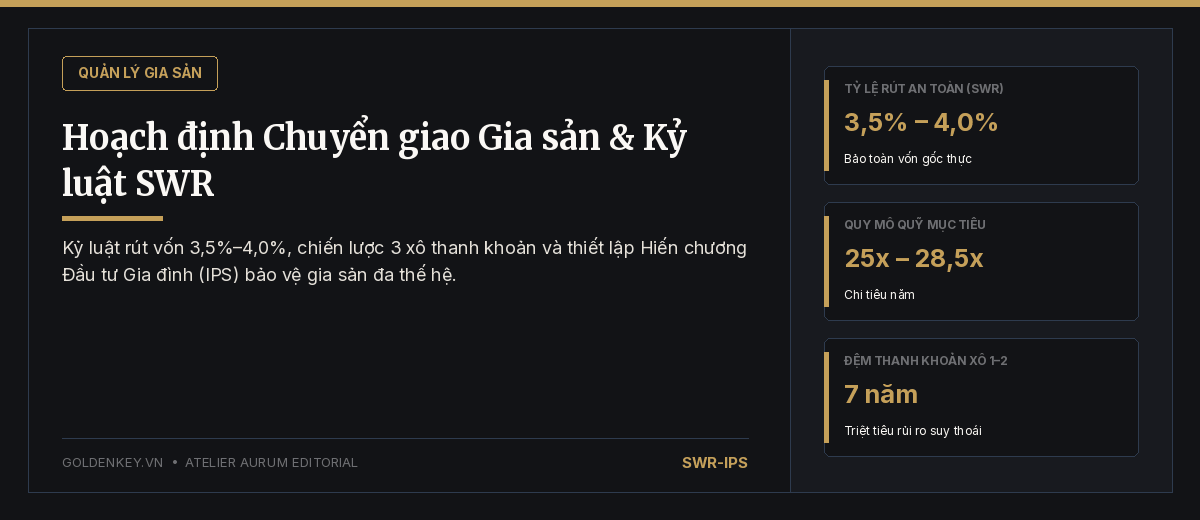
To ensure capital endures across 30–50 years independent of market luck or emotional impulse, premier institutional wealth managers anchor governance on two technical pillars: Safe Withdrawal Rate Discipline (SWR of 3.5%–4.0%) and a formal Family Investment Policy Statement (IPS).
- ▪The 3.5% – 4.0% Annual SWR Rule in Vietnam: Even when a multi-asset portfolio earns 8.0%–9.0% nominal annual returns, annual spending withdrawals should not exceed 3.5%–4.0% of portfolio NAV so that retained returns offset CPI inflation (3.8%–5.0%) and preserve real principal indefinitely.
- ▪Neutralizing Sequence-of-Returns Risk: Liquidating equities to fund living expenses during a two-year market downturn early in retirement inflicts irreversible NAV damage; the institutional solution isolates a dedicated "24–36 Month Liquidity Buffer" across Tiers 1–3.
- ▪The Family IPS Serves as a Constitutional Safeguard: Codifies target real return, maximum permissible drawdown, a prohibited Negative List, and capital-deployment approval protocols for NextGen stewards.
- ▪Compliance with Vietnamese Inheritance & PIT Law: Formalizes notarized wills and transparently navigates personal income tax rules governing registered asset transfers among direct family members.
1. Decoding the Mathematics of the Safe Withdrawal Rate (SWR 3.5% to 4.0%)
A widespread misconception among Vietnamese households runs as follows: "If I hold VND 20 billion in term deposits or corporate bonds yielding 7.5% net per annum (VND 1.5 billion in annual interest), I can spend all VND 1.5 billion every year without ever touching my VND 20 billion principal!" Nominally, that arithmetic appears intact; in terms of real purchasing power, however, consuming 100% of nominal interest amidst 4.5%–5.5% annual household basket inflation erodes more than half of the VND 20 billion principal's real purchasing power within 15 years—leaving annual interest insufficient to sustain the family's baseline standard of living.
Grounded in empirical capital-market history (William Bengen's Trinity Study) and rigorously recalibrated for Vietnam's inflation dynamics and real asset-class yields, the Institutional Safe Withdrawal Rate (SWR) for a balanced multi-asset portfolio (Term Deposits, Physical Gold, A+ Corporate Bonds, and Index ETFs/Value Equities) resides between 3.5% and 4.0% per annum:
The "3-Bucket Liquidity Strategy" Eliminating Sequence-of-Returns Risk
The deadliest threat during portfolio decumulation is Sequence-of-Returns Risk: even if a portfolio compounds at an 8.5% 20-year average return, suffering a −30% equity bear market during the first two years of retirement while being forced to sell depressed shares for living expenses permanently destroys share count—crippling the portfolio's capacity to recover when markets rebound.
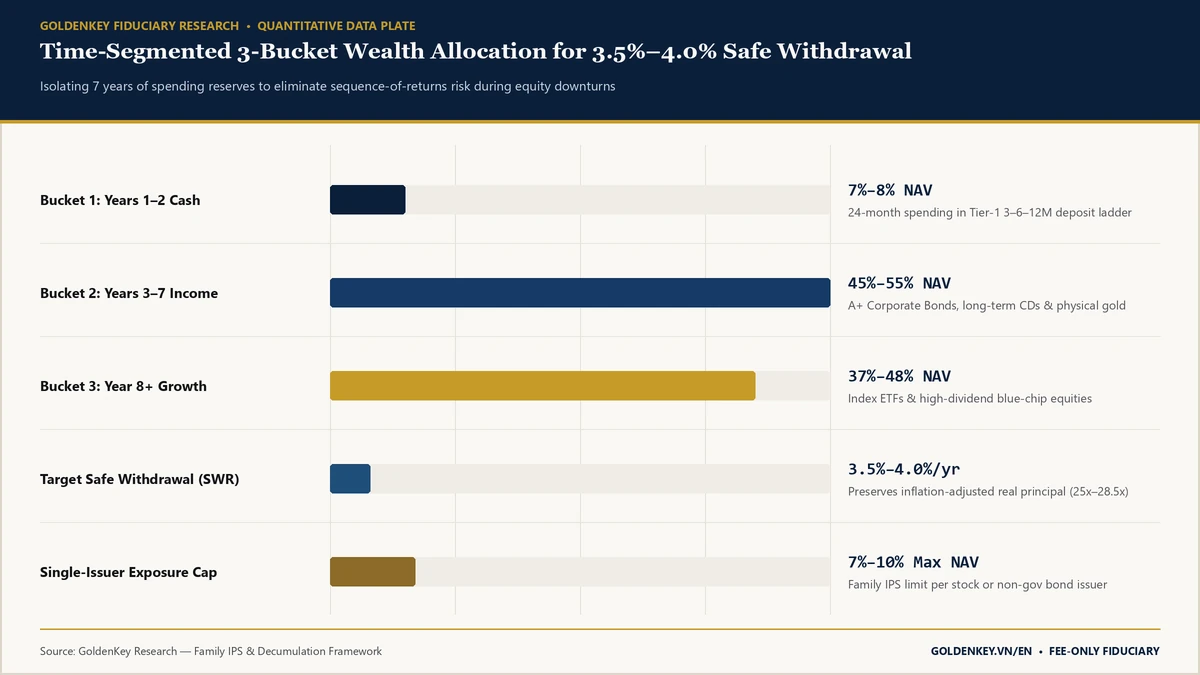
The Fiduciary engineering solution segments the Family Wealth Corpus into Three Time-Segmented Buckets:
- Bucket 1 — Immediate Spending Years 1 & 2 (7% – 8% of Corpus, equal to 24 months of expenses): Held 100% in a 3–6–12 month Term Deposit Ladder at Tier-1 commercial banks. Every monthly household withdrawal comes exclusively from Bucket 1.
- Bucket 2 — Medium-Term Income Buffer Years 3 to 7 (45% – 55% of Corpus): Allocated across A+ Corporate Bonds, long-dated Certificates of Deposit, and Physical Gold. Periodic coupon cashflows from Bucket 2 automatically replenish Bucket 1 every quarter.
- Bucket 3 — Long-Term Inflation-Hedging Growth Year 8+ (37% – 48% of Corpus): Invested in domestic Index ETFs and high-cash-dividend sector leaders. Only during favorable equity bull years are surplus gains harvested from Bucket 3 to refill Buckets 1 and 2; conversely, throughout a 2-to-3-year equity bear market, not a single share in Bucket 3 is ever sold because seven full years of liquidity are already ring-fenced in Buckets 1 and 2.

2. Institutional Architecture of a Family Investment Policy Statement (Family IPS)
In institutional asset management, no pension fund or university endowment deploys a single unit of currency without a written Investment Policy Statement (IPS) ratified by its Investment Committee. For private Vietnamese households, a Family IPS functions as a "financial constitution" preventing emotional decision-making and guiding NextGen stewards along disciplined rails:
| IPS Governance Clause | Explicit Quantitative Mandate | Multi-Generational Protection Objective |
|---|---|---|
| 1. Mission & Real Return Target | Target net after-tax return exceeding CPI by +2.5% to +3.5%/yr; annual spending cap SWR ≤ 4.0%/yr. | Curbs yield-chasing greed for 25%–30% speculative returns that risk permanent principal loss. |
| 2. Strategic Weights & Corridor | Specifies target weights (e.g., 15% Deposits • 10% Gold • 40% A+ Bonds • 35% ETF/Equities) with ±5% rebalancing bands. | Enforces mechanical buy-low/sell-high discipline and prevents asset-class drift beyond risk limits. |
| 3. Single-Issuer Concentration Limit | No single equity ticker or non-sovereign corporate bond issuer may exceed 7% – 10% of total NAV. | Ensures 90%+ of family net worth remains intact even if an individual issuer suffers force majeure distress. |
| 4. Prohibited Negative List | Strictly prohibited: structural margin debt, unlicensed Forex/Crypto platforms, unaudited bonds or ICR < 2x, informal usury lending. | Eliminates 95% of the most common causes of catastrophic household wealth destruction. |
| 5. Approval Rules & NextGen Venture Cap | Any new commitment exceeding 5% of NAV requires a written due-diligence memo and a mandatory 7-day Cooling-Off Period. | Prevents impulsive wire transfers under artificial "last-chance today" sales pressure. |
| 6. Audit Calendar & Custody Continuity | Semi-annual family governance review; physical custody ledger, insurance policies, and notarized will stored in a secure vault. | Guarantees legal continuity and seamless administrative handover in any emergency. |
3. Legal & Tax Considerations for Inheritance and Gift Transfers in Vietnam
Vietnamese statutory law (under the 2015 Civil Code and the Law on Personal Income Tax) provides distinct structural features that families must navigate transparently when planning succession:
- Tax Treatment of Direct-Lineage Inheritance & Gifts: Vietnamese tax law exempts Personal Income Tax (PIT) on income from inherited or gifted real estate transferred between spouses; biological or legally adopted parents and children; paternal/maternal grandparents and grandchildren; and biological siblings. However, for other assets subject to ownership registration—specifically listed securities (equities, bonds, fund certificates) and capital contributions in LLCs or joint-stock companies—inheritance or gift transfers exceeding VND 10 million per occurrence require careful review of statutory PIT filing obligations (currently a 10% rate on the portion exceeding VND 10 million for securities and corporate capital stakes) so households can prepare cash liquidity for tax settlement and execute title transfers cleanly at VSDC.
- Standardizing Notarized Wills & Marital vs. Separate Property Records: To prevent prolonged freezes of securities depository accounts or multi-year probate disputes that paralyze family enterprises, executing a legally notarized will accompanied by an itemized schedule of bank accounts, securities depository codes, and a designated estate administrator represents responsible modern stewardship.
Practical Checklist: 5 Steps to Launch a Sustainable Decumulation & Succession Plan
- ✓Step 1 — Compute Your 3.5%–4.0% SWR Independence Number: Multiply target annual household living expenses by 25x to 28.5x to establish the exact capital milestone required before living off portfolio cashflows.
- ✓Step 2 — Ring-Fence the 3-Bucket Liquidity Structure: Carve out 24 months of spending into a Tier-1 bank deposit ladder (Bucket 1) prior to retirement onset to immunize household living standards from short-term VN-Index volatility.
- ✓Step 3 — Draft Page One of Your Family IPS: Codify 4-tier target weights, a ≤ 10% single-issuer cap, and a prohibited Negative List co-signed by both spouses.
- ✓Step 4 — Assemble an "In-Case-of-Emergency" Family Dossier: Consolidate bank names, brokerage depository numbers, insurance policy schedules, and legal/fiduciary advisor contacts in a secure vault accessible to your spouse.
- ✓Step 5 — Train Adult Children Through Live Stewardship: Rather than funding passive consumption, entrust NextGen heirs with a ring-fenced training portfolio (index ETFs and investment-grade bonds) to practice financial-statement review and annual rebalancing discipline together.
Published under the Wealth Management practice and compiled independently by the GoldenKey Invest Research & Wealth Governance Council under our Three-Pillar Fiduciary Mandate: No Client Fund Custody — No Discretionary Order Execution — No Guaranteed Return Promises (with zero hidden brokerage or issuer distribution kickbacks). All data series, quantitative models, and regulatory frameworks cited herein are presented strictly for institutional research and objective investor due diligence; they do not constitute an offer, solicitation, or recommendation to buy, sell, or hold any specific security or corporate bond tranche.