

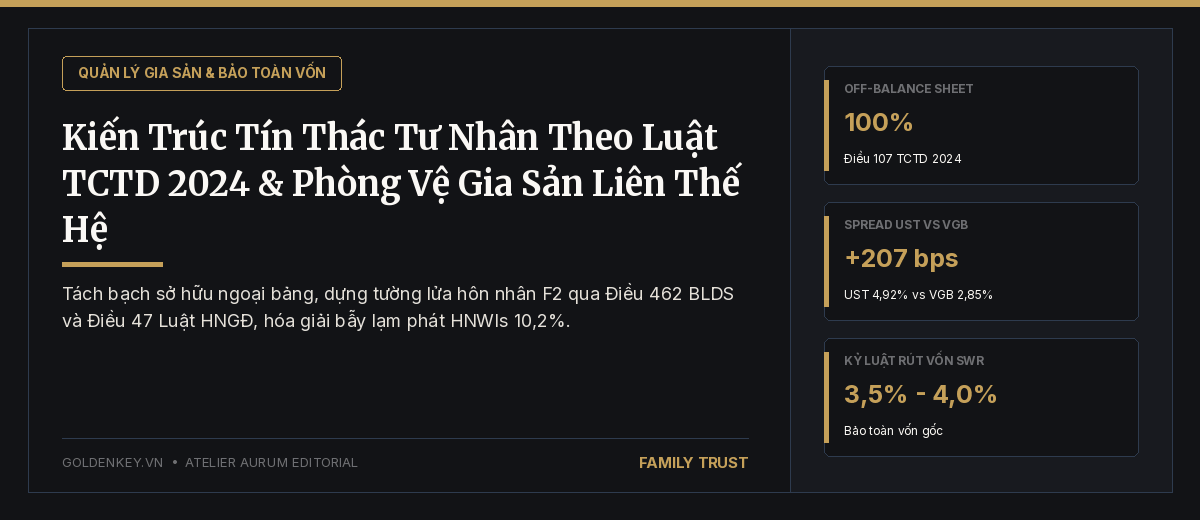
Vietnam’s private sector is entering the largest intergenerational wealth transfer in three decades of post-Doi Moi capital accumulation: first-generation founders (F1) who built institutionalized industrial and financial enterprises are transitioning both corporate control and investment capital to second- and third-generation successors (F2/F3). Yet the vast majority of Ultra-High-Net-Worth families (UHNWIs) in Vietnam still hold dynastic assets through fragmented personal title, relying on conventional wills or informal family understandings. This structural informality exposes family balance sheets to three systemic vulnerabilities: cross-default liability spillover from operating companies (Corporate Contagion), fragmentation of voting control upon next-generation divorce (Marital Contagion), and silent erosion of real purchasing power when domestic risk-free yields fail to offset affluent lifestyle inflation.
The enactment and implementation of Law on Credit Institutions No. 32/2024/QH15 — specifically Article 107(3) and Article 114 — marks a watershed institutional milestone: for the first time in Vietnamese statutory history, asset management, mandate administration, and fiduciary trusteeship conducted by licensed commercial banks operate under an explicit off-balance-sheet statutory ring-fence. This special report examines the legal and financial architecture of onshore Private Family Trusts and Fiduciary Wealth Mandates in Vietnam; dissects three-layer legal firewalls insulating operating-company voting control from F2 marital dissolution; and quantifies Safe Withdrawal Rate (SWR) discipline to preserve positive real principal amid a wide US–Vietnam sovereign yield spread and USD/VND testing 26,000.
1. Institutional Architecture of Onshore Private Trusts: Off-Balance-Sheet Ring-Fencing Under the 2024 Law on Credit Institutions
Within Vietnam’s Civil Law tradition, the Anglo-American Common Law concept of a “Trust” — which bifurcates property rights into Legal Ownership held by the trustee and Beneficial Ownership enjoyed by designated beneficiaries — historically confronted a statutory vacuum. Because Article 158 of the 2015 Civil Code defines ownership as a unitary bundle of possession, use, and disposition rights, earlier asset-management mandates were frequently re-characterized as revocable agency agreements or brokerage contracts, exposing entrusted assets to commingling with the asset manager’s own insolvency estate during commercial disputes.
The entry into force of the 2024 Law on Credit Institutions resolves this structural bottleneck. Pursuant to Article 107(3) and Article 114:
- Absolute Off-Balance-Sheet Isolation: All assets held under fiduciary trust or wealth-management mandates (comprising corporate equity stakes, Certificates of Deposit, bond portfolios, and income-producing real estate) administered by a licensed commercial bank or its asset-management subsidiary must be accounted for strictly off-balance-sheet and segregated from the Trustee’s own assets. Entrusted assets do not constitute assets of the credit institution and are legally immune from distribution upon the credit institution’s restructuring, dissolution, or bankruptcy.
- Statutory Demarcation Between Legal Title and Beneficial Interest: The licensed bank Trustee holds nominal legal title solely to execute governance, capital allocation, and settlement instructions codified in the Trust Deed. All economic cash flows — dividends, coupon income, and terminal liquidation proceeds — accrue exclusively to the Beneficiaries designated by the Settlor. Creditors of the Trustee possess zero legal standing to freeze, attach, or distrain trust corpus.
From a forensic legal risk management perspective, however, an onshore Family Trust achieves bulletproof enforceability only when stress-tested against two mandatory provisions of the 2015 Civil Code that can otherwise trigger judicial invalidation:
First, Sham Transactions Evading Pre-Existing Creditor Obligations (Article 124 of the 2015 Civil Code): If a founder transfers assets into a trust while either the individual or core operating business is subject to a pending bankruptcy petition, an enforceable court judgment, or delinquent third-party debt obligations, courts hold full authority to void the gift or transfer deed as a fraudulent conveyance. Consequently, the cardinal Fiduciary rule requires establishing the Family Trust strictly while the Settlor’s personal and corporate balance sheets are clean, unencumbered by latent litigation, and backed by an independent solvency audit.
Second, Forced Heirship / Mandatory Statutory Inheritance Shares (Article 644 of the 2015 Civil Code): Vietnamese law mandates that surviving parents, spouses, minor children, and incapacitated adult children of a decedent remain entitled to at least two-thirds (66.67%) of a statutory intestate share regardless of testamentary dispositions or post-mortem transfer clauses. If a trust structure attempts to distribute estate assets post-mortem while reducing protected Article 644 heirs below the 66.67% floor, courts will compel clawback adjustments. Institutional trust drafting therefore incorporates an explicit Mandatory Statutory Reserve within the Trust Deed’s distribution waterfall.
2. F2 Marital Contagion Firewalls and Bifurcation of Corporate Voting Control
Empirical governance reviews across large Vietnamese family conglomerates demonstrate that the single gravest threat to multigenerational enterprise continuity is not equity-market volatility, but Marital Contagion Risk. When F2 successors marry without institutional ring-fencing, direct transfers of family-company shares into personal F2 accounts immediately encounter community-property presumptions under Article 33 of the 2014 Law on Marriage and Family. Upon contentious divorce, an F2 spouse may petition for division of community property or joint distributions, risking dilution of voting blocks to outside parties or forcing distressed asset sales to fund cash equalization settlements.
To construct an impenetrable firewall safeguarding family enterprise control, Fiduciary wealth architecture integrates a three-layer legal defense:
Layer 1: Notarized Prenuptial Marital Property Regime Agreement
Pursuant to Articles 47, 48, and 49 of the 2014 Law on Marriage and Family, prospective spouses may execute a statutory marital property agreement notarized prior to marriage registration. Under this instrument, all existing equity holdings, future gifted shares, beneficial distributions from the Family Trust, and all secondary fruits, dividends, and capital gains derived therefrom are permanently ring-fenced as the separate property of the F2 family member — neutralizing statutory community-property presumptions at the root.
Layer 2: Conditional Share Gift Deed (Article 462 of the 2015 Civil Code)
When transferring equity from F1 founders to F2 successors, legal execution avoids unconditional gifts in favor of a Conditional Gift Contract under Article 462 of the 2015 Civil Code. Express conditions precedent and subsequent stipulate: “The Donee (F2) shall not transfer, pledge, or hypothecate gifted shares to any third party; in the event of marital dissolution proceedings involving F2 or a material breach of the Family Charter, the Donor (F1) or the Family Council retains the unilateral right to claw back 100% of gifted shares automatically without requiring external consent.” Supreme People’s Court jurisprudence upholds conditional gift clawbacks, ensuring immediate reversion of shares to the dynastic pool if marital contagion arises.
Layer 3: Bifurcating Voting Common Shares and Non-Voting Dividend Preference Shares (2020 Law on Enterprises)
A pervasive governance error among founders is conflating executive voting control with economic cash-flow entitlement. Under Articles 114, 116, and 117 of the 2020 Law on Enterprises, the corporatized family holding company is recapitalized into two distinct share classes:
- Voting Common Shares: Consolidated exclusively within the Family Council or entrusted to the licensed Trustee bound by fixed voting directives under the Family Investment Policy Statement (IPS). This block retains 100% authority to appoint the Board of Directors and govern corporate strategy.
- Non-Voting Dividend Preference Shares: Allocated to F2/F3 beneficiaries or credited to Family Trust distribution accounts. These shares carry a fixed annual preference dividend (e.g., 10%–12% of par value) plus participating bonus dividends, while Article 117(3) explicitly stipulates that dividend-preference shareholders hold zero voting rights, zero standing to attend General Meetings of Shareholders, and zero board-nomination rights. F2 heirs thus enjoy institutional cash flow without any capacity to fracture family control.
This share-class architecture operates alongside strict concentration risk management and separation of corporate vs. safe-haven capital, ensuring operating-company cyclicality never compromises core family wealth.
3. Quantifying Cashflow Discipline: The 3.5%–4.0% SWR Rule and Real Purchasing-Power Stress Test
Beyond legal governance, the most corrosive financial threat confronting Vietnamese UHNWI dynasties is the “Domestic Fixed-Income Trap.” Many families mistakenly assume that liquidating operating equity to park proceeds in long-term VND deposits or Vietnam Government Bonds (VGBs) guarantees absolute capital preservation. Primary market prints as of November 20, 2026 expose a severe quantitative erosion trap.
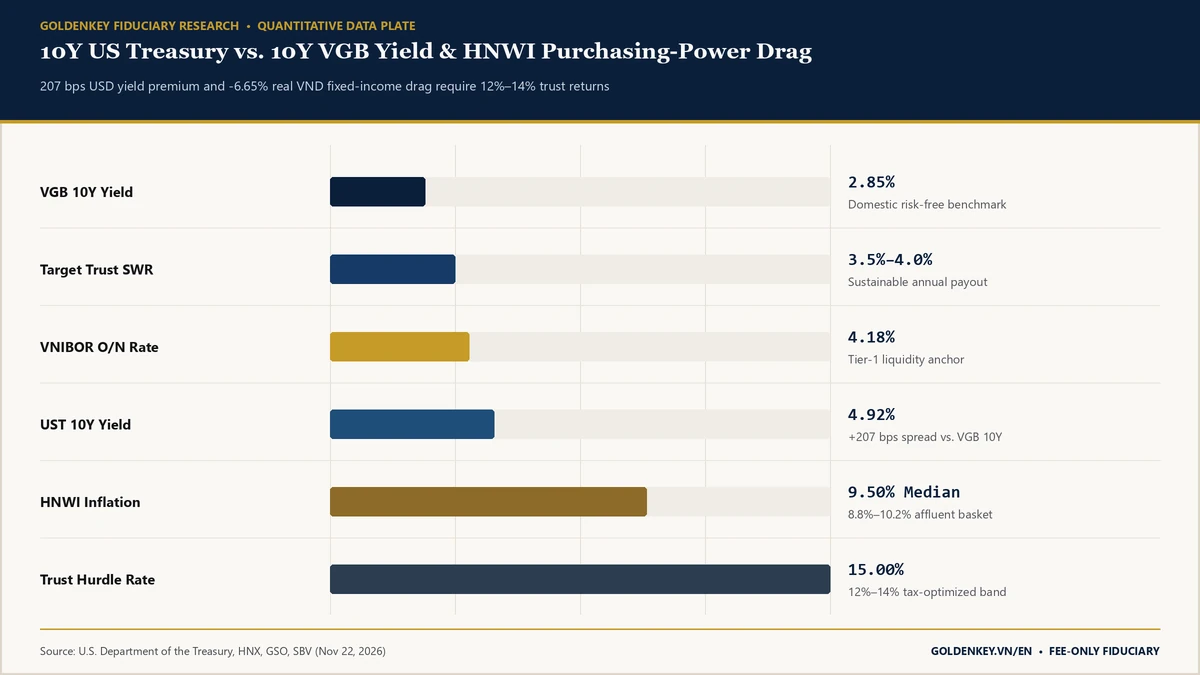
According to official secondary trading records on the Hanoi Stock Exchange (HNX), the 10-year Vietnam Government Bond benchmark yield (VGB 10Y) closed on November 20, 2026 at 2.85% p.a. Meanwhile, specialized price-index tracking from the General Statistics Office of Vietnam (GSO) and affluent-consumption benchmarks indicates that the bespoke HNWI consumption basket (encompassing international tuition up 8.25% YoY, premier international healthcare up 9.60% YoY, global life insurance premiums, and cross-border travel) is compounding at 8.8% to 10.2% p.a. (median 9.50% p.a.).
Quantifying Real Purchasing-Power Drag:
First-principles arithmetic confirms that an all-VND sovereign fixed-income wealth pool suffers a real purchasing-power deficit of -6.65% p.a. Layering on a 3.5% annual F2 living distribution causes real dynastic purchasing power to contract by more than 10% annually — halving real family wealth in just seven years.
Compounding this drag, the sovereign yield spread between 10-year US Treasuries (4.92% p.a.) and 10-year VGBs (2.85% p.a.) stands at a wide +207 bps. This structural interest-rate differential keeps interbank USD/VND elevated around 26,015–26,030 VND/USD and Vietcombank’s spot ask quote at 25,980 VND/USD (against the SBV Central Reference Rate of 24,285 VND/USD). Consequently, an onshore Family Trust must embed natural foreign-currency hedges and high-ROIC equity assets capable of compounding ahead of currency depreciation.
To solve this intergenerational compounding equation, Fiduciary governance enforces Milestone-Based Distributions anchored to a strict Safe Withdrawal Rate (SWR) of 3.5% to 4.0% p.a. of trust Net Asset Value. Rigorous cashflow planning requires deriving the minimum Hurdle Nominal Return from first principles:
Incorporating tax-efficient dividend reinvestment and staggered distribution pacing, the trust’s normalized target nominal return band sits at 12.0%–14.0% p.a. Achieving this compounding hurdle without breaching prudential risk budgets requires a three-tier trust asset allocation:
- Tier 1 — Short-Term Liquidity & Capital Preservation (15%–20%): State-owned commercial bank Certificates of Deposit, short-dated VGBs, and money-market instruments benchmarked to VNIBOR O/N (4.18% p.a.) funding 12 months of scheduled F2 SWR distributions.
- Tier 2 — Institutional Fixed Income & Senior Bank Bonds (20%–25%): Senior and Tier-2 bonds issued by Tier-1 financial institutions maintaining Capital Adequacy Ratios (CAR) > 12% and liquid Collateral Packages.
- Tier 3 — Core Operating Equity & Listed Compounders (50%–60%): Family holding-company shares alongside a curated basket of HOSE industry leaders possessing durable Economic Moats, sustainable ROE > 18% p.a., and low financial leverage — generating recurring cash dividends and capital appreciation that outpace HNWI inflation.
| Quantitative & Statutory Parameter | Empirical Print (Nov 22, 2026) | Fiduciary Governance Standard | Primary Verifiable Source |
|---|---|---|---|
| 10-Year Vietnam Government Bond (VGB 10Y) | 2.85% p.a. | Domestic risk-free sovereign baseline | HNX (Close of Nov 20, 2026) |
| 10-Year U.S. Treasury Yield (UST 10Y) | 4.92% p.a. | Global USD risk-free benchmark | U.S. Department of the Treasury |
| UST 10Y vs. VGB 10Y Sovereign Spread | +207 bps (+2.07% p.a.) | Positive USD carry exerts FX pressure | First-Principles Quantitative Synthesis |
| Spot USD/VND Ask Rate (Vietcombank) | 25,980 VND/USD | Macro FX volatility monitoring anchor | Vietcombank (VCB) |
| Interbank USD/VND Trading Range | 26,015 – 26,030 VND/USD | Wholesale FX equilibrium band | State Bank of Vietnam (SBV) |
| Overnight Interbank Rate (VNIBOR O/N) | 4.18% p.a. | Systemic short-term liquidity gauge | State Bank of Vietnam (SBV) |
| Composite HNWI Lifestyle Inflation Band | 8.8% – 10.2% p.a. (Health +9.60%, Edu +8.25%) | Real purchasing-power hurdle to beat | General Statistics Office (GSO) |
| Real Purchasing-Power Drag on VGB 10Y | -6.65% p.a. (2.85% – 9.50%) | Negative real yield — Fixed-income trap alert | First-Principles Quantitative Synthesis |
| Target Safe Withdrawal Rate (SWR) | 3.5% – 4.0% p.a. | Multigenerational principal preservation rule | Fiduciary Wealth Governance Standard |
| Normalized Target Portfolio Nominal Return | 12.0% – 14.0% p.a. | Compounding hurdle ensuring positive real NAV | Fiduciary Wealth Governance Standard |
| Forced-Heirship Statutory Reserve (Art. 644) | 66.67% (2/3 of statutory intestate share) | Mandatory reserve preventing judicial clawback | 2015 Civil Code (Article 644) |
| Licensed Bank Trustee Capital Adequacy (CAR) | Statutory >= 8.0% (Tier-1 Banks > 12.0%) | Counterparty prudential eligibility floor | 2024 Law on Credit Institutions & SBV |
4. Fiduciary Governance Standards and Elimination of Conflicts of Interest
Even the most impeccably drafted Trust Deed will fail in execution if the institutional Trustee succumbs to commercial Conflicts of Interest. Across conventional wealth-distribution channels, asset managers routinely pocket undisclosed placement commissions (Retrocession Fees / Kickbacks) from fund sponsors, insurers, or corporate bond issuers when stuffing client mandates with high-commission products — subverting fiduciary duty into conflicted product distribution.
GoldenKey Invest’s Fiduciary Wealth Architecture enforces independent oversight across three institutional pillars:
- Zero Retrocession & Strict Fixed-Fee Separation: A licensed commercial bank Trustee operating under the 2024 Law on Credit Institutions charges only a transparent published off-balance-sheet administration schedule (typically 0.80%–1.00% p.a.), while an Independent Fiduciary Advisor such as GoldenKey Invest charges strictly a Fixed-Fee Retainer (0% AUM/NAV management fee and absolute non-custody of client funds). Any third-party institutional rebates arising at the custodian level must be rebated 100% into the Family Trust corpus.
- Trust Protector Committee: Serving as the supreme supervisory organ comprising F1 founder representatives, independent legal counsel, and family auditors, the Trust Protector never micromanages daily portfolio trades but holds binding veto power over extraordinary capital distributions, authority to commission forensic audits, and unilateral power to remove and replace the bank Trustee upon any breach of the Investment Policy Statement or prudential capital deterioration.
- Independent Annual Off-Balance-Sheet Audit: All segregated trust holdings, share registries, cash-flow ledgers, and mark-to-market valuations undergo annual audit by an independent Big-Four or accredited audit firm, ensuring complete transparency across all generational beneficiaries.
5. Thesis Invalidation Triggers and Structural Recalibration Protocols
To preserve institutional discipline under macroeconomic or judicial shocks, every Family Trust Charter codifies five explicit Thesis Invalidation Triggers requiring immediate structural review:
- HNWI Lifestyle Inflation Shock: Realized HNWI basket inflation exceeds 10.5% p.a. for three consecutive years while net after-tax, after-fee trust portfolio returns trail 14.0% p.a., causing the 3.5%–4.0% SWR distribution to erode nominal corpus.
- Structural USD/VND Regime Break: Interbank USD/VND remains sustained above 26,500 VND/USD for longer than six months while trust holdings carry less than 30% exposure to FX-hedged or USD-revenue-generating assets.
- Adverse Supreme Court Precedent on Trust Segregation: Issuance of judicial precedent or statutory guidance holding that off-balance-sheet trust assets under the 2024 Law on Credit Institutions remain attachable for pre-existing personal liabilities of the Settlor (contravening Article 124 clearance), triggering immediate migration into a multi-tier corporate Holding Company structure.
- Core Family Enterprise Cash-Flow Deterioration: The flagship family operating company cuts cash dividend payouts below 4.0% p.a. or breaches Net Debt/EBITDA of 3.5x, impairing dividend inflows into the trust waterfall.
- Trustee Prudential Capital Breach: The licensed bank Trustee’s Capital Adequacy Ratio (CAR) falls below the 8.0% statutory minimum or enters SBV special supervision, immediately activating the Trust Protector’s step-in clause to transfer 100% of segregated off-balance-sheet assets to the designated successor Trustee.
Fiduciary Standard Statement • GoldenKey Invest’s Three-Pillar Mandate
This special report is compiled independently from first principles and verified primary disclosures from the State Bank of Vietnam (SBV), HOSE, HNX, the General Statistics Office (GSO), the Ministry of Finance, and current Vietnamese statutes. GoldenKey Invest unconditionally upholds its Three-Pillar Fiduciary Mandate:
- No Client Fund Custody: We never hold, custody, or intermediate client cash or securities. All dynastic trust assets must be held off-balance-sheet at licensed independent fiduciary institutions pursuant to statutory law.
- No Discretionary Order Execution or Hidden Kickbacks (Zero Retrocession): We accept zero undisclosed brokerage commissions, placement rebates, or financial inducements from any issuer, commercial bank, or fund manager.
- No Guaranteed Return Promises: We issue zero guaranteed return promises or speculative trading hype. All private wealth research is grounded in probability matrices, disciplined asset allocation, and multigenerational capital preservation.
This publication does not constitute an offer to buy, sell, or entrust specific securities. UHNWI families should engage qualified tax and trust legal counsel prior to executing formal Trust Deeds.